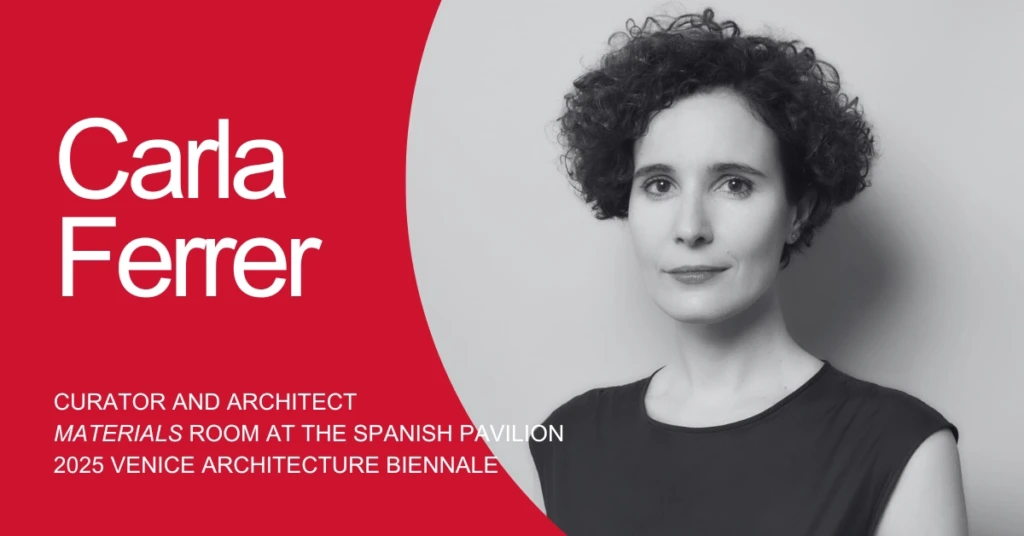
Carla Ferrer was always drawn to the world of architecture as a way to help people by making better buildings. That’s why he studied a degree, specialised in urban planning and housing, with a master’s degree from Harvard, and his studio, ITER, based in Milan, develops collective housing and public facilities projects. Deeply involved in Mass Madera since 2023, it made sense for her to be one of the curators of the Materials room at Internalities, the proposal for the Spanish Pavilion at the 2025 Venice Architecture Biennale. We connected with her to talk about her experience at the Biennial, her career, and her vision of architecture.
How did you come to collaborate on the biennial?
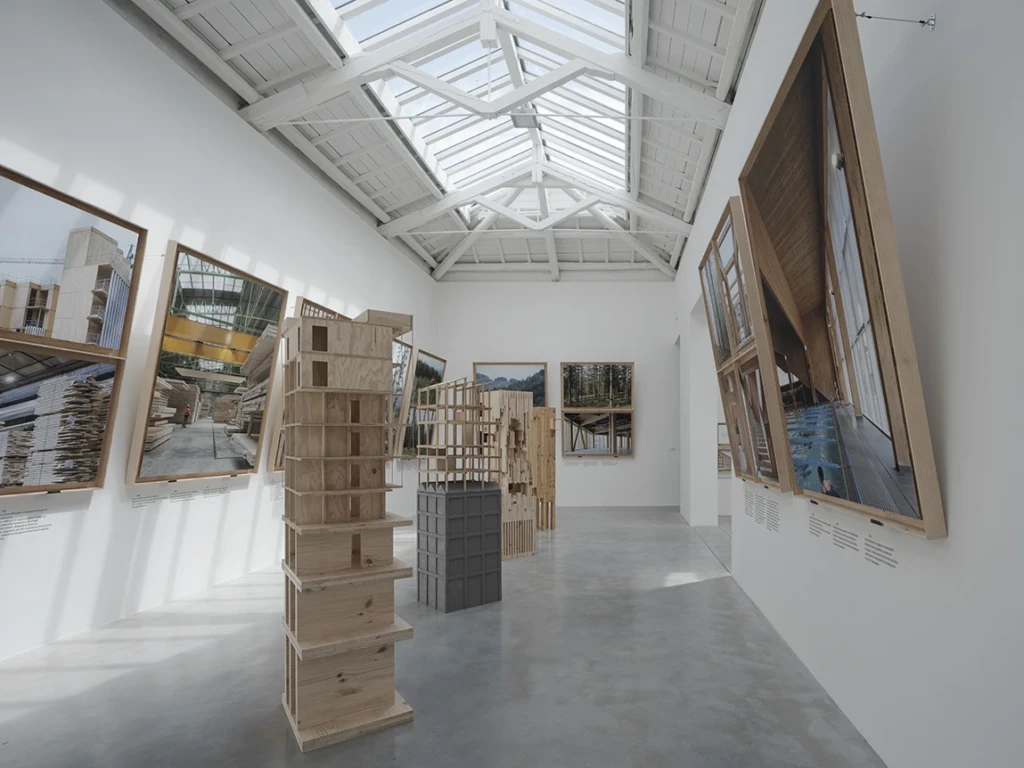
The curators, Roi Salgueiro and Manuel Bouzas, developed an open concept that addresses five major themes around the macro-theme internalities, which means how architecture can generate value in the territory, as opposed to the concept of externalities. Among these five themes, they decided to focus on materials and materiality on the question of how wood can represent an example of this, of generating value in the territory through architecture.
Since 2023, I have been collaborating with Mass Madera, a network promoting the use of industrialised wood in Spain. As we are pioneers in this aspect, in commenting on the use of wood architecture from the architectural perspective, they contacted Daniel Ibáñez, director of the Institute of Advanced Architecture of Catalonia (IACC) and founder of Mass Madera, and he counted on me to do it in a collaborative way.
What have you learned from the entire experience of participating in this exhibition?
I learned a lot. The curators’ approach wasn’t simple, because on the one hand, they identified us, but on the other, they also identified a specific territory, which was the Cantabrian Coast, where their thesis was that it is a place where this value is generated. We’re not based in the Basque Country, and we don’t know it in as much detail as if we lived there. So, it was an opportunity to look a little more closely, in a much more limited context, at how value is generated and how there’s an entire productive ecosystem at the forefront. That was a great learning experience, looking at it with a different lens, more from the bottom up and less from the top down.
You mentioned Mass Madera before. At what point in your career did you start to focus on wood as a material of the future?
For me, wood began to become a very present resource in 2015, when I was studying for a master’s degree in urban planning, landscape, and ecology at Harvard University. That’s where I met Daniel Ibáñez, who was also a professor in the master’s program. The master’s degree sought to analyse, beyond the architectural object, all the dimensions of building today, and the truth is that wood is the material that allows us to give something back to the land. That is, architecture should not only be an object in itself, but, through it, we can also enhance the use of our natural resources. There I already saw a bit of that intuition.
Ver esta publicación en Instagram
Afterwards, I went to work in Switzerland, which is somewhat the mecca of wood architecture, along with Austria and Germany, and there we began to see that in many of the projects we had, clients requested that we use that material.
With my experience in the United States and already beginning to develop specific projects, I ended up curating an exhibition at the Zurich architecture centre called Touch Wood, along with a catalogue that covered all the dimensions of wood, but focused on the country. There were international examples as well, but I celebrated what the last almost 15 years of wood in Switzerland had been like, because no one had told that story. It was almost like a story that was there to be told, because there were fantastic projects of completely different scales: offices, skyscrapers, everything.
Do you think that the importance of wood is already being seen from the outside? Because it also had this bad reputation that it involves cutting down trees, so it can’t be environmentally friendly…
That’s why we still exist: Mass Madera proves there’s still a lot of work to be done. We can’t be satisfied with the optimism of those insiders, the early adopters, or the fact that wood is increasingly present in the media. There is still much to be done, many myths and many barriers to be dismantled through pedagogy.
At Mass Madera, we also work in partnership with the Built by Nature Foundation, and through this, we are conducting various campaigns to debunk myths, raise awareness, and more.
Why did you study Architecture?
I have never had any doubts, I have always wanted to study Architecture. I already loved making plants and models when I was little, in a very spontaneous way. Being able to contribute in some way to improving people’s quality of life by better thinking about how buildings are is something that appeals to me. And that’s why the scale of work I always work on is the urban scale, or also that of collective housing. Always projects that somehow also look at the city, that go beyond the specific building and open up to other themes, to other problems, and seek to solve things that go beyond the block.
That’s why you specialised in urban planning.
Yes, in urban planning and housing, too. Housing, let’s say, of a social nature, like a cooperative. Housing that also creates something for the city, not just housing as a development, but housing that has an urban character.
What challenges do you think architecture faces in the next 10 or 20 years?
A very important challenge is the decarbonisation of the industry, and around that, there are a whole series of other challenges. From that perspective, the 2050 strategy, the ARCE strategy of the Ministry of Housing and Urban Agenda, has already identified many of the main challenges facing architecture in the coming years in our country. I think identifying it is fine, but the interesting thing is when you then go into the details of how those laws are being developed or how that transition is going to be made. We must ask ourselves how this decarbonisation will be achieved, and with what materials. And, on the other hand, what type of urban project and what type of territorial project is being done. Because it’s clear that there are many possibilities to rethink how we build. Digitalisation, for example, instead of being a challenge, is also a very important opportunity to improve the working conditions of people in the industry, because it is a tough industry. In short, it’s about these two questions: how we’re going to measure this decarbonisation so that it’s fair, and how we’re going to design this decarbonisation so that it also leaves us with a democratic and fair territory.
Ver esta publicación en Instagram
What is your relationship with social media? Do you use them, or better to keep them away?
It’s complex. The truth is that I personally share very little, less and less, and I also try to reduce my phone usage as much as I can. Professionally, I think it’s a very powerful tool in the end. A priori, I’m not a person who likes to communicate much; I prefer to do things, but I think being on social media is essential. Platforms like LinkedIn are a good way to stay up to date on what the people you work with are doing or to stay informed.
You live in Milan and work a lot in Switzerland. How do you think being outside of Spain has influenced you?
I live in Milan because I work here on projects in Italy, but also because for me Milan is a bit of a bridge between Spain and Switzerland, which are the two work environments in which I also move and know. From here, I can look at the other two countries with some perspective, but I’m also close enough to be able to be involved in both. For me, it’s a privilege to be able to learn how everything related to wood is developed in Switzerland, to see it up close.
In our office, this profile of working in three very clear countries, where we understand how the industry works, is key. We try to transfer information, but we are always very careful, because the conditions in each country are very specific, and that knowledge must be refined and grounded.
Of course, because in the end, architecture is local, what you design is for a specific place.
That’s one of the things that I think, in our generation, when we grew up or when we started this career, we didn’t have a clear idea of; it seemed like everything could be anywhere. Some people have always opted for local products, but the idea was that anything can work anywhere. Now we see that there are limits.
Where do you get your daily inspiration from?
I work on such complex projects that inspiration is the sum of factors. And prioritising factors or finding out what the priorities are or choosing the different options that make the most sense in my reality isn’t so much a task of inspiration, but rather a task of sorting out the puzzles and understanding which strategies make the most sense.