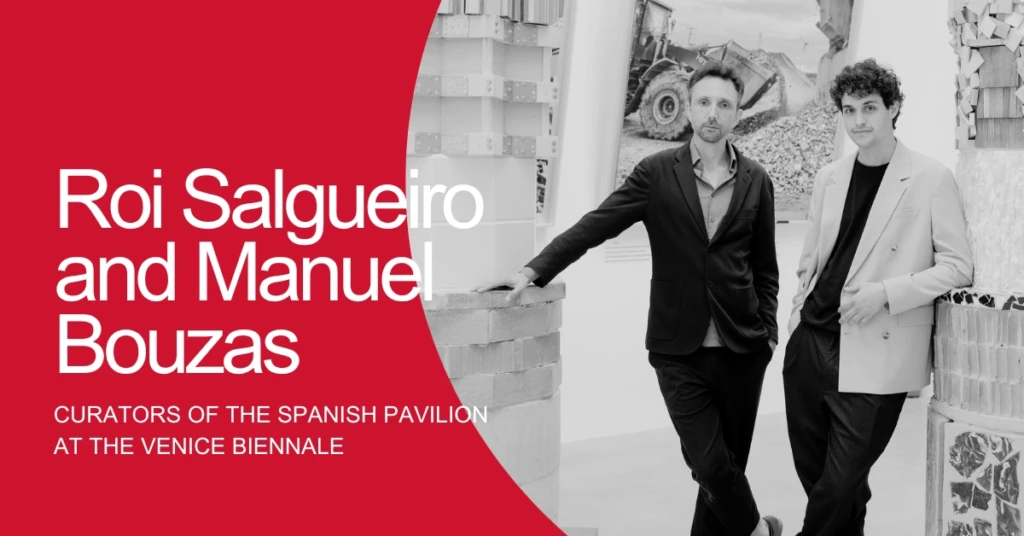
Architects Roi Salgueiro and Manuel Bouzas no longer speak as frequently as they did during the 8 months during which they developed and prepared Internalities. Architectures for Territorial Equilibrium, the Spanish Pavilion exhibition at the 19th Venice Architecture Biennale. Or at least, they no longer talk solely about that topic. After submitting a proposal to the Ministry of Housing and Urban Agenda competition that beat out nearly twenty other candidates, they became the curators of the Spanish portion of the exhibition. We spoke with them about the exhibition and their vision of architecture.
Let’s start from the beginning. How did you meet?
Manuel Bouzas: We both studied for our master’s degrees in the United States at Harvard University. Specifically, the same program, the Master of Design Studies, with a time difference. Roi finished in 2014, and I finished in 2024. During that period, Roi was a professor at MIT. At Harvard, we are allowed to take courses outside the university that have to do with neighbouring institutions, such as MIT, and that’s where we find ourselves. We share similar interests: both Galicians, expatriates, and with a certain interest in matters of ecology, territory, landscape… We did a work together that contained similar issues with what later became Internalities. A relationship of trust and friendship was created there. In the summer of 2024, in August, once the course is over, we will discuss formulating a slightly more robust proposal for the Spanish pavilion.
How did the idea to present yourselves come about, and how did you develop the proposal?
Roi Salqueiro: We had a first conversation at Café Derby in Santiago and began to discuss some of the ideas that were key to the competition proposal. After the meeting, we worked remotely for a month, fine-tuning the proposal. It has, on the one hand, a conceptual component. What we did was begin to explain clearly what this idea of internalities consisted of, giving it conceptual content by referring it to the term to which we contrast it, that of externality, and seeing what its dimensions could be. At that time, we also defined that the fundamental components of this idea of internality were how we internalised materials, energies, trades, waste and emissions. These were the themes that ultimately formed the five rooms of Internalities.
We also accompanied the conceptual proposal with a graphic outline of what the exhibition would look like, what the display devices would be, how the rooms would be organised, etc.
Ver esta publicación en Instagram
How would you define what internalities are?
Manuel Bouzas: This was the question we asked ourselves for the pavilion. We had a certain intuition of where the term could go, because we had its opposite. The approach was in opposition to the term externality, and that allowed us to categorise or break it down into five broad sections. Ultimately, the goal of the entire pavilion was to answer that question: how do we define internalities?
After nearly eight months of work and more than 50 participants, we arrived at this definition: “An internality is a methodology, as it addresses the consequences of environmental externalities associated with production processes through regional, regenerative, and low-ecological-impact resources in balance with the territories from which they originate”.
Wood plays a significant role in the exhibition, especially in the Materials room. Why?
Roi Salgueiro: We want to be the first example of what we are proposing. Internalities places a strong emphasis on the value of using local resources in architectural work, throughout all construction processes. Working with these resources is a fundamental tool for reducing carbon emissions, but it also allows us to develop both the ecologies that exist in a given location and the economies of that particular place.
Production took place very close to Galicia, in Portugal, and we felt it was important to work with a material that was also locally available to us and highlight its uses. Working with wood is a fairly logical choice, considering the nature of an exhibition, where you need lightweight material that can be easily assembled and disassembled to transport from one location to another.
Did you already have the team of collaborators who would accompany you in mind when you presented the project?
Manuel Bouzas: Not at all. We organised the proposal based on what we believed to be the most interesting things happening in Spain in recent years. We had very clear objectives and then we had a series of conversations with agents who supported these ideas, as happened with Finsa.
Roi Salgueiro: Regarding the people who collaborated, Manuel and I, of course, knew about what is being done in Spanish architecture, hence we were able to propose this theme with the conviction that there would be a whole series of participants who would endorse our idea of internality. The pavilion has two types of agents. One of them is the team of professional architects who form part of the central hall, Balance, in which 16 built works are displayed, which constitutes proof that in Spain an architecture that develops the idea of internality is already being carried out. For this room, we held an open call to which 200 studios submitted applications.
Then, around this main room, there are five other side rooms, each dedicated to a theme (materials, energy, trades, waste and emissions). What we did there was think about who the most relevant people could be to participate. We always maintained that there had to be an architectural profile linked to research, who was very good at that subject and who also worked in the geographical area we wanted to cover, and an architectural photography profile —usually a female photographer, because there are four women and one man in total— who was also from that geographical area. Those teams were our direct selection.
Ver esta publicación en Instagram
You mentioned before that it was all like a research process to try to find out what the internalities are. Is there anything that surprised you that you probably did not expect when you started?
Manuel Bouzas: I think there are several lessons. Overall, one lesson learned was how difficult it sometimes is to try to locate or research the origins of the materials we use to build. It took a lot of research by the 16 teams selected in the central room to really rewind the film. This speaks to an opaque, often untraceable supply chain, where doing things with a certain transparency requires commitment and effort.
I was also surprised by a lesson in the broadcast room, where they work with stone and make a vault. They are from the Balearic Islands and maintain the thesis that, to achieve effective decarbonization of their housing stock, they need to work with what they have on hand: stones, posidonia, wood, soil, etc. This leads them to an architecture of weight, contrary to what is sometimes thought that sustainability has to do with lightness. In reality, they almost return to a primitive, almost cave-like structure, where what matters is thermal inertia, sheltering you a little from the elements outside, and building again with the material and not against it.
Roi Salgueiro: For me, it was also very satisfying to see ways of using materials that one did not have before and the use of techniques that were perhaps somewhat lost. We have seen this, for example, with a home that uses a traditional technique called ballast, which had not been used for a long time. We have seen this with initiatives that reuse wood in places where wood was not used for construction, or through compacted earth that is industrialised and becomes a material that can be easily transported from one place to another.
We have seen a tremendous amount of technical ingenuity with a lot of research that basically implies that a new way of building is being generated. A whole range of techniques and ways of doing things that were not previously available are being made available to professionals.
How has the work been hand in hand? How do you complement each other?
Roi Salgueiro: I think that something that unites Manuel and me has always been an attempt at very strong clarity, to make an exposition that was in some way very clear concerning what its main thesis is and that this main thesis was understandable by the general public. I really enjoyed working with Manuel. I think he is a very precise person, who always tries to bring things to the highest level of quality.
Manuel Bouzas: I must add to the allusions! It has been an extremely pleasant experience working with Roi. It has been 8 months where things have flowed in a particularly natural way. It is something that surprised me, because sometimes in projects there is a contrast of views, but I think there was rarely anything on which we did not fully agree. It was wonderful to see Roi’s intellectual depth and ability to take a long-term view that only contributes to the project’s coherence.
Ver esta publicación en Instagram
What do you think architecture would be like in an ideal world, that is, if you were never said no to anything?
Roi Salgueiro: There is a perverse component to the question, because it is true that architecture always gains a lot through limitations. The fact that with a given project you must limit yourself to a certain square meter, a budget, a program, and a context is what ends up fuelling the way you work. Many times, it is the challenge of working on something exceedingly difficult that makes the response better.
But if we accept the premise, it will involve responding to the climate crisis by creating a way of doing things that truly leverages the materials we have available, by more closely interweaving architectural production with the production of the territory in general.
Manuel Bouzas: I think Roi’s answer is exceptionally good, but perhaps before that, I would say that in an ideal world there would be no abandoned or incomplete buildings, nor would there be neglected ruins or obsolete buildings. Sometimes the best way would be to simply not build or fix what we already have. In Europe, there are an enormous number of spaces waiting to be reconsidered. In an ideal world, there wouldn’t be these places; there would not be damaged or abandoned buildings within the city, they would be fixed with a logic remarkably like what Roi proposes.
Are there any questions you are still asking yourself after the exhibition?
Roi Salgueiro: There is always a question at the heart of how to ensure that the exhibition has a significant impact on public discourse, which helps tip the balance even further. What do we have to do? How can these inertias work to have a greater impact on the places they go? What relationships can we maintain with other actors to promote this agenda?
Manuel Bouzas: Or even, almost going to the root of the problem, the question is: can an exhibition be something more than an exhibition? Can the exhibition be a kind of stage where one presents something that somehow infiltrates much more deeply into the way a new generation understands how to build? We would like it not to be just another exhibition, but rather to have significance.