
Cooperative neighbourhoods have been resisting the pressure of the real estate market for decades and promoting collective forms of coexistence. From Geneva to Montevideo, passing through Zurich, the following experiences are emerging as solutions to access decent housing, moving away from its vision as a speculative asset and betting on a collectively managed right.
What are cooperative neighbourhoods?
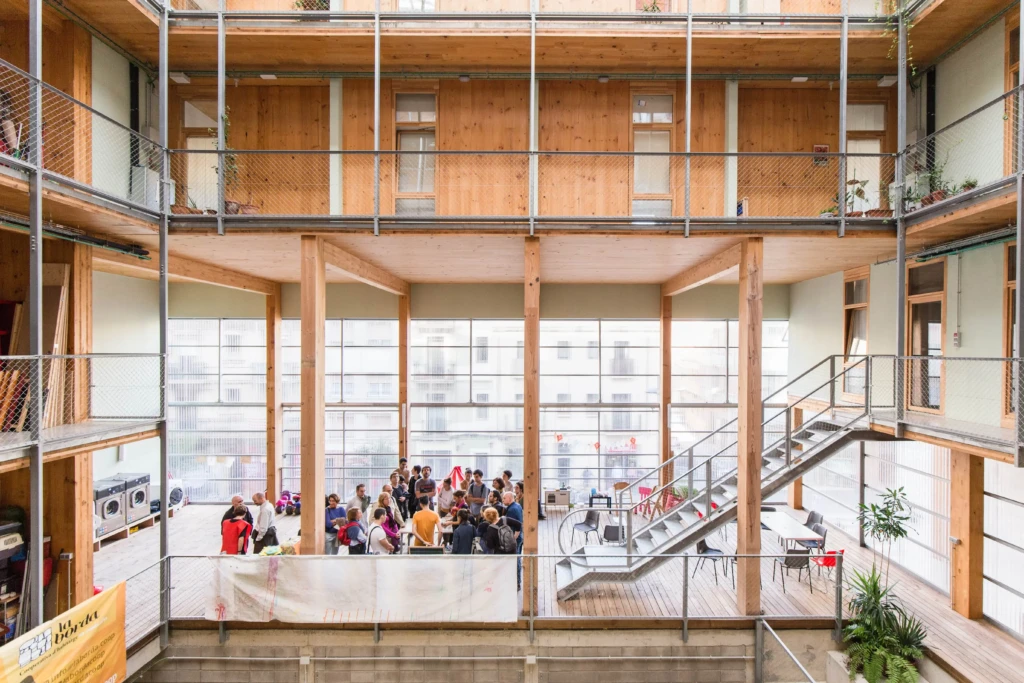
Cooperative neighbourhoods “are special urban developments where, if not all, most of the housing units are housing cooperatives that manage not only homes, but also commercial premises or common areas”, explains José Téllez, head of communications for the Catalan cooperative Sostre Cívic. “Many resources are shared, and more cooperative energy and mobility infrastructures can be designed, rather than individualised for each housing block”, he explains.
For example, if a building, due to its orientation, has more energy than another building, it can share that energy. The same applies to spaces like theatres or urban gardens: they are not part of a specific building, but are managed by the neighbourhood members. “This logic allows us to think about infrastructure not building by building, but shared among several buildings”, Téllez adds. It also includes services such as schools, cultural and sports facilities, and supermarkets. “They all operate under the same cooperative logic”.
The scale of the cooperative neighbourhood is key to the future of the cooperative housing sector, according to Eva Ortigosa, director of the organisation’s project coordination area. “We want to move towards a model where there is more than one Sostre Cívic: small, medium and large cooperatives, and projects that allow the cooperative model of transfer of use to grow and consolidate,” she says.
The concept of transfer of use is fundamental. This means that those who live in the homes are not individual owners of their apartments, but members of a cooperative that maintains ownership of the building. As Tellez explains, “the people who live there are members, but they have the indefinite right to live there, and ownership always remains with the cooperative”. This prevents individual profiteering and speculation.
Les Vergers: an eco-neighbourhood in Geneva
One of the most outstanding examples in Europe is the Les Vergers eco-neighbourhood in Geneva, Switzerland, which Sostre Cívic visited last year. This development has 1,350 cooperative homes spread across 30 buildings and nearly 3,000 residents, managed by seven cooperatives. 50% of the land was reserved for cooperative housing through surface rights; that is, it was built on public land, and its use is subject to limited rights. The neighbourhood has a climbing wall managed by the Codha cooperative.
The management of the neighbourhood, which was completed in 2023, is based on three pillars: social solidarity, environmental responsibility, and economic efficiency. In 2012, a charter of objectives was drawn up, which included energy efficiency, the reduction of greenhouse gas emissions, the quality of construction, water and waste management, as well as sustainable mobility and community relations.
Ver esta publicación en Instagram
The result is a highly energy-efficient urban environment. The neighbourhood has a renewable heating network that supplies all buildings and more than 10,500 m² of photovoltaic solar panels installed on the roofs, allowing buildings to produce some of their own energy.
On the ground floor, approximately 10,000 m² are allocated to commercial and community activities, assigned through application processes. Furthermore, mobility has been designed to reduce car use: the neighbourhood has a dense pedestrian and cycling network, a connection with public transport and only three roads accessible to motorised vehicles, which lead to underground parking lots with more than 1,200 spaces.
Ver esta publicación en Instagram
More Wohnen: The Zurich Cooperative Laboratory
In Zurich, the Mehr als Wohnen project (“More than a home”) represents another international reference point for urban cooperativism. Located in the Luchswiesen area, in a converted former industrial space, the neighbourhood houses around 370 homes and 1,300 residents.
The project was the result of an architectural competition promoted by the Zurich City Council, in which both professionals and future residents participated. The process included open discussions about the desired city model, incorporating questions such as “how do we want to live in the future?” or “what does an urban neighbourhood need?”.
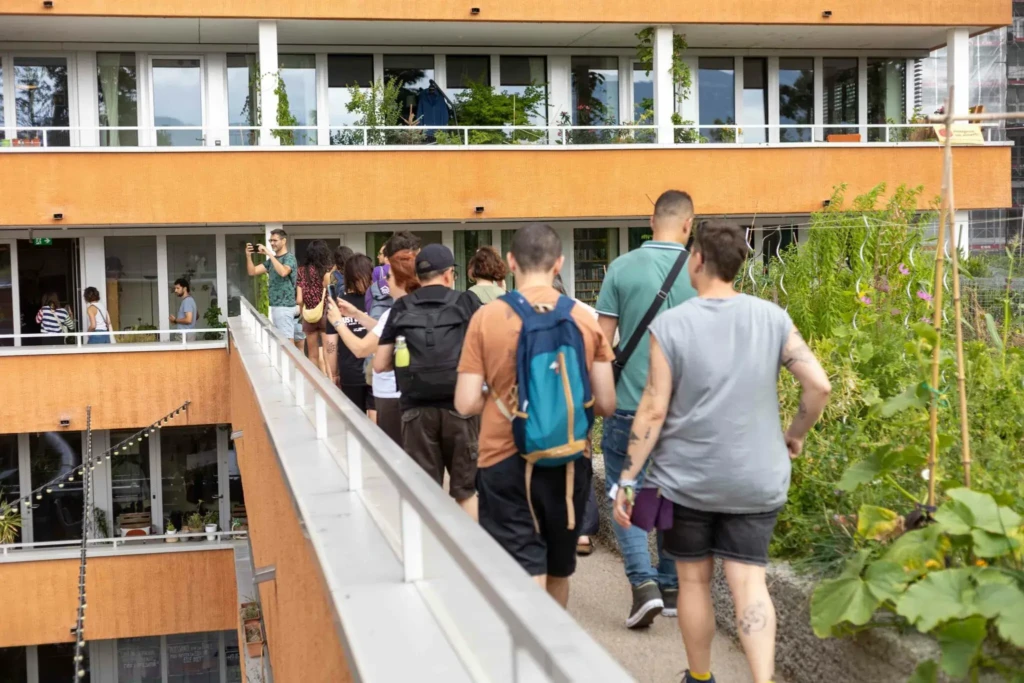
One of the most innovative aspects was the direct participation of the inhabitants in the design of the project, together with professionals in architecture and urban planning. In addition, “housing cluster” models were incorporated, which combine small private spaces with large shared common areas, fostering community life without sacrificing privacy.
The project also stands out for its focus on social diversity. The access criteria included variables such as income, age, and nationality, with the aim of reflecting the real composition of the city. To achieve this, a computer system was developed in collaboration with the Technical University of Zurich (ETH) that made it possible to balance the selection of residents.
The cooperative model has a long tradition in Switzerland. It emerged at the end of the 19th century as a response to the housing shortage in cities like Bern or Zurich. Today, approximately 27% of Zurich’s housing stock belongs to cooperatives, making the city a European benchmark. One of the key elements of their success is long-term financing. Cooperatives have access to mortgage loans of up to 80 or 100 years with low interest rates, which allows them to maintain stable rents well below the market rate.
Ver esta publicación en Instagram
Uruguay: cooperatives as a housing policy
Outside of Europe, Uruguay is one of the countries where the cooperative model has achieved greater consolidation. Its development began in the sixties and was institutionalised with the National Housing Law of 1968 and the creation of the Uruguayan Federation of Mutual Aid Housing Cooperatives (FUCVAM).
Currently, there are more than 730 cooperatives that bring together more than 35,000 families. Its unique feature is the system of mutual aid: the residents themselves participate in the construction of their homes, as well as their subsequent management.
In Montevideo, the Nuevo París neighbourhood brings together around 600 families in homes built collectively since the nineties. The neighbourhood has community spaces, shared facilities, and a strong neighbourhood organisational structure.
As in the Swiss models, the homes are not individually owned. Its inhabitants acquire a permanent right of use as long as they are part of the cooperative. If they abandon the project, the housing returns to the organisation to be reassigned, preventing speculation and ensuring the continuity of the community model.
El Barrio Cooperativo Alfredo Zitarrosa, en Montevideo, reúne a varias cooperativas de @FUCVAM y seis de sus calles llevan nombres de canciones de Zitarrosa. Hermoso barrio. Hermoso homenaje. pic.twitter.com/6YWA884WIb
— Archivo Zitarrosa (@ArchivZitarrosa) February 6, 2025
The cooperative neighbourhoods of Geneva, Zurich or Montevideo show that it is possible to think about housing from logics different from those of the traditional market. Its success lies in its ability to offer more affordable prices and, especially, in its potential to redefine the relationship between city, community and resources. In contrast to urban fragmentation and the individualisation of domestic space, these models advocate for shared infrastructure, collective management, and long-term planning. Although with very different contexts and scales, they all share a common idea: housing as a common good rather than a product.