A couple of decades ago, offices were, in the public imagination, drab, cubicle-filled, and visually unappealing places. This image was shattered by Google and its colourful spaces, complete with sofas, fruit bowls, and foosball tables. Suddenly, every company that wanted to project an image of modernity and creativity copied that model. Years went by, and a global event, the pandemic, demonstrated that remote work was also possible. With the health crisis over, there was a return to the office, and a model emerged that seems to define this decade: hybrid work.
Working some days from the office and others from home (or anywhere else) seems to be the middle ground being reached between management, which would prefer the entire team to be physically present at all times, and a workforce that has discovered its well-being has increased thanks to the option of remote work. According to a Cisco survey, by 2025, 47% of employees would have a hybrid work model, a decrease from 63% in 2022. However, the staff’s preference was clear: 63% would accept a pay cut in exchange for the possibility of working more days remotely.
These recent and significant changes are having an Impact on office design. “Companies want their employees to gradually return to the office. To achieve this, and to attract and retain talent, it is considered essential to have offices with a higher level of aesthetics, comfort, and quality of interior environment”, confirms Luis Suárez, head of the Workplace segment at Finsa.
On the other hand, real estate companies or landlords who lease offices to businesses seek to maximise the profitability of these assets, for which energy efficiency is essential. “It is estimated that by 2030, which is also when the Energy Performance of Buildings Directive (EPBD) will be implemented in the EU, 80% of the office building stock in Madrid and Barcelona will be obsolete in terms of these efficiency requirements”, Suárez points out. For this reason, a major renovation of these buildings is underway to bring them into compliance with the new standards and, at the same time, “the opportunity is being taken to obviously renovate the aesthetics of their interiors”.
What are the resulting workplace spaces like? Comfortable, aesthetically pleasing, and sustainable.
Employee well-being from a design perspective
People who are comfortable work better. This, demonstrated by numerous studies over the years, has been shaping office design for some time now. Furthermore, this space must compete in comfort and aesthetics with one’s own home, so that the number of days spent working remotely decreases by choice of the employee, not by imposition from their company. How is this achieved?
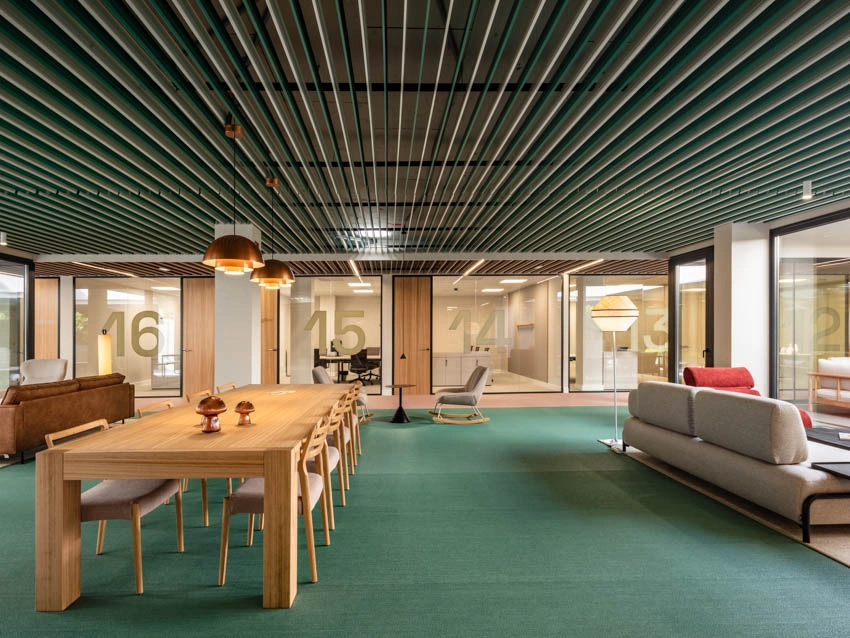
On the one hand, thanks to the choice of “ergonomic furniture adaptable to the specific needs of the individual and the workstation (adjustable heights, a variety of sizes, specific areas for each type of work, etc.)”, explains María Touriñán, from the Stella Hub flexible office space, a project in Santiago de Compostela. Furthermore, “the aim is to create warm environments, natural light, and organic materials that contribute to well-being and comfort at work”. Another aspect considered for achieving pleasant workplaces is acoustic comfort.
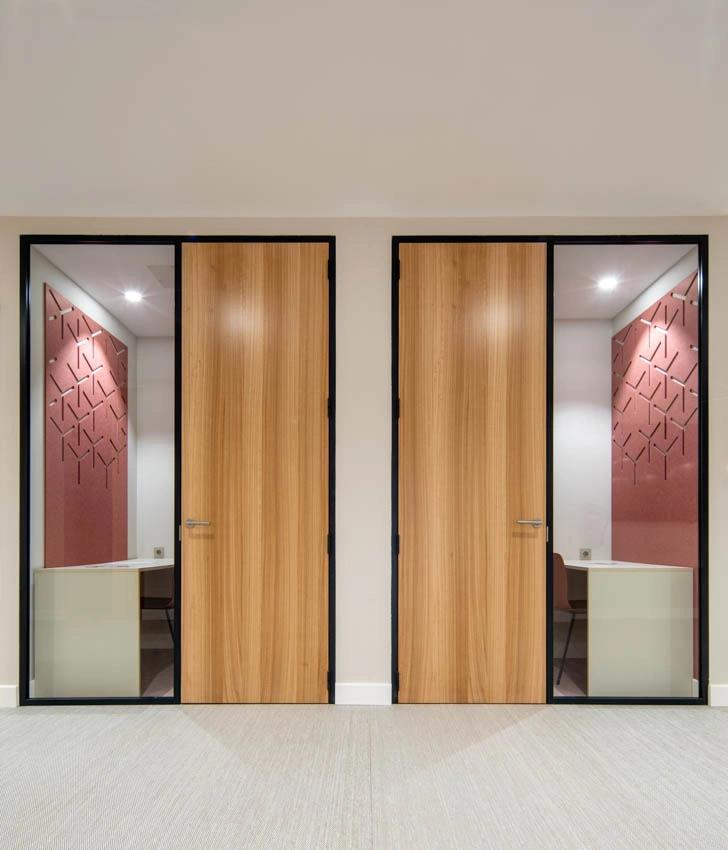
For that sense of well-being, for working comfortably and peacefully, white is often chosen, which remains “a safe bet”, says Suárez. There is also much more natural light, and when choosing wood, a material very present due to its aesthetic and sustainable characteristics, the most tranquil, knot-free varieties are preferred. However, for years now we have also been witnessing, to some extent, the disappearance of what we might call a generalised office aesthetic. “Right now, offices look like almost anything but offices”, says the head of Workplace. In other words, there is a wide mix of materials and solutions that are no longer specific to this type of interior, but rather “common to a hotel or a home”. Thus, in addition to white, many other colours are also used, the choice of which depends largely on the brand itself.
One office, multiple uses: flexibility reigns supreme
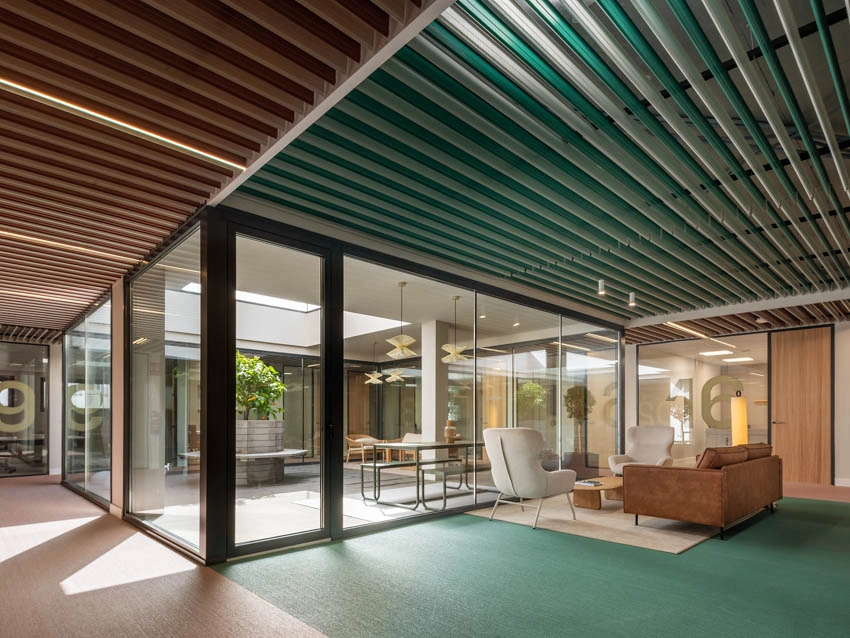
Another characteristic of this new corporate landscape is that the flexibility offered to staff is also reflected in the office layout itself. Since people don’t work in the office every day, there tend to be fewer workstations. And these, moreover, are not assigned. According to CBRE Research, in fact, by 2027, 73% of companies will already have a ratio of 1.5 people per workstation.
The office will primarily be used for “collaborative or group work”, explains Luis Suárez, so there will be a wide variety of areas. “Large cafeterias, flexible spaces that can be transformed in an hour and suddenly become something else, like a meeting room”, he exemplifies. “This allows for more customised designs, depending on the company”. A fluid office that changes and adapts.
As for the furniture, we find many pieces that provide precisely that flexibility and comfort: many soft seating areas that encourages collaborative work and, in some cases, such as when there are modular sofas or poufs, allows their arrangement to be changed immediately to suit the needs of the moment.
From sustainability to office regeneration
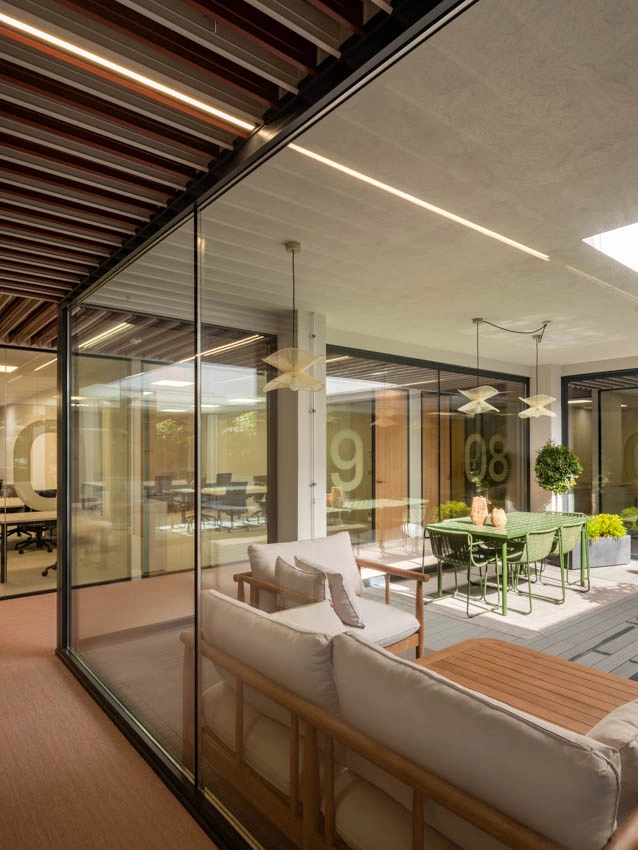
The pursuit of sustainability, essential not only due to regulatory requirements but also because of the climate emergency, is also permeating workspaces. “Sustainability is another pillar of today’s society that has also taken root in office spaces (energy-saving systems or products like paper, recycling, etc.)”, confirms María Touriñán.
This is also reflected in the choice of materials. “If they can be truly environmentally friendly, if they have a mission that is not only circular but regenerative, if they contribute something extra to the environment, all the better”, adds Luis Suárez. This is one of the reasons why wood is increasingly present in offices.
In the case of Stella Hub, all of this was achieved by choosing Finsa materials. “In the English-style courtyards, full of vegetation, both the ground covering and the large planters with citrus trees have been built with Finsa materials (Findeck and Savia autoclave-treated material), and the facade has been covered with treated Pine slats (Thermopine Grey).
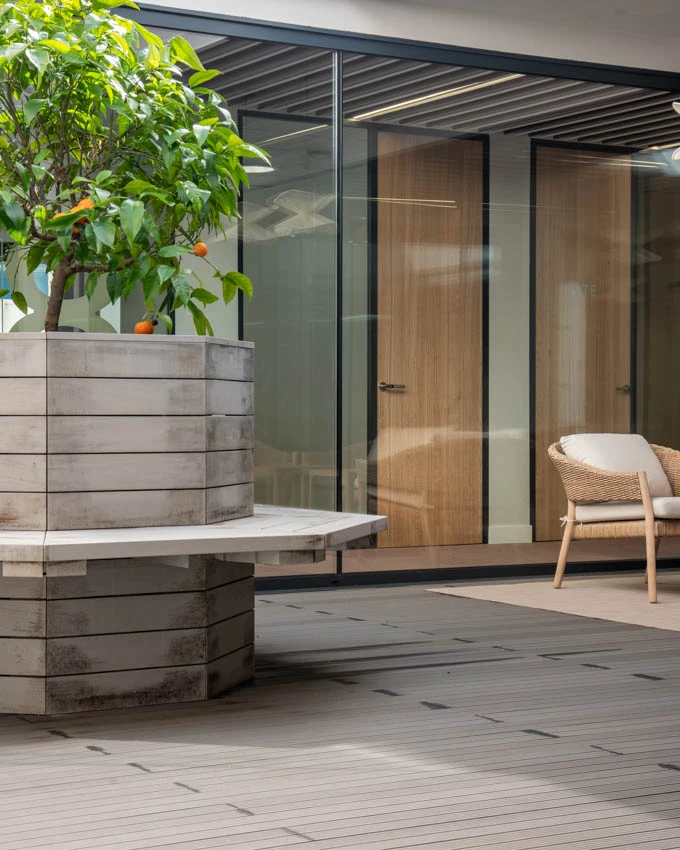
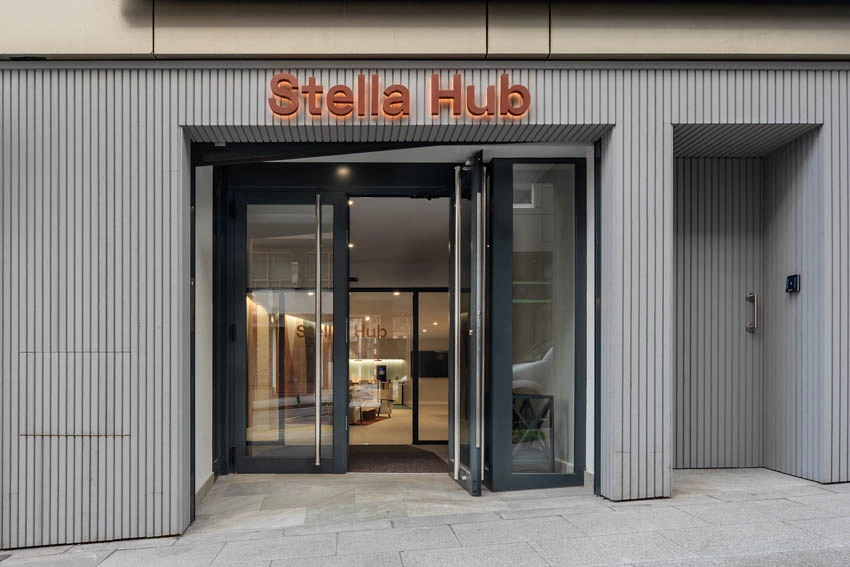
“All doors over 2 m high have been manufactured from bonded faces of Eucalyptus veneer and Fibrapan®; all furniture in the operational workspaces has been manufactured with Fimapan® Decor from Finsa, and the meeting tables with FibraPan® Lam Tech Cashmere in some cases and FibraPan® Natur Eucalipto Serene in others. The reception table was made with FibraPan® Natur and a FibraPan® Natur Mojave front desk”, Touriñán explains.
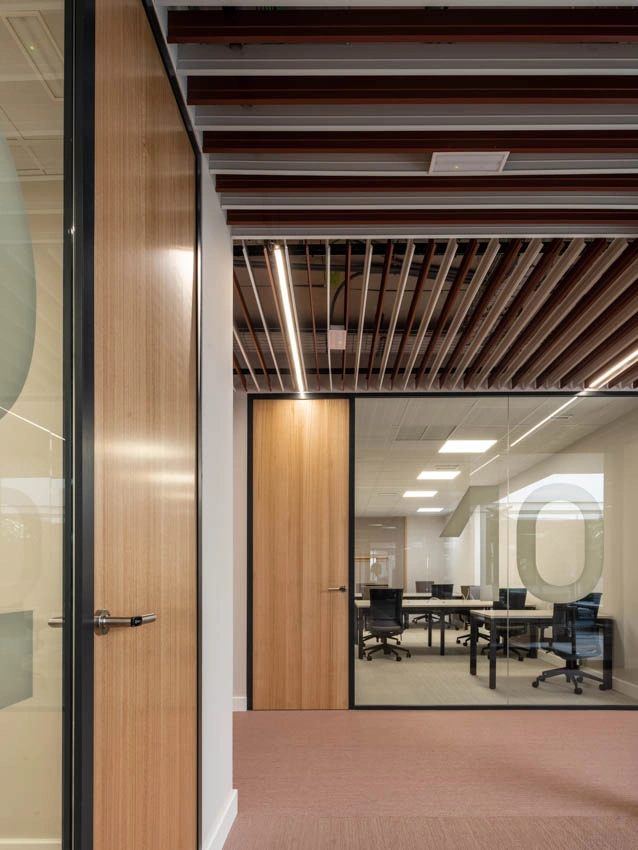
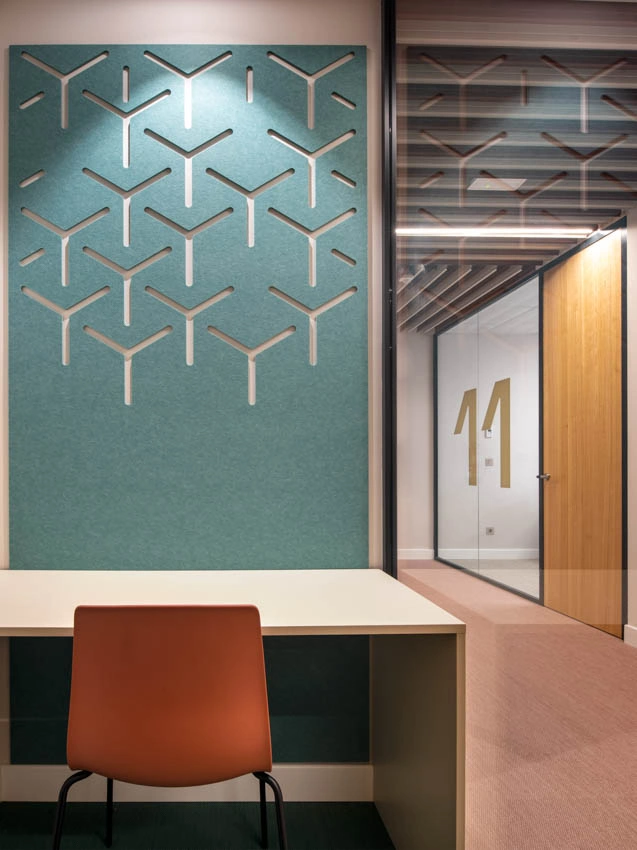
All the kitchen, canteen, and office modules are also from Finsa, as are all the storage spaces (FimaPan® Decor H Espiga Sal Textil). In addition, FibraPan® EZ Tex boards in various finishes and lacquers Textil are incorporated as large decorative panels in some of the rooms.
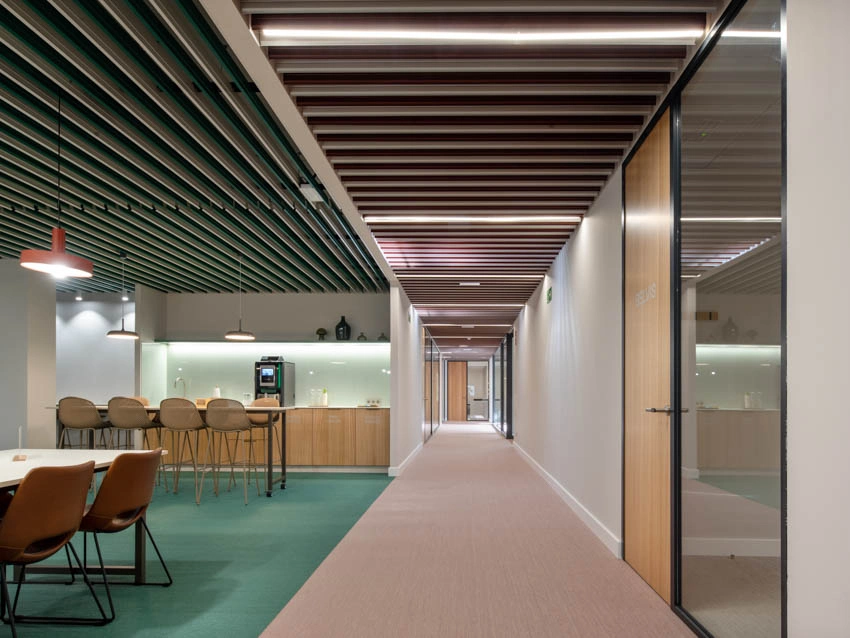
In recent years, there has been “a true revolution in offices”, summarises María Touriñán. “We’ve gone from closed, dark spaces, full of paperwork and lacking common areas, to open-plan spaces, full of light and colour, technologically advanced, with hardly any paperwork and plenty of collaborative areas”. All so that work is pleasant, calm, and productive.