Go on a meditation retreat, spend a few nights in a monastery, travel to Thailand to learn about Buddhism, do a life retreat, or go see the sunrise at Stonehenge. These are all examples of spiritual tourism, a way of exploring the world that goes beyond the typical relaxation or cultural trip. There is an intimate, almost secret, goal, which is to return as a person who knows herself much better.
It is difficult to find data on how many people make these types of trips, because studies and statistics tend to group them with those who have similar, but also somewhat different, motivations. In UN reports, for example, spiritual tourism is mixed with religious tourism, and it is indicated that each year between 300 and 330 million tourists visit the most important religious destinations in the world. It also blends with wellness tourism. Both trends are on the rise, and with them, spiritual tourism itself.
Why spiritual tourism is trending
“Spiritual tourism is more linked to the individual, to taking a trip as a way to experience a spiritual feeling and at the same time mentally recover from stressful everyday situations. It’s a way of connecting with oneself”, summarises Alberto Azuara Grande, vice-coordinator of the Tourism Degree at Rey Juan Carlos University and author of an article that assesses the possibility of extending the practice of spiritual tourism in areas with depopulation problems in the interior of Spain.
This confusion and overlap that exists with other types of travel is clearly seen in what is one of the clearest examples of spiritual experiences in Europe: the Camino de Santiago. Among the people who decide to make this religious pilgrimage, there are very diverse motivations. Some do it, indeed, for reasons of faith (46% during the first half of 2026, according to data from the Pilgrim’s Office), but some take it as a sporting challenge and, of course, those who travel all those kilometres for spiritual reasons, but without professing any faith. “They are usually people who do it alone and who, through the different experiences they live along the way, the connection with sacred places and with the territory, become filled. “It allows for a kind of self-reflection”, the expert explains.
Despite the difficulty in knowing exactly how many people make this type of trip -which also tends to be to distant places- it is considered to be a more prevalent choice. “The trend is on the rise mainly because most of us live in big cities. These are generally places where daily life generates a lot of stress and worries. This type of tourism is a way to disconnect. In this hyper-technological, hyper-connected society, I think people are looking for those retreats of a few days or a few weeks to reconnect with themselves”, she says.
Types of destinations for spiritual tourism
Can a trip anywhere become a spiritual journey? In a way, yes, because inner reflection can arise even on the most crowded of beaches, as long as you are in that vital moment of searching and, if possible, you are travelling alone. However, that doesn’t turn any popular beach into a spiritual tourism destination. More elements are needed.
Places that are originally religious, such as monasteries or convents, are a good example, Azuara Grande points out. “There are people who go to these places and stay there for a few days, and they don’t necessarily do it for reasons of faith. We’re looking for that solitude, that disconnection”, he points out. But yoga retreats or retreats with specific conditions are also understood as spiritual tourism.
The expert mentions some of these experiences aimed solely at women, which propose spending a few days in the mountains or in a rural environment. In fact, the World Tourism Organisation’s report Understanding and Quantifying Mountain Tourism mentions spiritual tourism as one of the reasons that lead people to this type of destination
The tourism industry is still working on capitalising on this trend towards travel focused on inner connection and reflection, which is why many places with the potential to be developed as spiritual tourism destinations have not yet done so. These are some examples of destinations already heavily shaped for that purpose.
Rishikesh, India
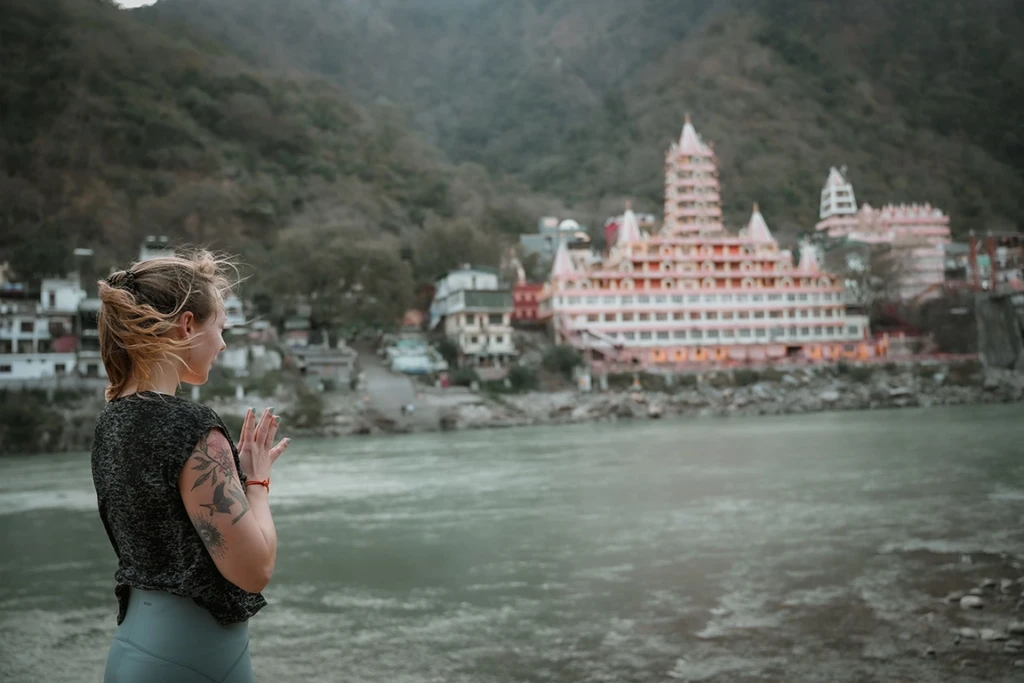
The Beatles already answered the call of spiritual tourism in 1968 and did so by going to Rishikesh, at the foot of the Himalayas, in northern India. More than half a century later, its ashrams, hotels and guesthouses continue to welcome travellers from all over the world. Known as the world capital of yoga, it is a classic destination for people looking to improve their technique and even become teachers.
There are many more places throughout the country that are very popular with tourists who want to find themselves. Back in 2015, in fact, a draft for its national tourism policy highlighted yoga, spirituality and wellness among the factors that would need to be developed to attract more visitors.
Ver esta publicación en Instagram
Mount Kurama, Japan
This mountain on the outskirts of Kyoto is the birthplace of reiki, a philosophy that also attracts many spiritual tourists. But even those more sceptical of the healing powers of the technique may find here the stillness and connection with something transcendent that they seek. As with many spiritual tourism destinations, Mount Kurama is connected to mystical legends from centuries ago, is considered to have esoteric powers, and is believed to be protected by tengu, creatures from Japanese folklore.
At the top, there is a temple, the Kuramadera, which can be reached on foot or by funicular. In addition, it is possible to connect the visit by making a pilgrimage up the mountain to the Kifune-jinja shrine.
Ver esta publicación en Instagram
Stonehenge, United Kingdom
“It is a very popular place for spiritual pilgrimage”, says Azuara Grande. Its popularity has led to the emergence of many companies that organise excursions and experiences focused on that aspect of tourism. It offers the opportunity to seek a connection with ancestors or with the mysterious energies of the Earth indicated by ley lines, in addition to activities related to Druidic traditions.
This last point connects with the Celtic world (although Stonehenge was not built by them), something that the expert believes has great potential for the development of this type of tourism. “In Ireland, England, French Brittany, Galicia…”, the expert lists. These areas with megalithic monuments and a connection to ancestral religions, also closely linked to the natural world, lend themselves to becoming very attractive destinations for this type of trip.
Ver esta publicación en Instagram
Spas and hot springs
Following the line of wonders of nature in which, throughout the centuries, human beings have found something more, an important aspect of spiritual tourism can also be found in areas of thermal waters. This is where it fully connects with health tourism. “These are places that allow for both spiritual and physical recovery, of body and soul”, the expert concludes.