Just over six years ago, in 2019, entrepreneur David Camba, an industrial technician by training working for a contract-sector company, was manufacturing small pieces from rice husk in his garage. In just a few years, he has gone from that garage to industrial-scale production and now leads Birdmind, one of Spain’s biomaterials companies with the greatest potential.
In this CONNECTION WITH… we explore how rice husk -a waste material of which Spain is the second-largest producer in Europe- and automation are redefining the contract sector and sustainability in construction.
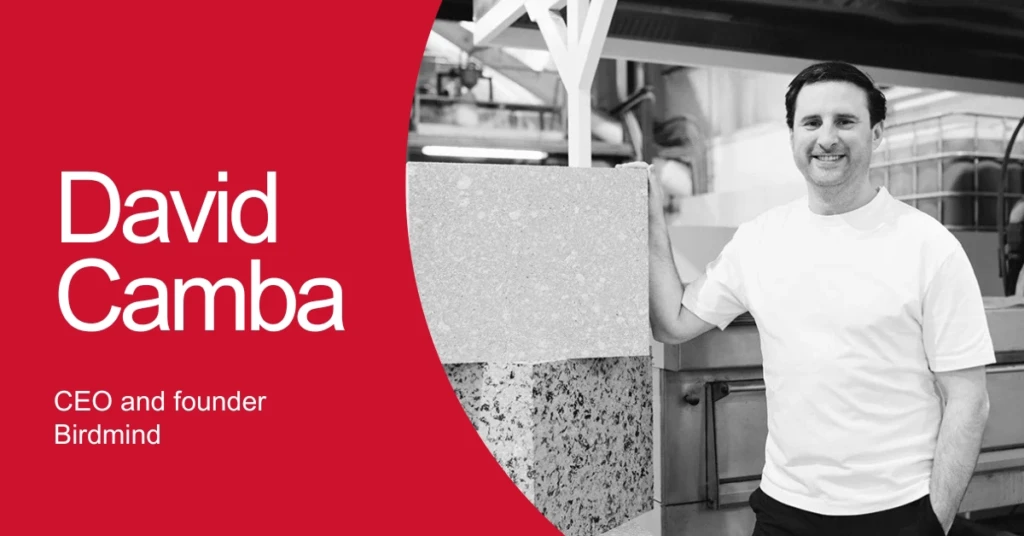
How did you start researching rice husk?
The idea came from looking for an alternative to conventional wood-based particle boards. I spent two years researching and testing different raw materials. I chose rice husk for two reasons: first, because of its technical characteristics —it is water-repellent, fire-retardant and antifungal— and second, because of the volume of raw material available in our country, which would ensure stable and scalable production.
Sometimes innovation means recovering something, because these biomaterials are not actually that new; they were already being used in other parts of the world.
That’s true, and it’s something not many people know. In Latin America, construction materials made from rice husk were already being developed more than 40 years ago. Spain is the second-largest rice producer in the European Union and generates thousands of tonnes of this waste. Today, the challenge is not the material itself, but its industrialisation.
You launched Birdmind in the middle of the coronavirus crisis. What have these six years of evolution been like?
Between late 2018 and 2020, I was carrying out tests and developing small 20 x 20 cm prototypes, which I made in a very artisanal way in my garage. After patenting them in 2021, I was selected by a business accelerator in Pontevedra, and that was when the project came to light. After being selected by two more accelerators, in 2022 the Xunta de Galicia awarded me one of the most important grants for entrepreneurs in Spain, from IGAPE, which allowed me to set up the company and start building the factory in the O Campiño industrial estate in Pontevedra.
What did you learn from your 18 years in contract before Birdmind?
All those years in the sector gave me a great deal of experience, but they also taught me that if you work hard and remain consistent, no matter how large and complex a project may be, everything can be achieved. When I started this project at the end of 2018, sustainability was not as visible as it is now. Those years helped me understand that today the market is interested in this type of material, but that you have to offer more than sustainability: you have to offer design and a distinctive finish.
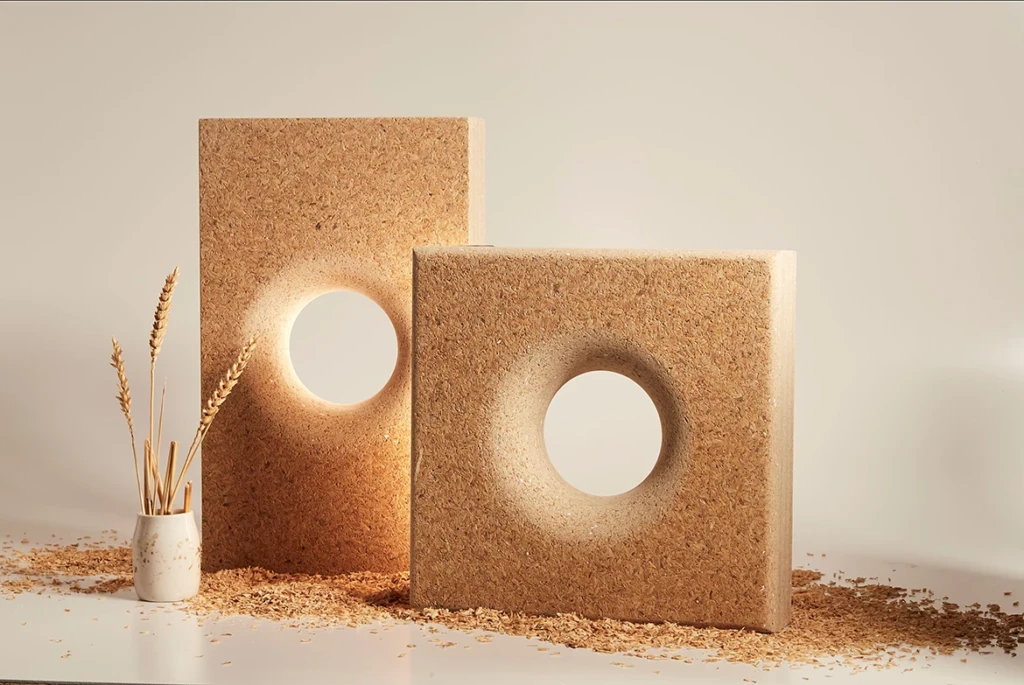
Will you relocate the factory?
Our intention is always to remain in Galicia. We have received a great deal of support from the public administration, so it is only fair to generate jobs and wealth here at home. That said, we don’t know what the future will bring, or whether there will come a point when it becomes necessary to set up a line in another country in order to reduce the carbon footprint. I think it is still too early to consider that.
Is the sector responding well to solutions such as Birdmind’s boards?
Like any new product, it is complex to introduce because clients are not familiar with it, and it requires preliminary work: sending samples and prototypes so they can see whether it fits the design of their projects. It is a slower process than introducing a conventional material, but we have the great advantage of having hardly any competition.
Have you had to demystify certain frictions around the product?
As it is something new, there are always doubts about its performance. That is why we offer the possibility of developing prototypes and finished products, so clients can see the quality of our products for themselves. However, the reception has been excellent; we are entering projects we never would have imagined.
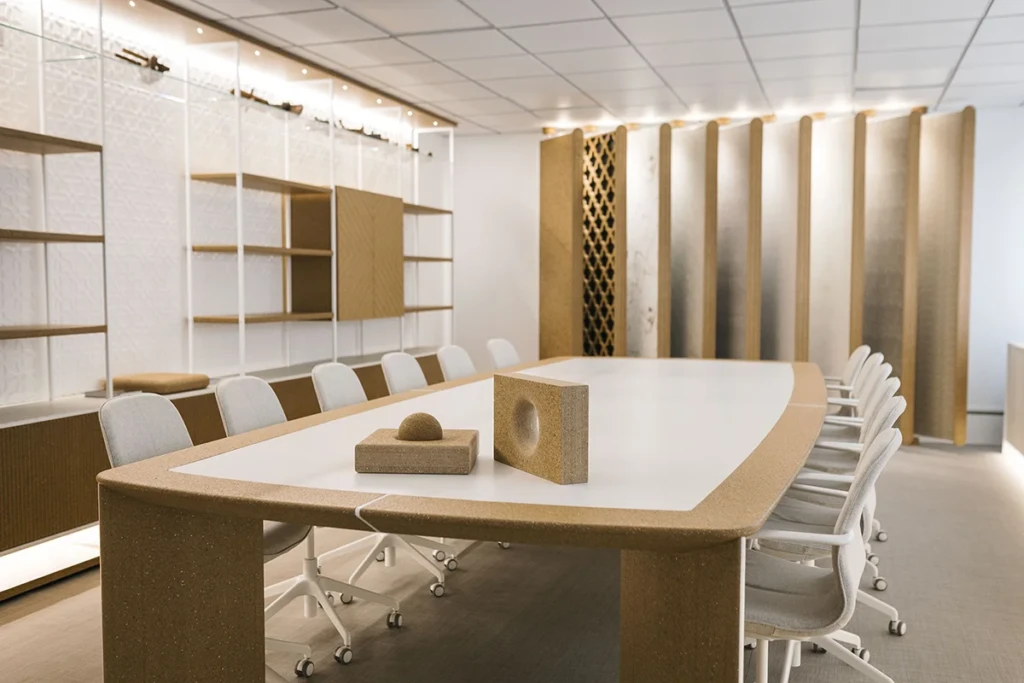
Why do you collaborate with acoustic companies?
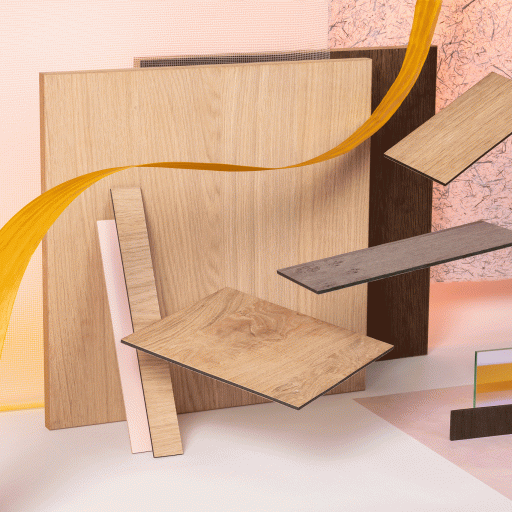
Many companies related to acoustic materials contact us because our boards have a surface texture that gives them better acoustic absorption capacity than other conventional panels. These companies machine our boards with different designs that further enhance those acoustic properties.
What was the reception like at Interihotel last year?
It was our first fair with our own stand, and it was amazing. Out of 300 stands, we were selected in two of the three award categories —Innovation and Sustainability— and we won the Interihotel 2025 Sustainable Product Award. This gave us enormous visibility among architects and interior designers, and real projects came out of it, including a clinic and a restaurant in the Balearic Islands, among others.
How have you managed to position the product in such different places as Denmark or South Africa?
We have invested a great deal in communication and marketing from the beginning. The case of Denmark and Sweden arose from an international mission organised by the Chamber of Commerce. We already have two distributors there and a very close collaboration with several architects and designers who use our panels for their furniture line.
We are currently in contact with distributors who want to distribute our boards in Germany, the United Kingdom, Italy and even Australia.
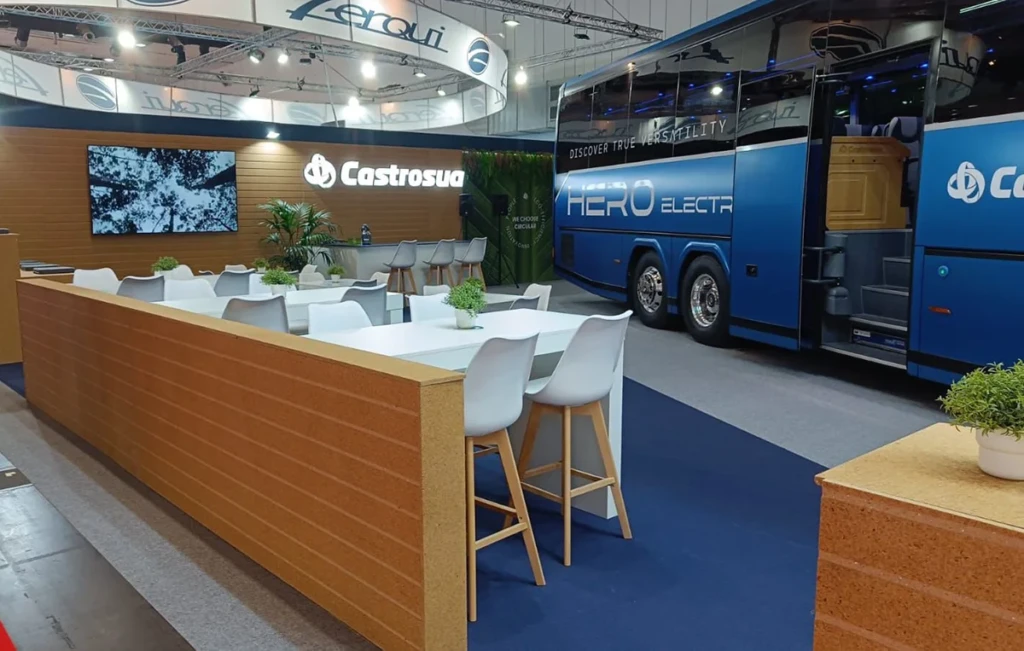
How do traditional materials such as wood coexist with other bio-designed materials made from waste?
They are completely complementary. We serve a small niche that is more focused on circular economy and sustainability, and we contribute new finishes. We have a very good relationship with traditional companies such as Finsa, from whom we are receiving great support.
Is automation the definitive lever for driving circularity?
Absolutely. We spent three years, from the moment we began developing the production line until we inaugurated the company, focused exclusively on developing and automating the entire production line from scratch. Today I can start the line from a mobile phone or a computer; it can operate 24 hours a day with hardly any staff. We believe that this large-scale production capacity is our strong point.
Is it easier to innovate in Caldas de Reis than in Silicon Valley?
I think today you can start a business from anywhere. In Galicia there are all kinds of tools, such as grants, accelerators and entrepreneurship hubs in rural areas, that make it possible. What matters is not where you are, but having clear ideas, being very persistent and, above all, being very stubborn and never giving up.
No one endures three years just to industrialise…
It is very complex. Entrepreneurship in the industrial sector requires a very large financial investment just to be able to launch a minimum viable product. Unlike other businesses that grow little by little, here you need major infrastructure from day one.
Where do you want to take Birdmind?
We have a 2,500 m² plant with room for a second line, even a third if we squeeze things a little. But beyond that, we would have to consider designing a plant with much greater capacity, one that does not limit our growth. We want to be able to have a specific line for each material we develop. We have a small laboratory where we are always researching and developing new materials with the same philosophy: always using raw materials that come from agricultural waste and waste from other industries.
We know we still have a lot to prove and that there is a lot of work ahead, but we believe we can become a European benchmark in circular economy.