The design world has understood that it is not enough to simply use biomaterials (or materials derived from biological sources) to create environmentally friendly solutions. They also must be local.
The idea of zero-kilometre biomaterials introduces a more precise logic: it is not only about reducing the environmental impact in terms of composition, but about rethinking the entire production chain, from the origin of the raw material to its transformation and final use. It is a change of scale that connects the object with its territory. Locally sourced materials not only reduce the carbon footprint from transportation but also boost the circular economy and the local productive fabric.
In this context, the work of designer Julia Stekeete emerges as a paradigmatic case. Their design studio, Bagaceira, investigates new applications for bio-based materials and proposes a broader reflection on the origin and journey of what we design.
From the choice of material to analysing its life cycle
Their approach challenges one of the most widespread simplifications in ecological discourse: the idea that sustainability is resolved in the choice of material. For her, the true indicator lies in the complete life cycle analysis. “It is very important to keep in mind the distance between the raw material, the place of manufacture, and the final customer, but also the energy you spend between each step”, she points out. “When we talk about life cycle analysis, we are measuring the carbon impact at each step. “I believe that’s more important than the distance itself”, she emphasises.
During his early years as a furniture design student, her interest in materials was almost intuitive, fuelled by his curiosity: where does linen come from? How does it grow? How does it transform into fibre? That initial curiosity led to deeper research during her master’s degree in materials design and research at ELISAVA, the Institute for Advanced Architecture of Catalonia, where she began working with mycelium and algae.
“I wanted to understand how to add value to materials and extend their lifespan”, she recalls. In that process, he discovered the potential of biomaterials not only as substitutes but as active agents in carbon capture during their growth.
The origin of Bagaceira
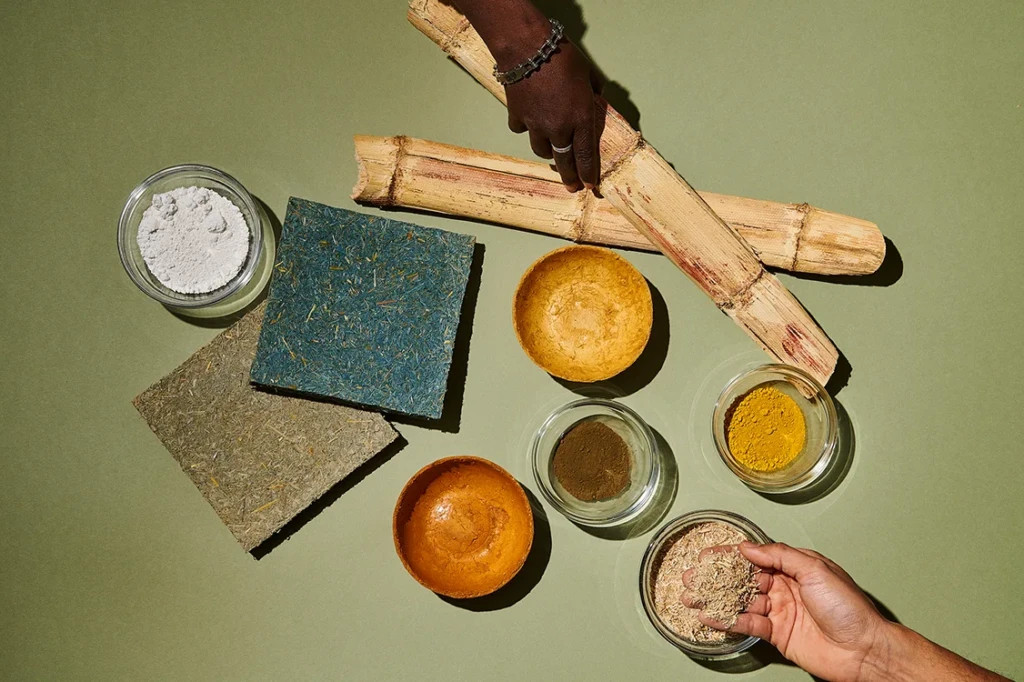
The turning point came in Brazil. There, Stekeete met sugarcane bagasse, an abundant and, paradoxically, underutilised byproduct. Sugar cane, one of the most widespread crops in the world, generates enormous quantities of this residue after the extraction of its juice. Despite its capacity to store carbon and its renewable nature, bagasse is often discarded, burned or abandoned, contributing to the emission of greenhouse gases.
The question that then arose was: why not transform that waste into a durable material? However, when the project was moved to Spain, a key contradiction emerged. Importing bagasse from Brazil negated much of the project’s purpose. The solution required a radical rethink: finding a local source.
The process was not immediate. For a time, the designer collected small amounts of bagasse from Brazilian restaurants, in an almost artisanal exercise. But the scale was insufficient. The answer came in southern Spain, where conditions allow the cultivation of tropical species, such as sugar cane. “There is a microclimate between the Sierra Nevada and the Granada Coast where tropical plants grow because there is a lot of humidity and higher temperatures,” she explains. Records of sugarcane cultivation in the Granada area date back to the 10th century.
So there, in collaboration with a small-scale rum factory that grows its own raw materials, Stekeete found a stable supply. “We are working with a rum factory that has a more artisanal production, a high-quality product, and they grow 100% of their sugarcane here and create a lot of bagasse, so we are using this as raw material”, the designer points out.
Construction materials and furniture made from sugarcane bagasse
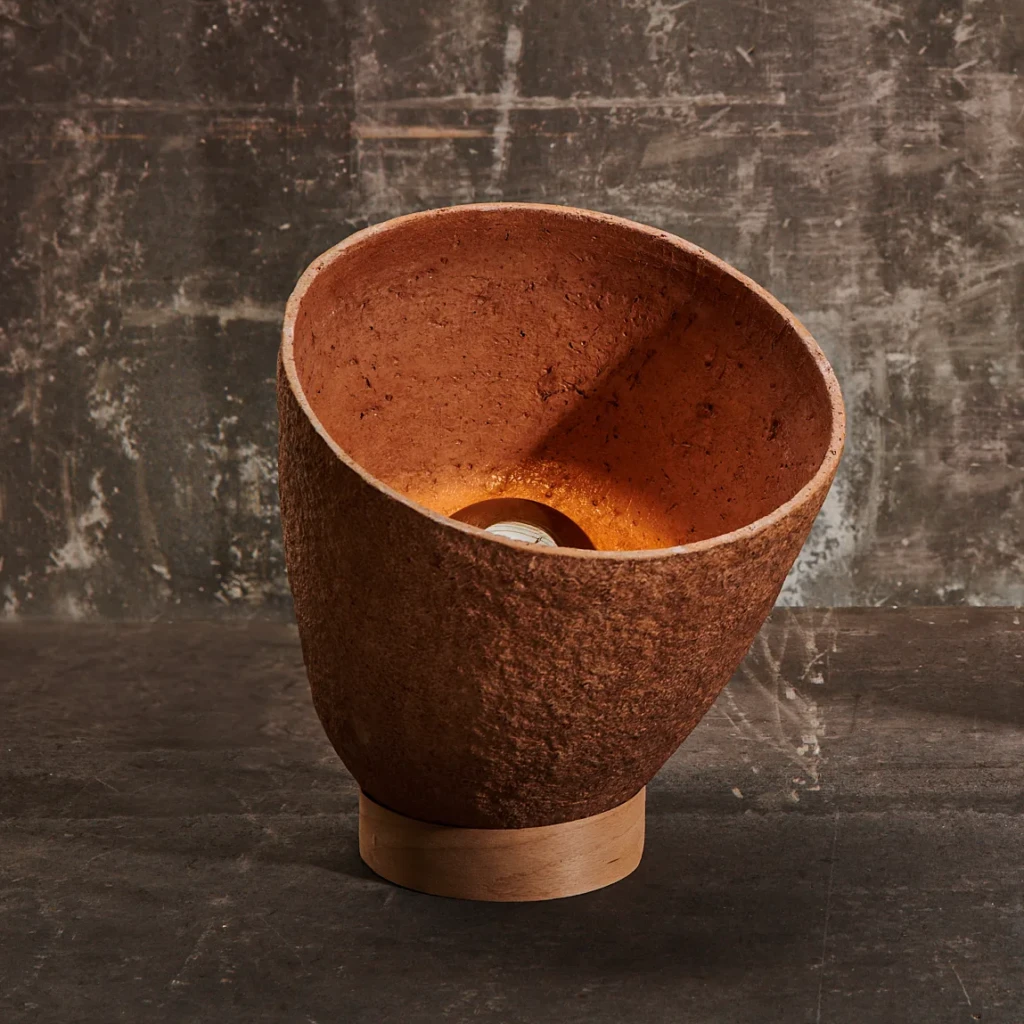
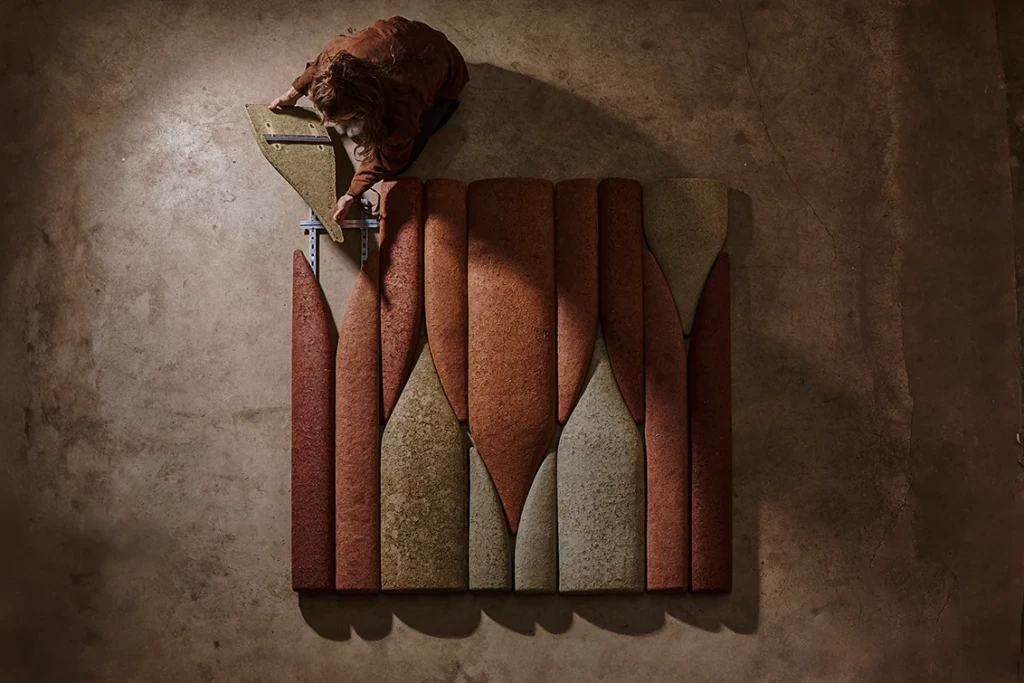
From that initial foundation, the project has evolved towards applications that transcend the experimental. In collaboration with researchers from the University of East London and Igor Barboza, co-founder of the Bagaceira studio, Stekeete works on the development of building materials, as well as furniture objects, especially acoustic panels and lamps. “We have obtained a material that absorbs ambient sound very well”, she says.
Beyond their technical properties, these objects embody the possibility of integrating agricultural waste into contemporary spaces, not as a compromise solution, but as an aesthetic and cultural choice.
One of the major challenges posed by locally sourced biomaterials is how to scale up their production and how to achieve higher performance. “Any biomaterial has to compete with all the plastics we have invented over the years. “These are wonderful when we talk about performance, but they are very polluting”, she warns.
In her opinion, wood can be a good example of a locally sourced biomaterial: ” Solid wood is an incredible material and we are achieving more and more with this resource”, she says, although she emphasises that forest management must be prioritised to ensure respect for the origin.
In this scenario, agricultural waste appears as a particularly promising alternative. Unlike other resources, they do not require additional production: they already exist as an inevitable part of our food systems. Its use not only reduces waste but also introduces a circular logic in which design becomes another link in the ecosystem. “Many times, these wastes are burned or not used. “I think they have great potential”, she says.
More innovations with local waste
Stekeete ‘s work is not an isolated case. Initiatives such as Agro Biomaterials, born in Andorra, explore similar paths by transforming local organic waste (fruit pulp, vegetables or plant by-products) into sustainable bioplastics. Their work combines design, experimentation and circular economy: they collect these wastes, process them with natural ingredients and turn them into new materials that can be used in packaging, objects or design projects. Furthermore, they not only produce materials but also teach how to create them through kits and workshops, encouraging anyone to reuse their own waste and participate in a more local and sustainable model.
Ver esta publicación en Instagram
Meanwhile, projects like Re biq broaden the scope by incorporating industrial and organic waste into the development of new materials. Through collaboration with companies, they analyse waste such as bottles, beer spent grain or fruit peels to convert them into bioceramics or stone-like materials, capable of being integrated into design, decoration or industry. From these waste materials, they develop products such as bioceramics or “stone” type materials (such as their Biolithos material), which can be used in design, decoration or industry.
Beyond their environmental impact, locally sourced biomaterials introduce a cultural dimension that redefines the practice of design. Each material tells a story linked to a territory, a climate, and a productive community. In this sense, designing with local materials is also designing with memory. The object ceases to be an isolated element and becomes a meeting point between geography, economy, and culture. In a globalised world, true innovation may lie in looking again at what we have close by.