We live connected. Or hyperconnected. Our mobile phones have become another organ of our body. Faced with this digital saturation, disconnecting has ceased to be a passing fad and has become a contemporary necessity. Given this need, how can we design spaces that promote disconnection through architecture and interior design?
The society of (digital) fatigue
Adults spend more than three hours a day glued to their mobile phone screens; young people between 18 and 24 years old, more than four and a half hours. This constant exposure has diminished our ability to concentrate. According to a study by Dr Gloria Mark of the University of California, Irvine, the average attention span on any screen fell from 2.5 minutes in 2004 to 1 minute and 15 seconds in 2012, and to 47 seconds in recent years.
For South Korean philosopher Byung-Chul Han, author of works such as The Burnout Society and recognised with international awards for his philosophical thinking on the present moment, the mobile phone has become an instrument of domination rather than liberation. “It is the cult item of digital domination”, he asserted in this interview.But not all digital experiences are the same. Some help us create good habits, while others aim to keep us glued to screens for longer periods. As a guide to ethical design, Taiwanese entrepreneur Yu-Kai Chou’s Octalysis theory shows us what eight impulses lie behind design decisions: some empower us and fuel our creativity, while others awaken compulsion, anxiety, scarcity, and impatience.
Analogue habits, more than a trend
Faced with this digital saturation, more and more spaces are opting for analogue. Book clubs, pottery workshops, mobile-free travel, the return to basic mobile phones… It’s not nostalgia, but a conscious search for balance in our lives. “More than a trend, I see it as a necessity”, says Carmelo Rodríguez, co-founder of the design and architecture project Enorme Studio. Along the same lines, Rocío Pino, also a co-founder of the study, speaks of a “slower, more mindful, and more connected life, far removed from technological burnout”. In her opinion, analogue activities “foster concentration and patience, and reduce mobile phone addiction, improving well-being”.
“A garden within a garden”
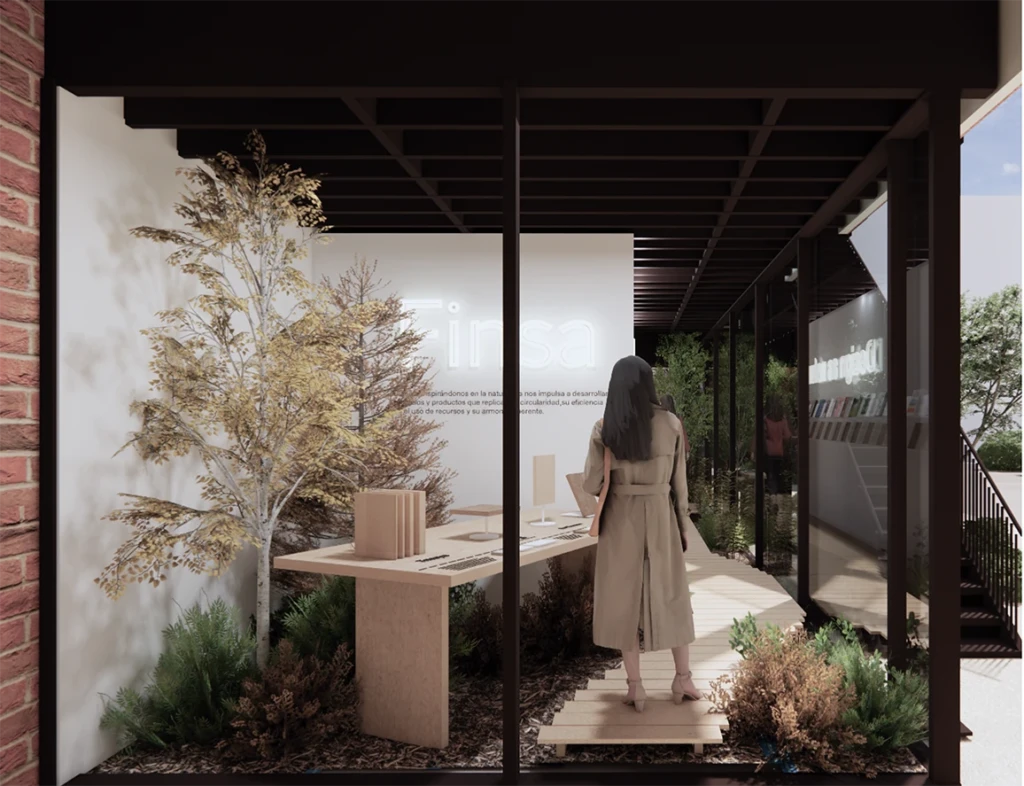
This perspective connects design, architecture, and a slower lifestyle. Baño de bosque by Finsa arises precisely from this reflection. Designed by Enorme Studio together with Finsa and landscape architect Álex Fenollar, the installation is presented as an ephemeral and immersive garden, a sensory refuge that will be present at Madrid Design Festival. A place that explicitly invites you to disconnect from digital noise. “We are so bombarded with information that we need these kinds of spaces where we can take a break from the continuous message on our screens”, explains Rodríguez.
Conceived as a place for slow reading and contemplation, the project offers a leisurely experience. “We propose a garden within a garden. We invite people to sit down, walk around the space and, above all, put down their mobile phones, to reconnect with themselves. Often a book helps a lot”, he adds.
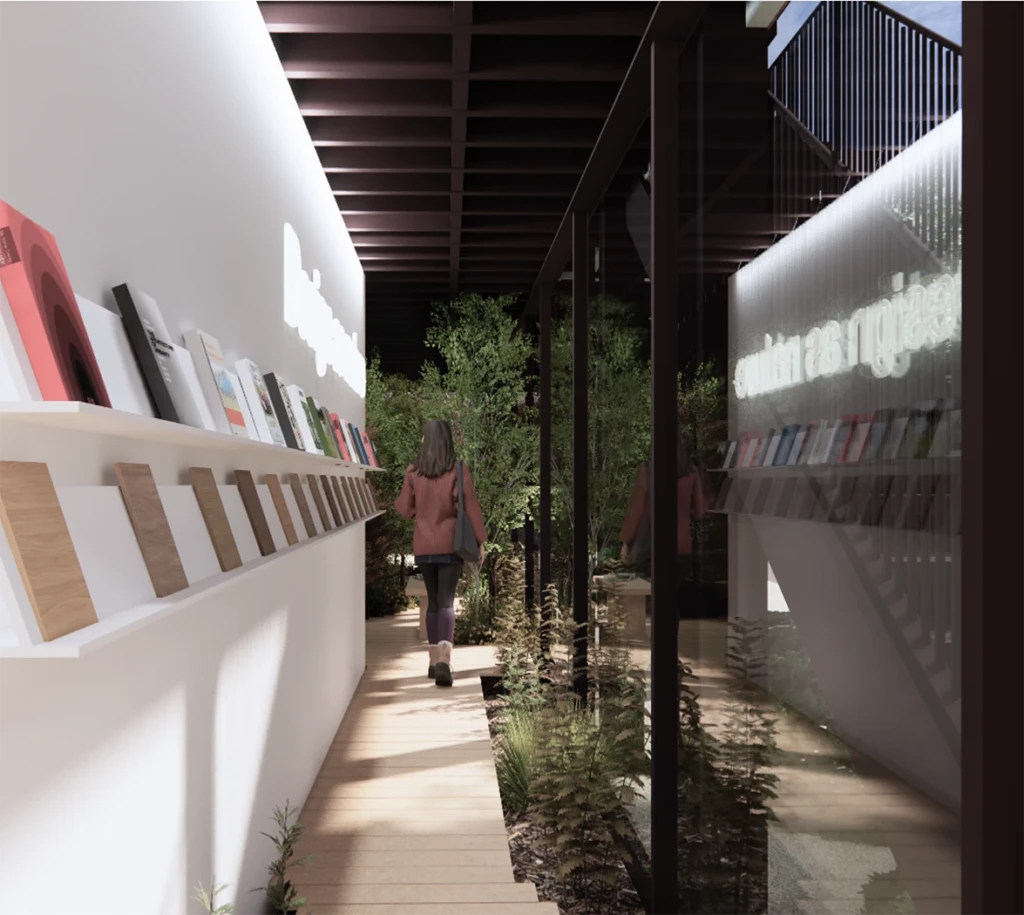
The space, which features a selection of books on design and nature, is inspired by a classic of American literature: Walden, by Henry David Thoreau. The writer spent two years, two months and two days in a small cabin he built in the forest. “I wanted to reconnect with nature, a problem that seems to have haunted us for centuries”, says Rodríguez.
Light, nature and materiality to disconnect
For the architect, any space that seeks to help with digital disconnection must have a landscape component, good lighting conditions, and a certain materiality. Natural light, textures, and the warmth of materials are essential elements to create an atmosphere that invites you to stop.
Natural elements are also essential. In Baño de Bosque by Finsa, Enorme Studio has opted for native plants from Madrid, which will later be replanted in nearby gardens. The glass installation acts as a frame that encapsulates the landscape, a contained and silent forest, and transforms the act of reading or simply being into a contemplative experience.
Thyme is among the selected plants. Its aroma is part of this sensory experience. “These small, subtle touches give us a more sensory experience”, Rodríguez describes. A couple of birdhouses have also been added. “If a bird or insect were to get in, the life of the installation would be amplified. “Even pigeons are welcome”, he says.
“Collective rest”
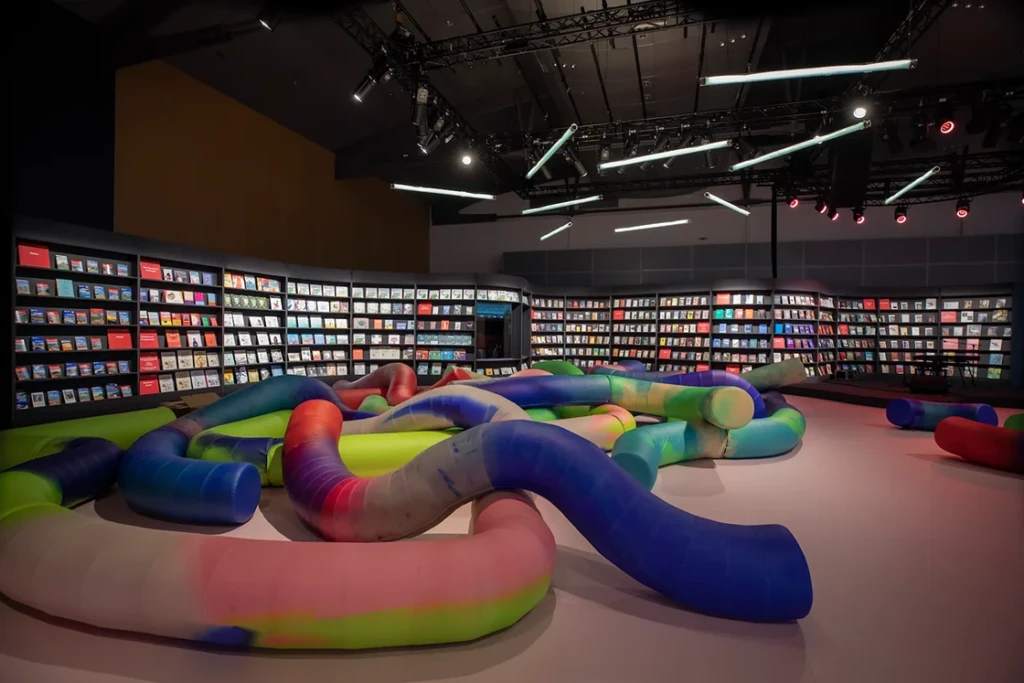
The theme of disconnection is not new in the work of Enorme Studio. In 2022, he designed The Theory of Cherries, the Spanish pavilion at the Frankfurt Book Fair, which incorporated a 130-meter-long sofa. “It was a huge success, it was always full of people thanks to that call for collective reading”.
While that project focused on a space for collective disconnection, Baño de Bosque by Finsa proposes a more intimate break, in a small space, designed for a maximum of three people. Although they are two different scales, they have the same intention.
In Rodríguez’s opinion, it’s not about giving up on technology, but about combining it with other technologies. “The goal is not to abandon digital technology, but to redefine its place”, Pina agrees. “The screen leaves an identity void”, Rodríguez reflects, “while art actively contributes to building it”.
At a time when attention has become a scarce commodity, it is urgent to think about the ethical use of technology and about spaces that balance it. Spaces like Baño de Bosque by Finsa demonstrate that architecture and design can be a refuge, a pause, and an invitation to reconnect with ourselves and with nature.