Much has happened since the first passive house was built in Darmstadt, Germany, in 1990, and a few years later, the PasssivHaus-Institut (PHI) was founded to promote what they already considered a standard: homes so well insulated that they minimise their energy consumption. Three decades later, there are several thousand PHI-certified homes worldwide, with nearly 500 located in Spain. How have things changed in these thirty years? What’s new in the Passivhaus world?
The importance of materials in Passivhaus
The Passive House standard has five principles (superior thermal insulation, high-performance windows, absence of thermal bridges, controlled mechanical ventilation, and complete airtightness), and it is by complying with them that the objective of this type of housing is achieved: by avoiding the need for heating or air conditioning, energy consumption is minimal.
The materials used to build (or renovate) a passive house are key to making several of these principles a reality and, over time, they have become more efficient at ensuring that barrier that prevents heat from escaping (or cold from sneaking in) in winter and vice versa.
This could be achieved with traditional industrial and construction solutions, but in recent years, these have been replaced by sustainable and bio-based materials. which, thanks to their basic properties and different innovations, achieve that hermeticity that takes care of the energy efficiency. Solutions made from expanded cork, recycled cellulose, hemp and flax fibres, and even mycelium insulation (cultivated fungi) combine excellent thermal properties with a very low environmental impact.
Ver esta publicación en Instagram
In addition to these newer materials in the world of construction, there are also other classic materials that, when properly treated, increase their insulation capacity to meet the PassivHaus standard. One of them is wood: not all wood is the same (for starters, it comes from different species), and not every board will block out air and cold, which is why not all boards made of this material have PHI approval. Some, however, do: SuperPan® Tech P5 and Vapourstop are two examples developed by Finsa that are recognised with the Certified Component awarded by the institute to particularly energy-efficient materials and components. Tech P5 and Vapourstop are wood fibreboard panels with particle board interiors whose development prioritised airtightness, allowing for the creation of airtight envelopes that do not introduce infiltrating air into the interior of the building.
Good insulation = low impact?
Are all well-insulated homes sustainable and low-impact? It depends, as always, on many other factors that accompany the construction and operation of a home. Focusing on the energy aspect, the PHI itself rewards the use of renewable energy sources in its passive house certificates. Thus, a building that has the Passivhaus standard Classic could reach the Plus or Premium classes (introduced in 2015) if it also generates renewable energy through photovoltaic panels or another system for self-consumption.
The Passivhaus standard focuses almost exclusively on energy efficiency —that is, minimising heating and cooling demands through highly efficient design— in practice, many of these homes end up being sustainable in other respects as well. The need to minimise thermal loss drives the use of durable materials, high-quality construction systems, and controlled ventilation with heat recovery, which improves indoor air quality and extends the building’s lifespan.
Ver esta publicación en Instagram
This trend toward overall sustainability, essential in the current climate emergency, is also being promoted through legislation. An example is the new European Energy Efficiency Directive (EPBD), which aims to curb the generation of greenhouse gas emissions both during the construction of the building and throughout its useful life. Thus, materials that demonstrate, through their environmental product declarations, that they have a low carbon equivalent will be best positioned in life-cycle analyses of building projects for prescription and use.
This once again places wood as a very interesting material for use in construction, both in the context of passive houses and for homes that do not seek that standard, since it is a resource that sequesters carbon in its growth stage, and its subsequent industrial transformation process is also limited in energy consumption.
For all this, it is no coincidence that many of the houses or materials recognized with the Passivhaus standard also have many other sustainability certificates, which reward an approach that seeks to minimize the impact on the environment: LEED (Leadership in Energy and Environmental Design), BREEAM (certifies sustainable construction), Cradle to Cradle (very focused on the circular economy), etc.
3 passive and sustainable houses in Spain
LILU’s House (Abrera, Barcelona)
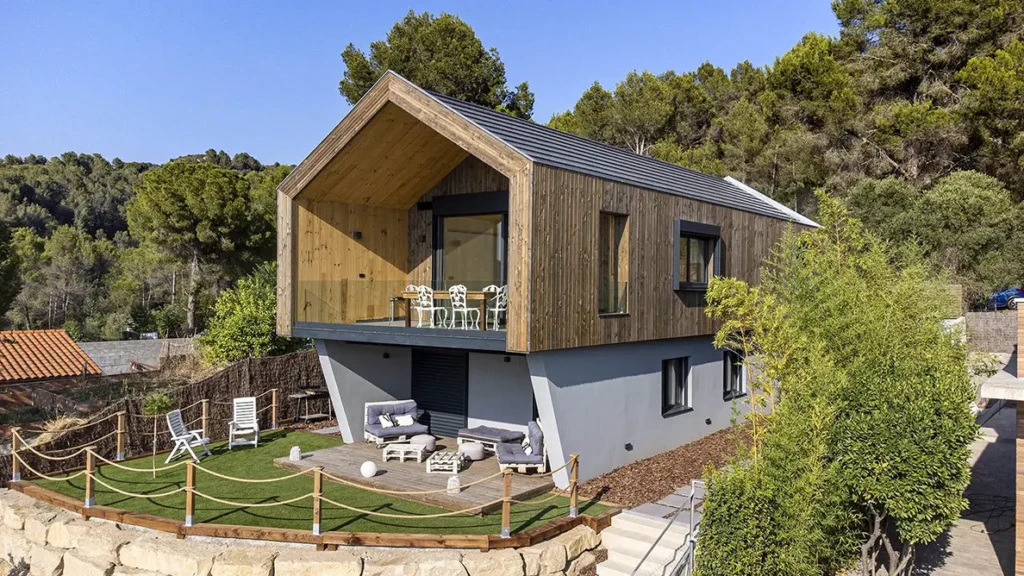
Lilu’s house is a three-in-one: its 142.4 m2 of surface area, spread over two floors, has room for a home, an office and a research unit on wood construction. Because, yes, that is the main material of the building’s structure, with a façade that uses Finsa boards certified by the PHI. It meets the PassivHaus Plus standard and generates 42% more energy than it consumes.
Villaornate House (Villaornate, León)
Designed by architect Sergio Torre and built in 2023, it also has the PHI Plus certification. This is a 163 m2 home, on a single floor, which uses certified wood in its structure and on the façade (here, again, with Finsa solutions). Designed to achieve maximum interior comfort, optimal health, and near-zero energy consumption, it is environmentally friendly, sustainable, and bioclimatic, using recycled and recyclable materials.
Ver esta publicación en Instagram
House in Meco (Madrid)
Located on a 430 m2 plot, this home designed by the ESPassivHaus studio stands out for its large windows, which are not incompatible with great thermal insulation. Spread over two floors and a basement, it combines concrete, Finsa wood, and aluminium to achieve the desired energy, environmental, and aesthetic objectives.
Ver esta publicación en Instagram
Innovation and sustainability have made passive houses increasingly in demand, and more than thirty years after the standard’s inception, they are more relevant than ever. Interest in Spain can be measured by the fact that the Spanish Passive House Conference (CEPH) will be in its seventeenth year in 2025, to be held in early November in Avilés.