You don’t go into a sauna to do something, but to stop doing it: to sweat, to breathe slowly, to simply exist. Although behind that apparent simplicity lies a thousand-year-old tradition. One that today, far from having been relegated to Nordic folklore, is going through a moment of extraordinary renewal.
As journalist Emma O’Kelly explains in her book Sauna: The Power of Deep Heat, each culture has enjoyed its own form of sweat baths. From the Ottoman hammam (or Turkish bath) to the Mayan temazcal, from the banya in Russia to the saunas of Finland. Thus, the sauna, in all its variations, is not a luxury product or a fad: it is the result of human need and has taken different forms according to the climate, the available materials and the values of each people.
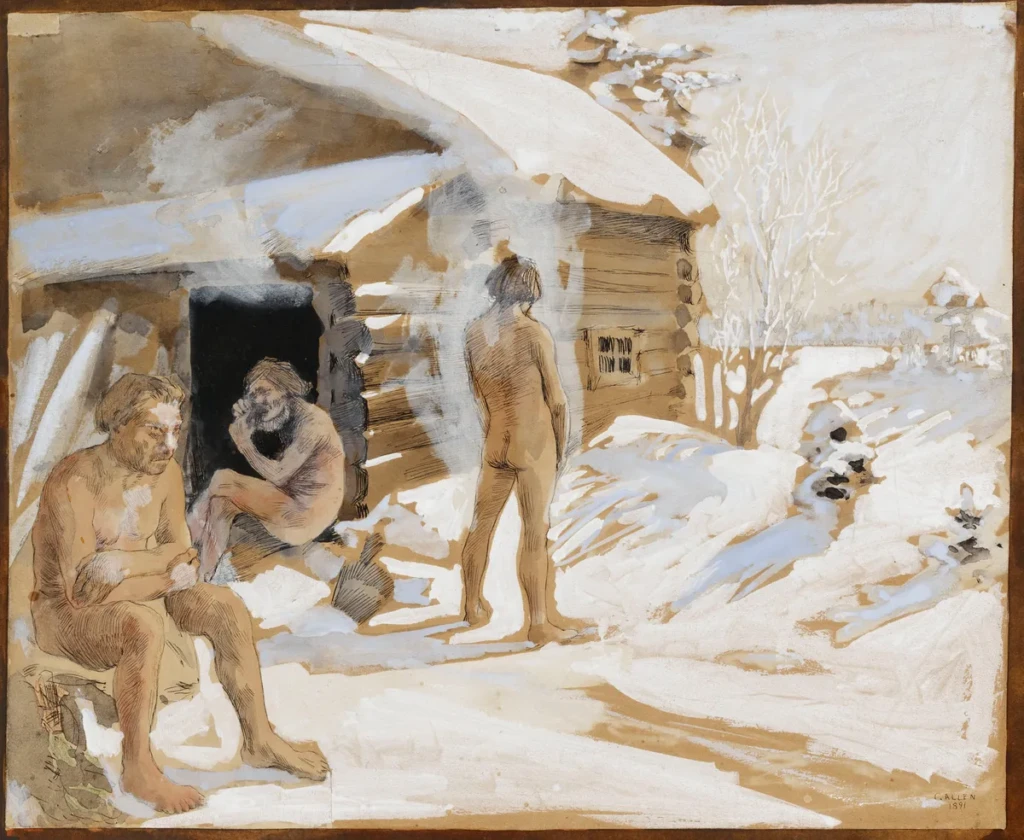
O’Kelly not only highlights their benefits for physical and mental health, but also points out how saunas are part of social, spiritual and everyday life. In Finland, where there are 3.3 million saunas for 5.5 million inhabitants, the sauna is almost a religion. A place for cleansing the body and spirit, for negotiations, for shared silence among friends, or for creating social bonds.
A prehistoric origin, a contemporary relevance
The earliest evidence of saunas points to pits dug in the ground during the Stone Age, more than 10,000 years ago, in which stones were heated in a fire and water was poured over them to generate steam. The transition to wood came around the 12th century, when the first independent log structures began to appear in Finland: the savusauna or smoke sauna. It was a simple, one-room building with a stone stove but no chimney.That smokehouse wasn’t just a place to wash up. It was frequently the first building constructed when establishing a new settlement, and it fulfilled functions that today we distribute between the hospital, the church, and the living room. It was used for giving birth and for holding wakes for the dead. The sick people were cured. Important decisions were made. It was, in every sense, the centre of community life.

The materiality of the sauna and its sensory experience
For centuries, wood has been more than just a building material. It has been the very soul of the sauna, an element that shapes the physical and emotional experience of deep heat. The first smoke saunas appeared around the year 1000 AD and consisted of simple wooden structures with a stone stove.
The wooden sauna has a symbolic dimension: it represents the connection with nature and an ancestral tradition in which the building was almost an extension of the landscape and community life. The traditional northern European woods used inside the sauna, mainly aspen and alder, do not overheat or release resin, making them soft to the touch and safe in contact with the skin. Fir and pine, which are more resinous, are common in the exterior structure.
They all contribute visual warmth and an enveloping quality that makes the sauna an intimate and natural space. In addition, the wood, when heated, releases subtle fragrances and regulates the heat so that it is never aggressive to the touch. Today, alternatives such as Ther mopine wood, heat-treated pine wood, represent a solution for spaces subjected to high temperatures such as saunas. This is an entirely natural wood option, after all chemical or biological products have been eliminated from its treatment.
Contemporary architecture has found in the sauna a fertile ground for exploring the relationship between body, matter and environment. These three works demonstrate this.
Löyly
In Finnish, löyly is the steam that arises when water touches the hot stones of the stove. It is also the name of a well-known public establishment in Helsinki. Designed by Avanto Architects in 2016, it has become one of the contemporary icons of Finnish sauna culture. Located facing the Baltic Sea, it is made up of a structure of heat-treated pine wood, whose wooden slats, seen from the outside, create an opaque blind effect, and seen from the inside, allow you to contemplate the seascape without interruptions.
Ver esta publicación en Instagram
Sauna Sazae
Located on the Japanese island of Naoshima, the Sa zae Sauna, designed by Kengo Kuma & Associates, transforms the sauna experience into something close to sculpture. This small pavilion is characterised by a folded envelope that evokes natural forms such as seashells and stones polished by water. The work engages in dialogue with the coastal landscape and with the Japanese tradition of integration between architecture and nature.
Ver esta publicación en Instagram
Grotto Sauna
In Canada, the Grotto Sauna, designed by the Partisans studio on Lake Huron, is inspired by water-eroded grottoes. Its interior consists of a warm interior lined with wooden curves that evoke a cave, reinforcing the idea of the sauna as a primordial refuge. Made with local cedar wood for its strength, aroma and colour, where each piece of wood was individually worked for later assembly.
Ver esta publicación en Instagram
What unites these diverse projects is the understanding of the sauna not as a simple technical enclosure, but as an architectural typology where matter, climate and ritual intertwine. In contemporary architecture focused on well-being, thermally treated solid wood solutions allow for enhanced dimensional stability and durability, expanding design possibilities without sacrificing the material’s natural expressiveness. This takes on greater relevance in the current context, in which architecture is urgently seeking ways to reconnect the body with the natural environment; the sauna offers a lesson that has been perfected for thousands of years.