Alberto Fesser and Alberto Anaut met when they were six years old, in the schoolyard, and have been friends ever since. Their professional careers took them down different paths: Fesser went into business consulting, and Anaut became a journalist. But 30 years ago, Anaut “got it into his head that we had to create cultural projects, that we couldn’t be satisfied with the existing programming”, Fesser recalls. So he called his friend, and together they founded La Fábrica, which has just been recognised with the 2026 National Design Award in the Business category. We spoke with Alberto Fesser, president of La Fábrica since Anaut died in 2023, to discuss why design is closely linked to cultural management.
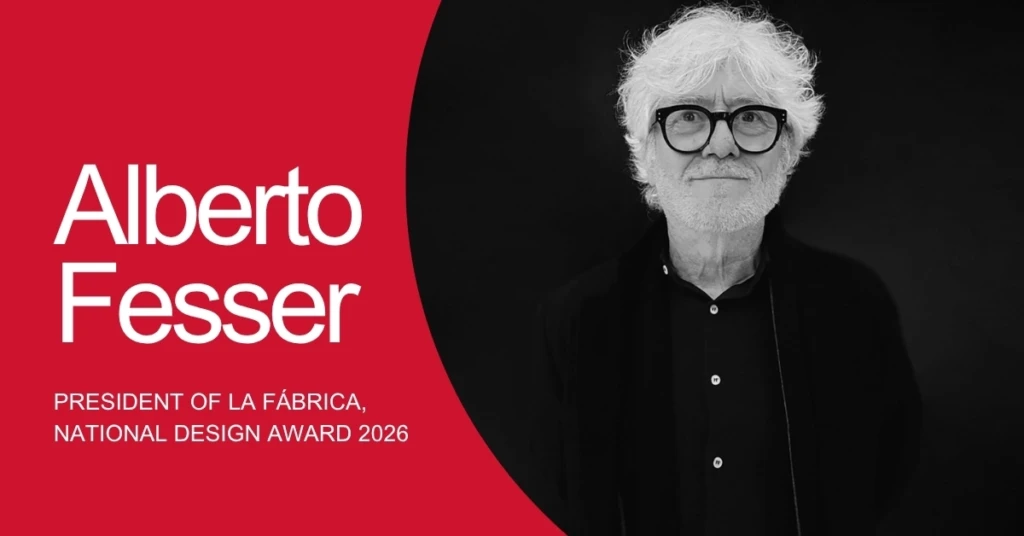
When people think of design, they usually imagine objects or something graphic, but you’re a cultural project management company. Were you surprised to win the National Design Award?
That’s a very pleasant surprise —that they chose us when considering a design award. It’s not the first time this has happened; a few years ago, we received a LAUS award with a similar rationale: that we’re a company that has understood design as a strategic tool for carrying out its project. For the National Design Award in the business category (there are many more!), we’d all expect them to choose a company that produces, manufactures, or sells design. One that makes furniture, lamps… The fact that they suddenly chose a company that doesn’t sell any physical product, but has made design a strategy for achieving its goals, seems very well received and truly wonderful.
Ver esta publicación en Instagram
You talk about making design a strategy. What exactly does that mean?
When we were thinking about creating a photography festival, which later became PHotoESPAÑA, we figured the first people we should tell were the Madrid City Council, the Ministry of Culture, and Telefónica, so we started writing a dossier to explain what we wanted to do. At one point, I said to Alberto: “How are we going to present this dossier? With a spiral binding?” I was used to writing shoddy reports; the important thing was the content, and everything else didn’t matter. But Alberto didn’t see it that way. He said it had to be presented properly, that we had to invest some time and effort in doing it right. So we started by creating the festival’s logo.
The day we go to Madrid City Hall to tell them we’re going to hold a photography festival, we go with a dossier, a folder, stationery, and a business card to present PHotoESPAÑA, a project that’s already a reality, that will take place next June, and “if you want to join, great, and if not, you’ll miss out”. You’re going to present something that’s already been born, that’s already real. From the beginning, we believed that design isn’t just the packaging, the image, or how you present something. It’s even more than that; it’s an attitude.
At the entrance to La Fábrica, there’s a sign that says, “Nothing is the same”. It means many things, because you can read it on many levels. There’s one, the most basic, which is the attention to detail. But there’s another interpretation that I find more interesting, which is that the cultural projects we do aren’t done just for the sake of it. Cultural projects have a purpose; they have a social impact, they have repercussions. If you work with that attitude, design isn’t just an embellishment you add at the end. From the beginning, everything has meaning; everything is for a reason.
Ver esta publicación en Instagram
Now, with AI and the proliferation, for example, of posters that have not been designed by a person but by a bot, it sometimes seems that dedicating time to things is almost outdated.
I believe nothing is more profitable, more useful, saves you more time and money, or improves the outcome more than taking the time to think about what you’re doing before you do it. But it’s true. I’m getting on in years, and I’m getting further and further ahead of the team at La Fábrica. I think the younger ones are a bit more impulsive in this respect than I’d like; they’re less reflective because they think everything is immediate. The other day I took a taxi for a straight trip, but the driver kept insisting on knowing the number so he could put it in the GPS, because that way he wouldn’t have to think. I was struck by a man who considered it an advantage not having to think because “this machine will think for me”. That’s what I find a bit of a drawback of artificial intelligence: this idea that it’s coming to solve problems we didn’t even have.
In 30 years, many things have changed and many will remain the same in the world of cultural projects. What would you say is different for you, and what are you still doing exactly the same?
I remember another anecdote. When La Fábrica started to grow, Alberto suggested we write La Fábrica’s White Paper, explaining the project’s general philosophy to share with collaborators and clients. We worked on it for a while, and then it was forgotten. A few years ago, we remembered it and decided to retrieve it. We thought it would have become completely outdated and would need to be rewritten. But to our surprise, it was still perfectly relevant.
In 30 years, so much has changed. The cultural landscape has changed, evolving significantly for the better (there’s more, more diverse, and more decentralised availability). Society isn’t the same either. And then there’s the whole digitalisation thing, which has changed how projects are communicated. But essentially, everything remains the same. We believe that culture has enormous transformative potential. What is our reason for being? Why do we do this? So that creators can do their work, and above all, so that their work reaches people, not just the same old few culture vultures already on the radar.
Ver esta publicación en Instagram
Is there any project from all these years that you are particularly proud of?
It’s like asking if you love your mom or dad more, but if I have to choose, I’d pick our master’s program. We established the La Fábrica de Proyectos Culturales (The Factory of Cultural Projects) Master’s program over a decade ago, with the motto “we teach you how we do it”, and that’s exactly what it is. For me, it has a beautiful sense of passing the torch, of saying, “Hey, we’ve been doing things for 30 years, and there are many people who also want to do things. Let’s help them, let’s share our experience, our contacts, our way of doing things, in case it helps them, inspires them, or is useful to them”. I don’t skimp on time: I dedicate as much time as each student asks for. It’s something that really touches my heart.
Ver esta publicación en Instagram
Madrid Design Festival celebrates its tenth anniversary in 2027. What is your assessment of this event?
The festival is a long-term project, so its first ten years are the first steps towards some very ambitious goals: to put Madrid on the international design map, to structure the sector by fostering collaboration and to show companies, administrations, media and citizens that, as the festival’s motto says, design can change the world.
You have been president of La Fábrica since the death of Alberto Anaut in 2023. How has your work changed in this new role?
Alberto was a giant, an irreplaceable figure because of his talent, his work ethic, and his charisma. In that sense, the organisation of La Fábrica has changed somewhat because he was so involved in so many things that neither I nor anyone else could replace him. Now the organisation is a bit more shared, since I’ve been chosen as president. In a way, we’re determined to keep everything the same and maintain the momentum Alberto gave us, because he left us with a plan for many years to come. Every time we launch a new project, every time something goes well, we think, “Another thing Alberto did right”. But I have noticed that I have to be much more visible. I’m invited to many more events now, and I have to wear a tie much more often than just a year ago. But I do it gladly.
What example comes to mind when you think of something well designed?
I’m not going to mention the clothespin, which is the usual example, but it’s true that when you come across something well-designed, it brings me peace. Conversely, when you see something poorly designed, I’m uncomfortable. I think good design isn’t just about functionality; it’s about making you smile. You see this pencil and you start writing even if you had nothing to write, because it draws you in; it invites you to. Design has this quality of making everything comfortable, and when you’re comfortable, you can do what you need to do: you can work, you can think, you can enjoy yourself. For me, it’s another element of the environment, of the order of things, of the balance, of the harmony that makes you feel good.
What inspires you daily?
A friend of mine, Telmo Rodríguez, who makes wonderful wines, once told me, “Success is a form of failure”. I thought it was brilliant. Success is a form of failure in the sense that it makes you complacent, thinking what you’ve done is good enough, and therefore it becomes a routine. And routine leads straight to failure.
What inspires me, and what I recommend everyone do, is not to be self-absorbed, not to think you’re the smartest because, for example, you’ve won the National Design Award. You have to go out into the street; you have to visit things, you have to see other people’s projects, you have to listen to people, you have to ride the subway to see who else is on it and what’s going on. You have to travel. Above all, you have to keep your eyes open all day long.