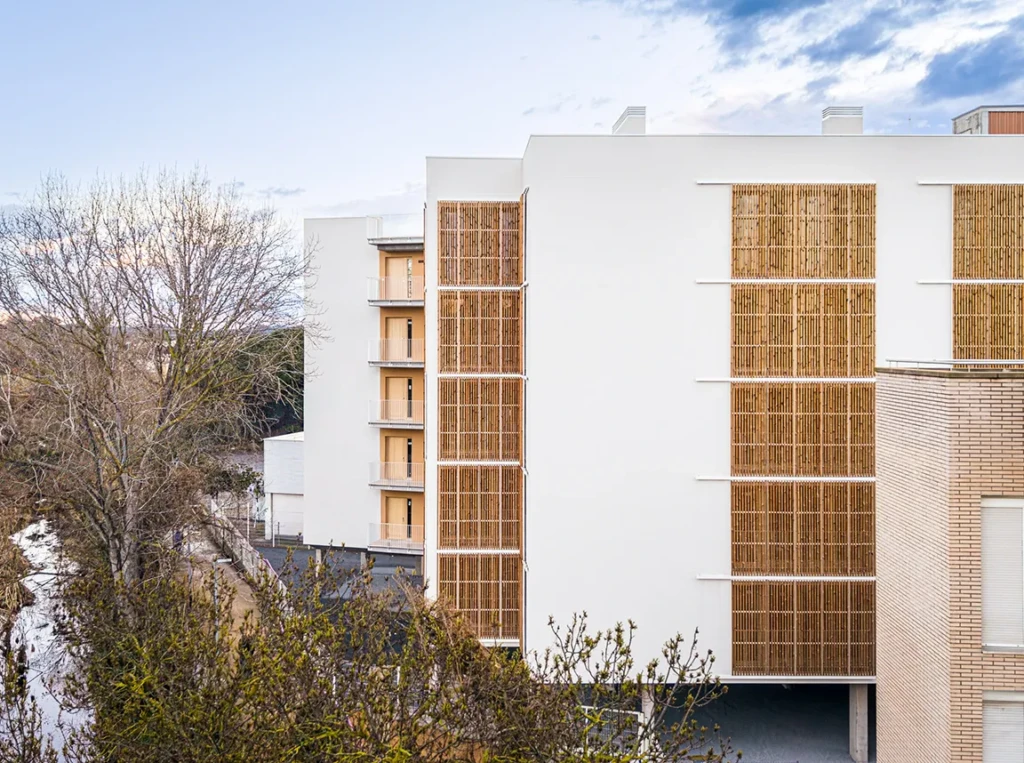
As access to housing becomes increasingly fragile, projects like Terra de Mar force us to look beyond the market. Promoted by Sostre Cívic and designed by UMMA, this cooperative building in Palamós (Catalonia) proposes another way of understanding ownership, sustainability and coexistence, after having become the first cooperative housing in Spain to obtain the VERDE certificate issued by GBCe.
Some buildings are interpreted through their form, while others are better understood through the structure that makes them possible. Terra de Mar belongs to this second category. At a time when the housing crisis can no longer be explained solely in terms of supply and demand, the project introduces a more fundamental question: what happens when housing ceases to be considered a commodity and is once again organised as a use good?
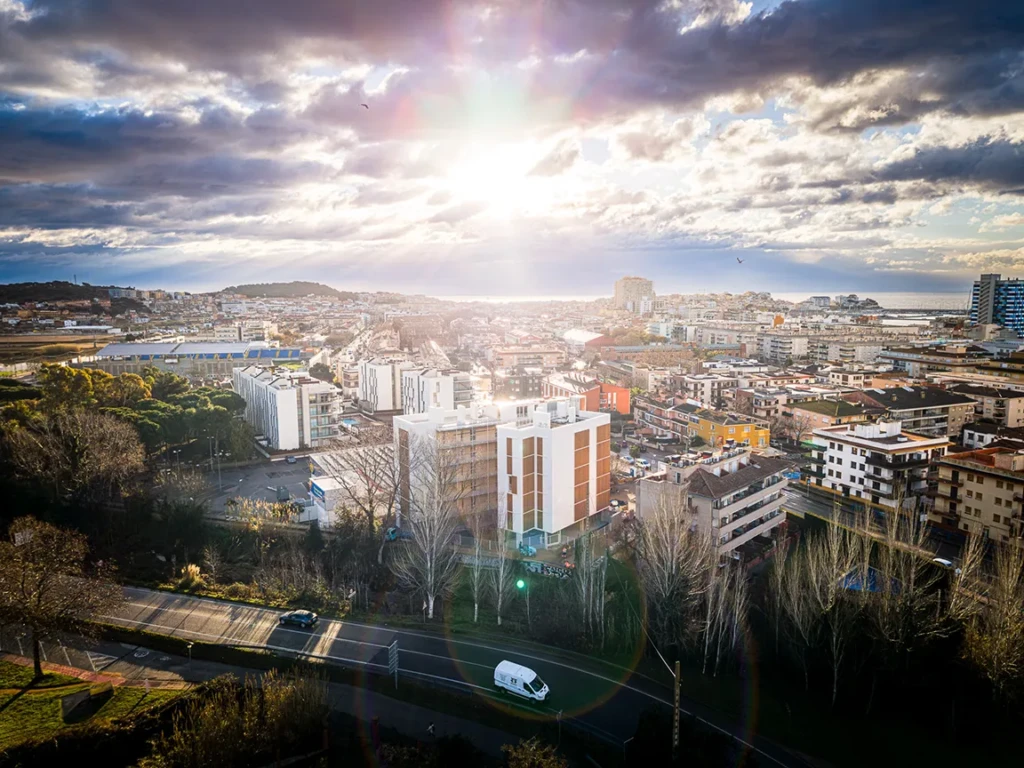
Terra de Mar was created on public land ceded by the City Council under a surface rights agreement for 75 years. The development is being carried out by Sostre Cívic, a leader in cooperative housing with right of use (a common model in Denmark or Switzerland), and is structured around the separation of ownership from use. In this way, the cooperative maintains collective ownership and members gain access to a stable right of use, at cost price and with democratic management.
Architecture to sustain a community
UMMA translates that ambition into a spatial organisation of 34 accommodations that avoids several common features of conventional collective housing. The building takes advantage of the geometry of the plot to compact the buildable area on the typical floors and free up two decisive areas: the ground floor and the roof, where facilities, parking and some of the most important community spaces are located, such as the multipurpose room and the laundry.
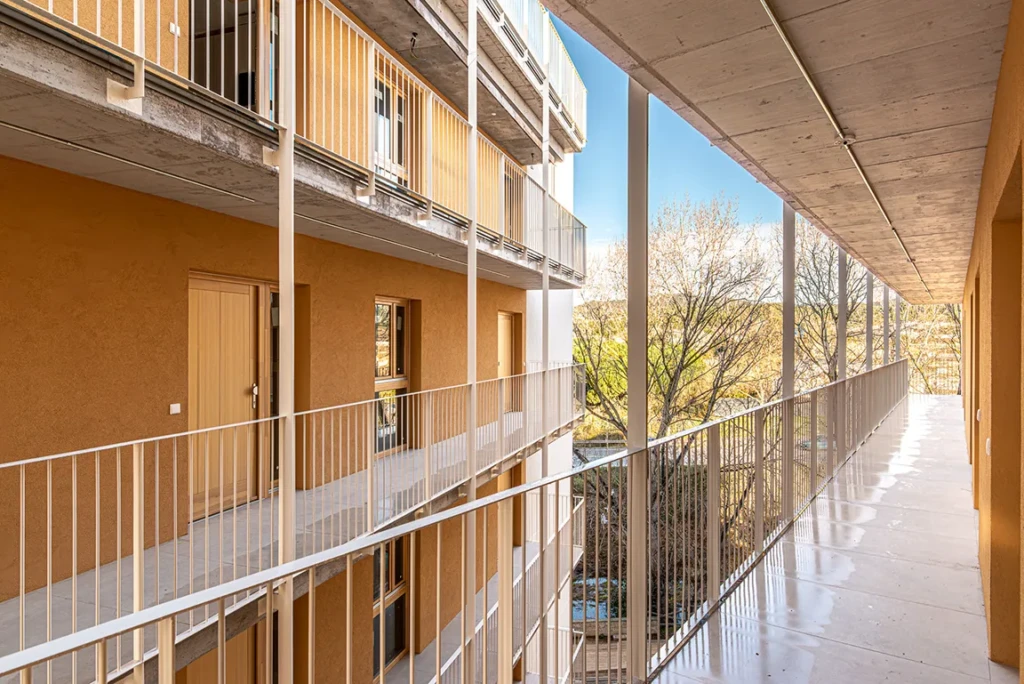
The most interesting operation, however, lies in the unfolding of the volume. The building opens in two sections towards the stream and creates between them an exteriorised interior space that functions almost as a shared facade. This allows natural and cross ventilation in all homes, introduces light into circulation areas and turns walkways, stairs and elevator arrival areas into social spaces.
Sustainability without rhetoric
At Terra de Mar, sustainability is formulated as a starting criterion. Both the cooperative and the studio agree that it is a principle that runs through the entire project: from reducing the incorporated impact to efficiency in use, including the choice of materials and the constructive organisation.
The project combines an efficient building envelope, passive ventilation, solar protection, centralised aerothermal energy and photovoltaic production, giving it the distinction of being a nearly zero emissions building, nZEB. But perhaps the most relevant thing is that this strategy is not separate from affordability. Here, the environmental objective does not compete with the economic one; it reinforces it. Industrialising processes, better controlling execution, and reducing construction uncertainties not only decrease impact; it also helps stabilise costs and make a residential model viable outside of speculation.
Industrialisation to improve processes and quality
In this balance between technical precision, reduced impact and economic control, the lightweight wooden frame of SuperPan® Vapourstop takes on a central role. Although the main structure of the building is resolved with concrete for economic and technical reasons, the facades are executed with lightweight timber frame panels, with a triple layer of wood fibre insulation, pre- industrialised and dry-assembled on site.
The system’s contribution is not only material. It allows for faster assembly, improved accuracy, greater quality control at the factory, and a reduction in the building’s built-in footprint. It also responds well to one of the fundamental conditions of the project: to demonstrate that collectively managed social housing can achieve high standards of efficiency and durability without driving up the cost of access.
An aesthetic of carefully cultivated austerity
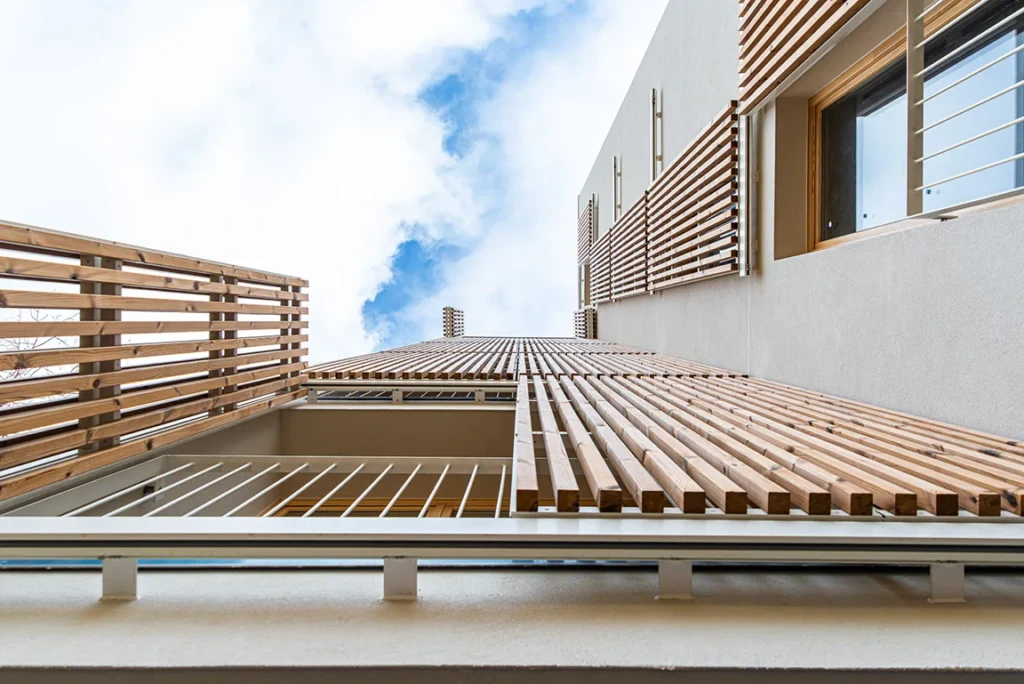
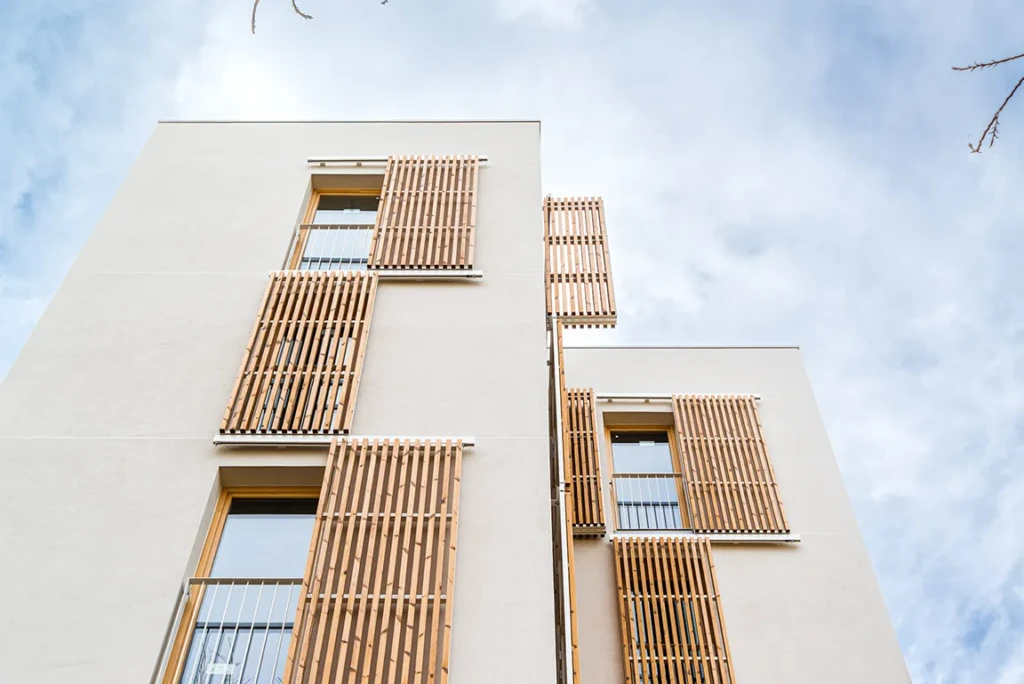
Terra de Mar does not seek spectacularity. His language is based on a precise austerity, where beauty arises from constructive clarity, domestic scale, and coherence between use and form. The facade combines light colors, high-performance wooden joinery and sun protection through folding and sliding shutters made of heat-treated pine slats.
More than building an iconic image, the project wants to convey something else: dignity, permanence, and legibility. There is a clear intention to make visible that this architecture responds to an economy of means without sacrificing warmth or spatial quality. In a context where much of the affordable housing is trapped between material precarity and formal banality, Terra de Mar advocates a third way: a sober, contemporary architecture designed to last.