The idea of space design often leads us to think about fields such as architecture or interior design. We see buildings and rooms, forgetting a very important area that also needs to be designed: the exterior spaces. These are the domain of landscape architects, who, according to the European Federation of Landscape Architecture, “study, plan, design and manage urban, rural and natural landscapes in time and space based on the characteristics and historical and cultural values of the place”.
Frederick Law Olmsted was a landscape architect, responsible for the design of New York’s Central Park, and so was Gertrude Jekyll, who created and designed more than four hundred gardens in the United Kingdom, Europe, and the United States. In other words, the world of landscape design is broad and varied, and it is even difficult to give a definition. “It can be interpreted in many ways”, confirms landscape architect Senén Rivero, who is in charge of this area at A Panda da Dá. “It can be done from a more territorial point of view, such as landscape management, to interpretation, perhaps more of the English school, of garden design or outdoor space design, and there it has a relationship with architecture. There is the architect, who focuses on the building, and the landscape architect, who focuses on the exteriors. There is a somewhat grey line to differentiate what a garden designer does from what a landscape architect does,” he explains. The website of the Spanish Association of Landscape Architects, in fact, includes among the areas of activity of the profession categories such as engineering, rehabilitation and restoration of the landscape or the design of green infrastructures.
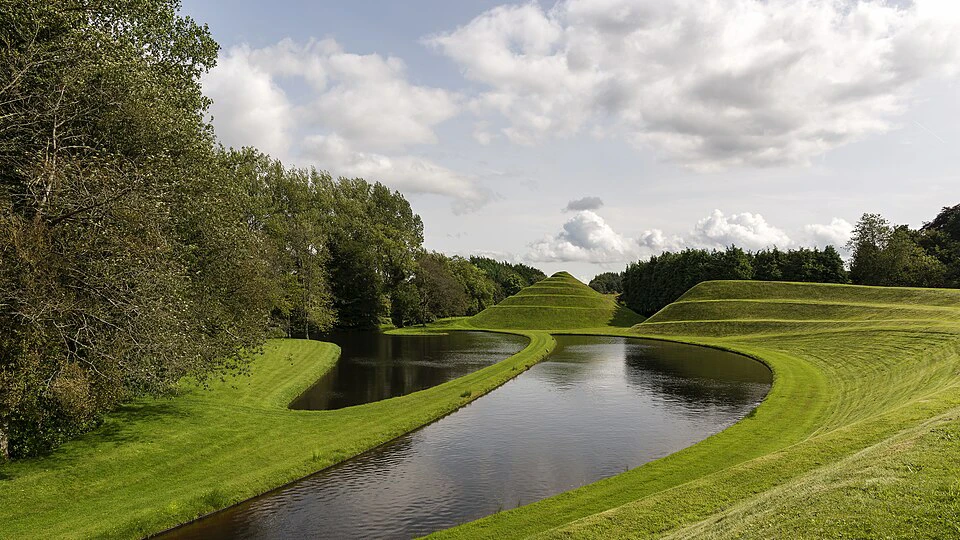
Senén Rivero cites the Garden of Cosmic Speculation , located in Scotland, as an example of a landscape project that he particularly likes.
Rivero, who trained in England, understands his profession as “designing exterior spaces, usually linked to a property, a residential space, but also for public spaces or even farms and productive spaces”, he says. From Orza Paisajismo, Carmela Moral Ardines offers a similar definition: for them, landscape design addresses the exterior space, “both urbanisation and gardens, in public and private spaces”.
Being a landscape designer today
This blurriness in the definition and in the limits that mark what is and what is not landscape design may be due, precisely, to the fact that in Spain it is still a relatively recent field. “The profession in Spain is growing a lot, but compared to other countries, we are still in a somewhat embryonic state. There are indeed professionals who have been in the sector for quite some time, but most of the work done in outdoor spaces has not been done by professionals trained in the field”, Rivero argues.
Ver esta publicación en Instagram
In recent years, however, things have begun to change. “What we are noticing is that people are increasingly aware of the quality of life that outdoor spaces provide and are demanding them more”, says Moral Ardines, who points out that this is something they also see among colleagues in the professional world. “We notice this greater sensitivity in the professional world, among colleagues, architects, developers, and interior designers, who demand and are aware of the value that our work brings”, she points out. Thus, she sees the positive side of the fact that landscaping in Spain is still in its infancy, as it means that those who demand it “are sensitive and open to it”. However, she still misses the fact that those starting a housing project don’t allocate a percentage of the outdoor space.
What explains this growth in recent years? Two causes seem to emerge clearly: in a context of climate emergency, the increasingly widespread awareness that green spaces are important was also compounded by the Covid-19 pandemic as a catalyst for this outward-looking perspective. “Suddenly, we also started looking at what we have outside our homes, we gave much more importance to green spaces, to gardens”, Rivero points out.
In addition, the pandemic had another side effect that is helping this current boom in landscaping: many people decided to change careers and look for something that truly excites them. “This resurgence of the sector has led to more and more universities offering master’s degrees or courses in landscape design”, adds Rivero, who is part of the winning team of the competition for the architectural and landscape rehabilitation of A Panda da Dá.
Ver esta publicación en Instagram
Trends in landscaping: sustainability and contact with nature
The landscaping done now is not the same as it was twenty years ago. At this time of professional growth, there is one essential word in everything that is done: sustainability. “We came from a model in which nature is something we subdue, in which everything is perfect and with very defined lines, and I think the trend now worldwide is not to try to take over nature, but to work with it”, says Senén Rivero.
This translates into gardens that are “somewhat more informal, with a slightly more naturalistic style, using plants that are more adapted to the location. In most of Spain, it means plants that don’t need watering”, he explains. This also means being more careful with the species that are introduced (trying to avoid invasive ones) and, in general, “a more sensible use of resources, both of the plants we use, as well as materials, such as water, and other elements”.
Within this framework of sustainability, which we could understand as a macro-trend, current landscape projects are also characterised by “the search for contact with nature, whose benefits we are increasingly aware of, and by the flexibility of the spaces”, notes Carmela Moral Ardines. “More and more activities are being held outdoors, and the idea is that the same space can be adapted: that it can serve for a large family meal or with friends but can also become a smaller and more welcoming place”, she explains.
Ver esta publicación en Instagram
Furthermore, Orza Paisajismo, responsible for projects such as the 75 homes in Foxos, have detected another trend. “We work a lot in the north, where many times you are inside the house, but appreciating and enjoying the garden. That garden that you can see from inside the house, I think that’s also a trend”, says Moral Ardines.
The future of landscape design: a sector shaped by climate change
The global context of climate emergency is also impossible to ignore when thinking about what the future of this sector will be like, which will have to face a change of rules at a global level. It’s something that, in reality, is already happening. “When we do more decentralised work, it is very important to travel and study the area in depth, both in terms of vegetation and orography or orientations. “We are already noticing changes in environments that we have known for a long time; it is something that we already perceive”, confirms Moral Ardines.
“Everything we know is going to be of little use to us”, agrees Senén Rivero, speaking about aspects such as the best times for pruning and planting, and what can and cannot be planted. “We live in an extremely changeable climate with many extremes, hot and dry summers and especially cold winters. When selecting plants and designing green spaces, we will probably have to redo many things we have already done. We may have to limit the range of plants a bit and look for the most resilient ones, as well as discard the idea that the same recipe will work for all places. “The current technical level allows us to do practically anything we want, but we must ask ourselves at what price, including the environmental variable and recalculate,” he says.
Ultimately, it’s about continuing down the path of sustainable landscaping, because not everything green, just because it’s green, is good. As Rivero concludes, “we will have to change the paradigm a little”.