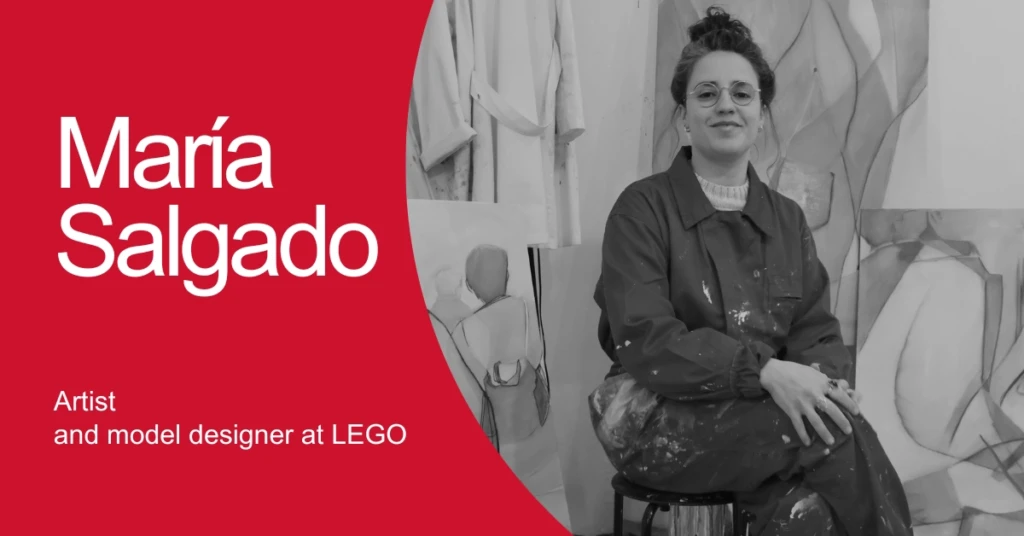
María Salgado ended up in the world of toys by chance. After studying Product Design Engineering, he completed a scholarship at SEAT in Barcelona. One day, while walking down the street, he ran into a classmate who told him he had gone to a job interview at a toy company. “I thought it was really cool. It had never occurred to me before, but, of course, someone has to design the toys!” he says. Since they were looking for two people, he also showed up and they hired them both. Three years later, he saw a job offer at LEGO and applied. The selection process lasted several months, but she was selected and moved to Denmark, where she combines work with her artistic production. In 2024, after several years with the Danish company, he took a year’s leave, travelling between Galicia and Denmark. He rejoined in 2025.
 During that year of leave, you opened Espazo Salgado with your father, the designer Xosé Salgado. How did the idea come about? What is the purpose of the space?
I’d had the idea for the space for a while, to open a place with my father to also motivate him to get back to painting, because he did things at home, but more in a smaller format. It’s not the same as having a space where you can go and do things a little bigger. Or simply change the chip, get there and be more in exploration mode. I’ve been wanting to do the leave of absence thing for a while now, and I said to myself, “Well, look, I’ll do it now and we’ll take advantage of it to open the store.” I’ve already returned to work, but my father is still there and goes almost every day.
Ver esta publicación en Instagram
During that time working side by side, did you also collaborate on any projects?
Yes, sometimes we each did our own thing, sometimes we worked together. The place is intended to have a good time, to experience both together. Since we were experimenting, we didn’t want to do it with super expensive materials; we wanted to try things. For example, there was a hardware store in the neighbourhood that was having a clearance sale, so we stopped by and bought some materials that were on sale and that weren’t meant for painting on paper or canvas. And from there we try things together, sometimes working together and sometimes individually.
It’s interesting, because he comes more from that, from daring, and he also likes the most abstract and the material being the one that does the work and you being a medium that directs it. I come more from the figurative, from an engineering that is quite artistic and creative, but an engineering nonetheless, and also from illustration. From there, I wanted to move to a larger format and forget about drawing or controlling so much, let go, and instead of doing more illustration, do more artistic work. We gave each other a lot of feedback.
You also did some workshops together, both on-site and off-site. One of them was the one you taught at A Panda da Dá in the summer of 2024. What did it consist of?
Finsa’s workshop in A Panda da Dá was about experimental watercolour. We worked with watercolours because we wanted a medium that wasn’t toxic, and we didn’t do it on a table, but on boards, so we could move and play with the body, the water, the position… Watercolour can be worked in many ways, like all materials, you can explore it however you want, but the approach my father and I like to work with is to give it a little twist. We called it experimental watercolour so people wouldn’t think it was just a matter of just arriving and painting the landscape of the place.
Ver esta publicación en Instagram
Now you are back in Denmark and at your job at LEGO. What does it consist of? What is your job there?
It is a job that only exists at LEGO, the title is model designer. When you buy a box of LEGO, it comes with instructions for making that specific model, like a pirate ship. Someone had to design that pirate ship with the LEGO pieces that exist. My job is basically to choose the pieces that exist in the LEGO system and design with them. At the other toy company, the tool we used for design was 3D drawing and modelling. Now, more than 3D modelling, I use LEGO pieces. I still use drawing because in the early stages, for communication, it’s very valuable.
How many designers work on each model? How long does each project take?
It’s a big team, but normally, model designers work with at most two or three people. Then there are also element designers, graphic designers… And also those who make the instructions, who participate in the design process. It has to be a dialogue with them, where they tell you, for example, if something is possible for a certain age. The duration depends on the project. In design, there is the concept phase and then the development phase. The entire design usually takes about a year, and then it moves into the production phase. Now I’m a little more in the concept phase, and we’re working three or four years ahead. But in development, we are talking about one or two years in advance.
What would you say you’ve learned at LEGO and while in Denmark?
One of the things about LEGO is that it’s a very international environment. Being surrounded by people from other places, with different perspectives and different ways of seeing the world, makes you realise that maybe things or traditions that you saw as normal, or worldviews, aren’t the same for other people. You also try to find your family a little bit; your friends become your family. And you learn to be alone.
Ver esta publicación en Instagram
And do you think this has somehow crept into your artistic production?
Yes, definitely yes. Now, for example, when I return to Galicia, I look at everything differently. I work a lot on routine, everyday life and a little bit on tradition. Since I also do figurative work, I have to find discourses and motifs to draw, to create the theme of a series of prints, for example. And I draw a lot from that, from Galicia, from the tradition, the everyday life there. If I weren’t out, I’d probably be talking about something else.
Maybe you were looking more outside and not so much at home.
Maybe. There’s also something I’d like to address at some point: the feeling of being uprooted. Because I do feel it, and I’m not working on it that much right now, maybe because I haven’t found a way to communicate it yet. I have some things there about how I feel about living abroad that I haven’t thrown away as much, perhaps also a little out of shame. Maybe in a few years, with more maturity… These are feelings I would like to understand before talking about them.
Your parents are artists, designers. How do you think that has influenced you?
When you’re little, your family is what you know and you see everything as normal, but then, looking back, you do see things that have influenced you. When we went on trips, for example, we always went to many museums. They took me and explained the works, the artists, to me. I was bored and tired, but then you realised that logically it did have an influence, because there were many artists that I already knew by the age of 14 or 15 and had seen works by almost all of them. Also, the atmosphere in A Coruña, among my parents’ friends… Yes, it influences you, but you don’t realise it until later.
What characterises your artistic work?
I think people watching. When I return to Galicia, perhaps because I miss the context of people’s expressions or the customs I no longer have around me, going out is like being at home, and I notice things like the typical interactions of two men sitting on a bench talking, with lots of gestures. Observe people, everyday life and daily life.
Also exploring different media, with things like printmaking, trying to bring the drawing to different formats. In illustration, we work more with a commission and with reproducibility in mind. I try to stick with those figurative elements, because I still like to tell a story with a scene or recreate an atmosphere, but without thinking about commissions and with the intention of creating unique works.
Ver esta publicación en Instagram
You also attach great importance to sustainability. How do you introduce it?
It is a topic that concerns me and with which I feel involved. I’ve found a way to approach it from a food perspective, something that’s also linked to Galician tradition. I haven’t eaten meat or fish for 6 years now. It’s not just what you put on your plate, but also how it affects, changes, or reframes my social interactions when I return to Galicia. I try to focus on that, because food is a big change we can make simply by going to the supermarket and deciding what to buy and what not to, and it has a huge environmental impact.
Do you also seek sustainability through materials?
I try, yes. For example, I now work with water-based oils, a type of oil that has become popular in recent years and is more sustainable; it cleans up with water. I also try to reuse papers and materials. There’s a lot of second-hand culture here in Denmark, so I often go to second-hand shops on weekends and there are a lot of leftover old papers. It’s not always possible, but I try. Another example: my partner sews, makes historical costumes, and I use the leftover fabric to paint. As much as possible, I try to reuse materials and not use toxic products, finding a balance.
Ver esta publicación en Instagram
What is a day in your life like?
I get up around 6:45. In the office, we have flexibility regarding the time of entry. The great thing about Danish and Nordic philosophy in general is the balance between personal and work life. I usually get to the office before 9 a.m. I usually go by car with some friends or colleagues or by bus, it takes me half an hour. At the office, we usually have a meeting in the morning to define and tell the rest of the team what each of us will be working on. Around 12, we’re going to eat, for half an hour. The meetings are held in the morning, and then in the afternoon I build, either on the computer or I go to the pieces’ library. Sometimes we have a brainstorming session that lasts all day. At 4, I leave and return to where I live, Vejle. Since I have many hours until the evening, that’s when I take advantage and do my projects. The winters are long; my projects are also a way for me to escape.
It might seem like your job is to play…
We take it seriously, of course, but the atmosphere is really cool, because in the end, we make toys. Sometimes we get too worried about a project that may not be exactly what we had in mind. But there’s always someone who remembers: “Look, we make toys, okay?” If you design toys out of bitterness, you won’t get them as well. It has to be fun.
Where do you get your daily inspiration from?
From my origins. Sometimes I also try to use art as a form of therapy. If I care about something, for example, sustainability, why not apply it to what I do? I try to pour out my thoughts or worries. For years, I have also tried to work on series, on projects that conceptually fall under the same framework. I also try to remind myself that not everything has to be super serious. You can start drawing again just for the sake of drawing, not because you’re going to do an exhibition or participate in a project. I also always try to keep a sketchbook, carry it with me and draw outdoors, draw some buildings, something I’m not so used to. That also allows me to explore with different materials and do exercises, and that often gives rise to a ton of ideas, because sometimes if you start with a blank page, it’s complicated.
Ver esta publicación en Instagram
Where do you see yourself in ten years?
Everything is so uncertain right now that I don’t know, but I would like to be in Galicia.