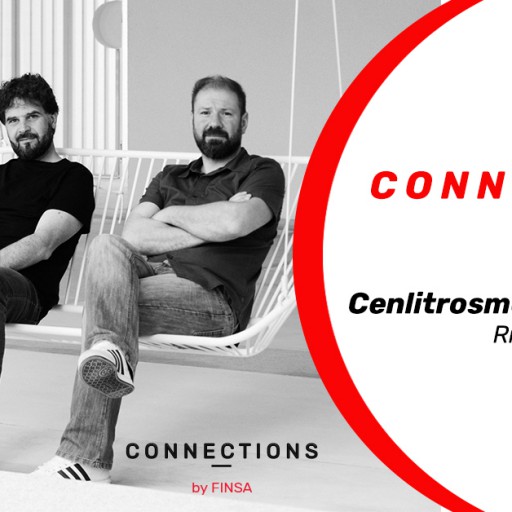
Las tendencias nacen de las formas más inesperadas. Durante una entrevista con El País Semanal, hablando sobre cómo los hospitales suelen ser lugares deprimentes, el arquitecto Íñigo Berasategui, que junto a Ane Arce forma el estudio BeAr, dijo que en la arquitectura también puede haber optimismo. Esa declaración llegó al titular del reportaje y, de pronto, muchos medios empezaron a hablar de arquitectura optimista y a citar a BeAr como una especie de líderes de un movimiento.
Trends are born in the most unexpected ways. During an interview with El País Semanal, talking about how hospitals are often depressing places, the architect Íñigo Berasategui, who, together with Ane Arce, forms the BeAr studio, said that there can also be optimism in architecture. That statement made it into the headline of the report and, suddenly, many media outlets began to talk about optimistic architecture and to cite BeAr as a kind of leader of a movement.
“I don’t know if we would call it that…”, Berasategui replies when asked to define what optimistic architecture is. What they were talking about when that label emerged was that for their team, it was important “to try to create spaces that encourage a relaxed, leisurely life“. They also referred to the fact that they see architecture as a tool with which to generate spaces that promote comfort, spaces that revolve around the idea of enjoyment. This can be called optimistic architecture if you like, but bearing in mind that, at least for the moment, it is not a movement that has been officially recognised by that name. In the absence of a term that generates consensus, we will continue to use it in this report.
Keys to an optimistic architecture
How are these spaces focused on pleasure and enjoyment achieved? There is no recipe that explains step by step what needs to be done or the elements that each building or room must include. As Berasategui explains, the key is to talk to the person who has placed the order, establish a relationship of trust with them, and be able to convey how they like to live. “It’s not about telling us how they imagine the living room or the kitchen, but whether they like to cook, how they like to eat, whether they like to spend a lot of time in their room reading… Knowing what they value in their daily life”, she explains.
Then the architecture team will be responsible for seeing how all of that translates into a specific space, colours, or materials. “Sometimes, instead of this, the first thing they tell us is that they want something they have seen elsewhere, but it is not always going to be the best thing for the way they like to live. Spaces are for different people, so they shouldn’t be the same. Sometimes it seems like we all have to live in little white boxes”, she reflects.
Ver esta publicación en Instagram
Are there any materials that are particularly suitable for this type of project? Berasategui argues that it’s not so much about what they use, but what they don’t. “We don’t use plastic materials or materials that imitate other materials”, he explains. In general, it shows a certain preference for materials that change over time. “We like wood, marble, cork… When you install wood, it looks neutral, but if you return to the house after two years, you notice where the sun has shone, the areas where the children have played… It’s something we find beautiful and that we try to convey to the client”, he explains.
In this optimistic architecture, sustainability also plays an important role, understood as “intervening only as much as necessary”. Before tearing things down and building everything new, “you have to think carefully about what’s there, whether it’s worthwhile or not, and the materials you’re going to use, which must have a purpose and last”.
He gives an example of a project they are particularly proud of, which perfectly exemplifies the entire process of an architecture born from conversations with the client. This is the Casa Nahinuena, a single-family home in Górliz (Vizcaya) that was also in the Spanish Pavilion of the Venice Biennale.
Ver esta publicación en Instagram
“The client had bought a plot of land near the sea, and he especially wanted a garden because he saw retirement coming up in a few years, and he loves taking care of plants. If we went with a conventional solution and placed the house on the ground, instead of a garden, it would look like two long planters. In the end, we decided to put the house elevated, with the garden passing underneath, having the entire garden area from one side of the plot to the other. For this, we had to give up building a basement and a garage, but the cars can get wet and, in exchange for this, he was able to have the garden he wanted, with a pond and everything”, says Berasategui.
Optimistic architecture in the fight against uniformity
One of the most analysed and discussed concerns in the world of design and architecture is that there seems to be a certain uniformity in buildings, which somewhat eliminates the peculiarities and characteristics of local tradition. This lack of variety, which goes beyond the types that facilitate design and construction in architecture (the common elements that all train stations have, for example), also seeps into urban landscapes (an example is zebra buildings) and interiors.
“There are several factors that influence this”, Berasategui points out. “It may be that we are a society with many doubts, we find it very difficult to make decisions, and above all, we find it difficult to show ourselves as different from others”, he says. This leads to the idea that “what doesn’t stand out, what is the same, what is easy” is the most straightforward. That’s why they also have to do that educational work sometimes -although less and less- with their clients. Sometimes, you might want something simply because it’s the only thing you know about it, having seen it in a magazine or on social media.
At BeAr, they are not alone -nor are they the first- to do architecture from this different point of view. Among her role models is the Italian-Brazilian architect Lina Bo Bardi, known, among other works, for the Glass House (her own home). Berasategui also cites the 2026 Pritzker Prize winner, Smiljan Radić.
Ver esta publicación en Instagram
Ver esta publicación en Instagram
In Spain, they highlight the Barcelona-based studio MAIO and the Madrid-based Langarita Navarro, “because they are from an older generation and also started out doing things very differently from how they were done here”, they explain.
Ver esta publicación en Instagram
Ver esta publicación en Instagram
Apply optimistic architecture to a health centre
This architectural philosophy is not only valid for homes, but also for other spaces and buildings. At BeAr, they obtain many of their projects through public competitions and one of the most recent is a health centre. How to change the usual look and design of a healthcare space to turn it into a place where people can feel comfortable? “It’s very complex. They have been more receptive, for example, to letting us intervene in the image of the building, in the facades or in the volumetry. Inside, it’s more complicated because the requirements range from healthcare professionals to their own technicians or maintenance staff. We have achieved some milestones such as having much more natural lighting than in other centres, having overhead lighting in some areas, having wood in different areas…”, he explains.
What label should be used for this vision of architecture? Ultimately, it’s about building places that help us see and judge things in their most favourable light. And seeing and judging things from their good side is, in the words of the RAE (Royal Spanish Academy), the definition of optimism.