
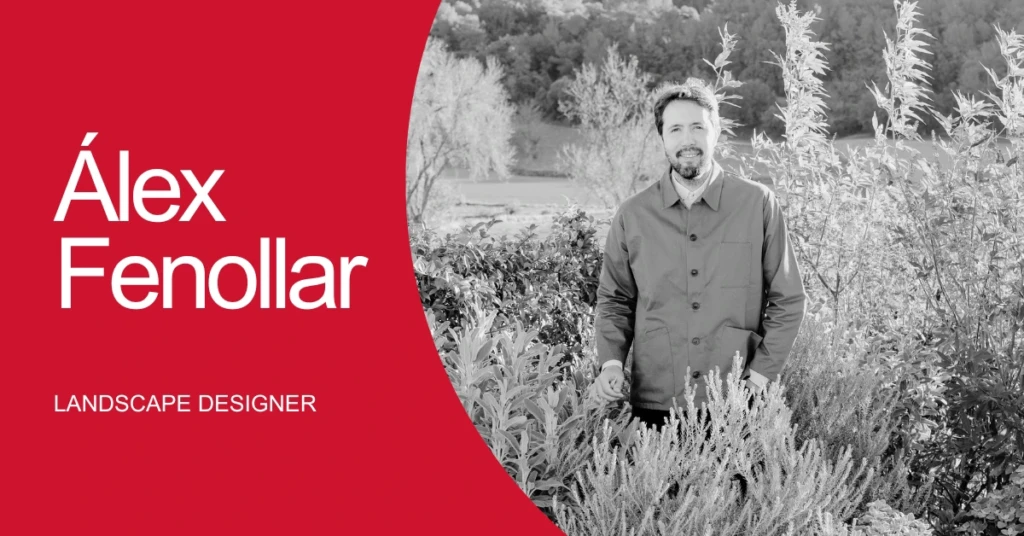
During his childhood in the Sierra de Mariola (Alicante), an area “of orchards and almond trees and olive trees and corn in summer and a large market”, Àlex Fenollar was not at all interested in all the agricultural activity of his grandparents. He studied Journalism and worked for a while in advertising and, suddenly one day, he realised that everything he rejected as a child was actually very beautiful. As a result, he changed his professional life and became a landscape designer.
 How did landscaping come into your life?
I always say it’s almost like a divine calling; it has a lot of vocational and unexpected aspects; it’s not a path you know exists. For those of us who don’t come from families with a gardening or landscaping heritage, it’s a process of self-discovery. In my case, it coincided with the arrival of my son. It was a moment of reflection where I said, “This calling I feel towards nature, towards the garden, towards the countryside, perhaps it could be a profession”. It began, against all odds, very blindly, and I charted my own course at a time when landscape design was experiencing a great boom. It came to me through vocation, interest, and because I am passionate about it. Because I think it’s the most beautiful thing in the world.
You define yourself as self-taught, but you also have specialised training. How do you think that mixes or translates into what later becomes your work?
It’s a profession that can be quite frustrating at first, because you discover it exists and then you don’t know where to start. In the case of Spain, it is something structural; there is no landscape tradition that has given it an academic body and regulated training (although it has begun to change).
But, in addition, this lack of definition is inherent to landscape design, which is multidisciplinary and has many variables. In landscape design, there are people from fine arts, writers, journalists, there are engineers, there are architects, there are agronomists… There is landscape design more focused on civil works, on swimming pools, on paving, and then there are landscape designers who do forest restoration, something very ecological. There is so much to it, which makes it very difficult to find a career or training that encompasses it all. The part that interests me most is the one that has always been least addressed, that of horticulture: the plants, the plant material, the communities, how to use a palette of species in a local context.
On the other hand, I also have this insecurity and imposter syndrome, so I attended several training courses both in Spain and in England. But I believe that the core of it all is self-learning, both practical and theoretical. Every year, a huge number of books on landscape design are published in England and other countries, and that is a great source of knowledge.
How is that knowledge transferred to the local context in which you work? How can all that literature, conceived from an English perspective, be applied in other places?
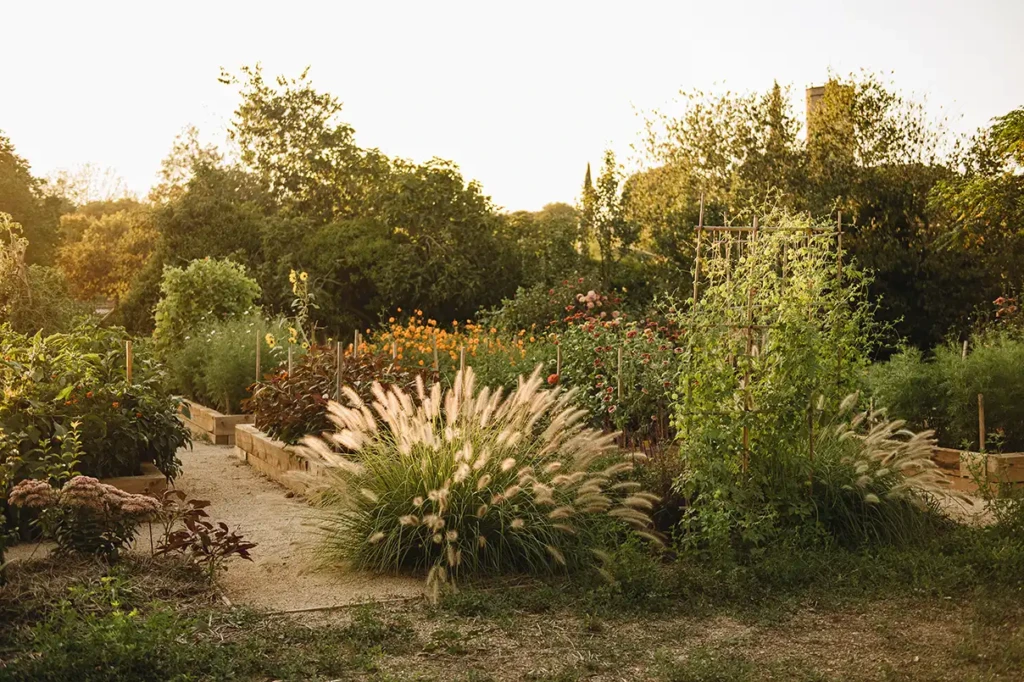
We always have to adapt our English knowledge to our circumstances. I always say that I take the spirit, the gardening vocation of the English: they are passionate about gardening and there is a constant motivation to improve, to create very elevated experiences, to restore landscapes. That engine is perfectly transferable. Then, of course, there are very different conditions, very different climates: one has to learn to question what comes from England. For example, in all their plant catalogues, some are called drought-tolerant. But in Spain, we don’t have to look for drought-tolerant plants; we have to look for drought-loving ones. Apart from that, it is the vocation, the desire, the English thoroughness that must be brought here, playing with other ingredients. The desire to create immersive gardens where there is a succession of bridges of interest, pleasure, and knowledge throughout the year… that we can certainly bring to life.
You were talking earlier about how landscape design is experiencing a boom. What do you think is the reason?
Of course, Covid was an immediate trigger, but there were already many landscape architects who were transforming the discipline. Gardens have always been enclosed spaces in themselves; there was a big difference between garden and nature. The garden often consisted of geometric lines, very forced, very rational, very human in contrast to nature. In the 20th century, gardens emerged from that shell and a much more fluid integration between garden and nature began. I believe that the current boom in landscape design in Spain and other countries has to do with a need to reconnect with the natural world in a domesticated and interpreted way.
Although one might think that, by using nature as raw material, landscaping is sustainable in itself, this is not the case. How is sustainability introduced into the profession?
The great exponents of landscape design continue to be the English, and English landscape design as we know it dates from the 19th century. The result was highly natural, highly harmonious, but it involved atrocities such as taking an entire village and razing it because it interrupted the fantastic views of a large property. Watercourses were being diverted, the ecosystem was being massively altered; it was a gigantic disruption. Some gardens are not sustainable at all, because some people say that a garden should be beautiful, period, even if there is a price to pay for that beauty.
However, today young landscape designers are born, grow up and work in an environment so conditioned by climate change, by threats of all kinds, with such an unpredictable future, that we are sustainable: we don’t need to be asked for a sustainable garden, we have it completely internalised. Furthermore, the beauty and strength of contemporary landscaping is that it has no other way of being if it is not sustainable.
You talk about climate change. How does this translate into the practice of the profession, what changes?
Climate change is, above all, unpredictability; the patterns are unpredictable. It’s a constant challenge that pushes us to do experimental things; we have to keep trying, be very flexible, and always be looking at the garden. But gardening, that looks at the garden: it is change, it is evolution, it is editing. The only thing that remains unchanged is a set of stairs.
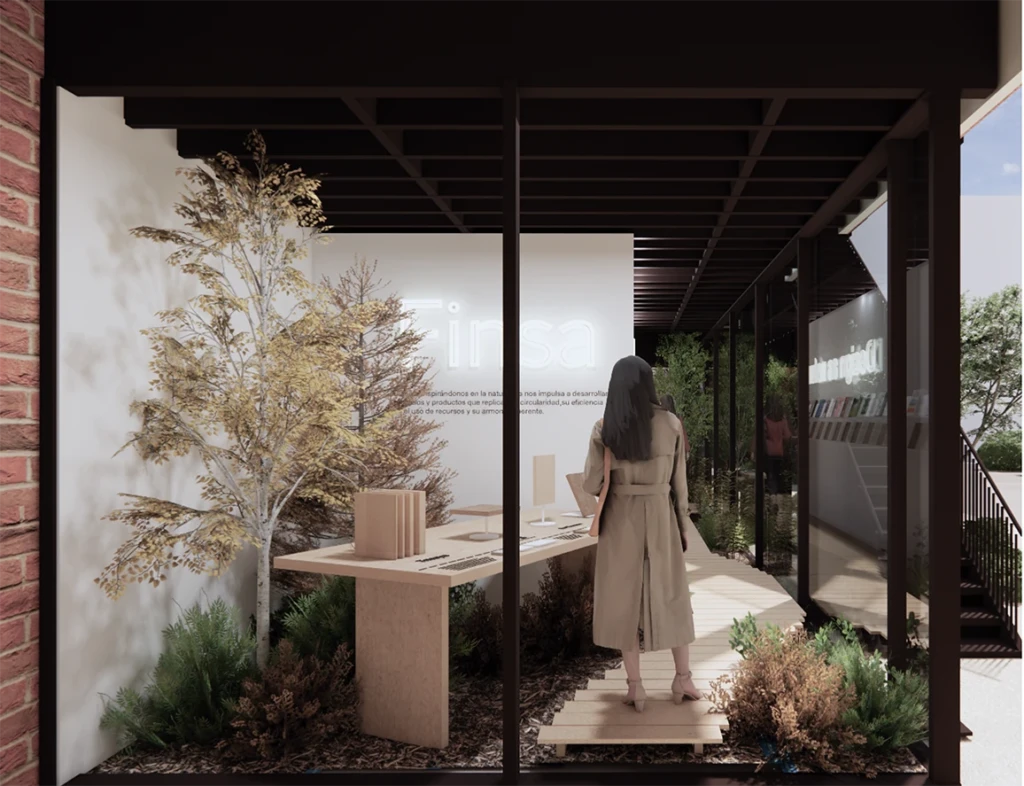
Together with Enorme Studio, you are responsible for the design of Baño de Bosque, Finsa’s space at the Madrid Design Festival 2026. How did you develop the project?
Enorme Studio, who are friends and colleagues, told me about this idea of making an ephemeral installation with Finsa products and using the concept of the book Walden, by Henry David Thoreau. They asked me, “How do we recreate a forest in Madrid?”, and I told them that landscape designers are always inspired by the ecosystems found in nature. We decided to embrace the concept of forest and undergrowth, where there is light filtered through the trees, and we thought of an excursion through Guadarrama or Gredos, through a humanised forest; that’s why a platform appears to create a forest path. We wanted to create an immersion, a bath in the native forest that could also represent a double immersion in the garden and in the book, two contexts in which time stands still. You enter while still being in the world, but at the same time, you are separate, or at least in another world.
Which project are you most proud of?
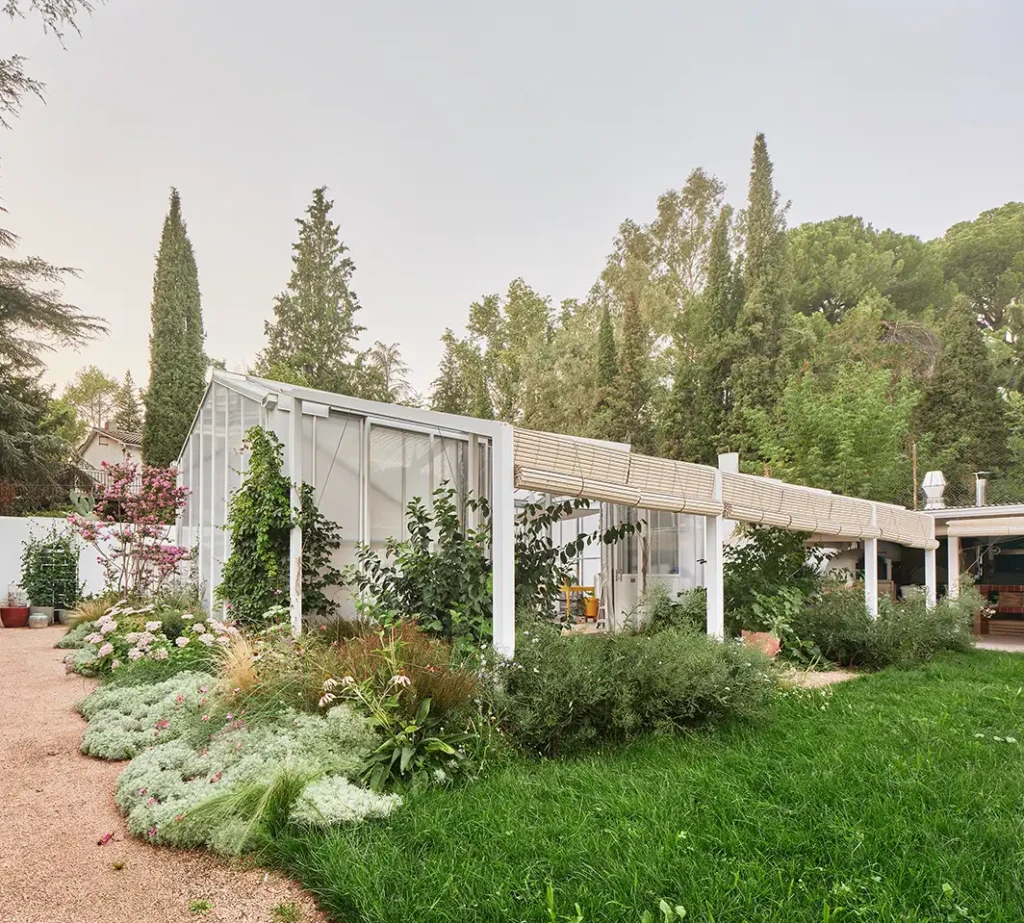
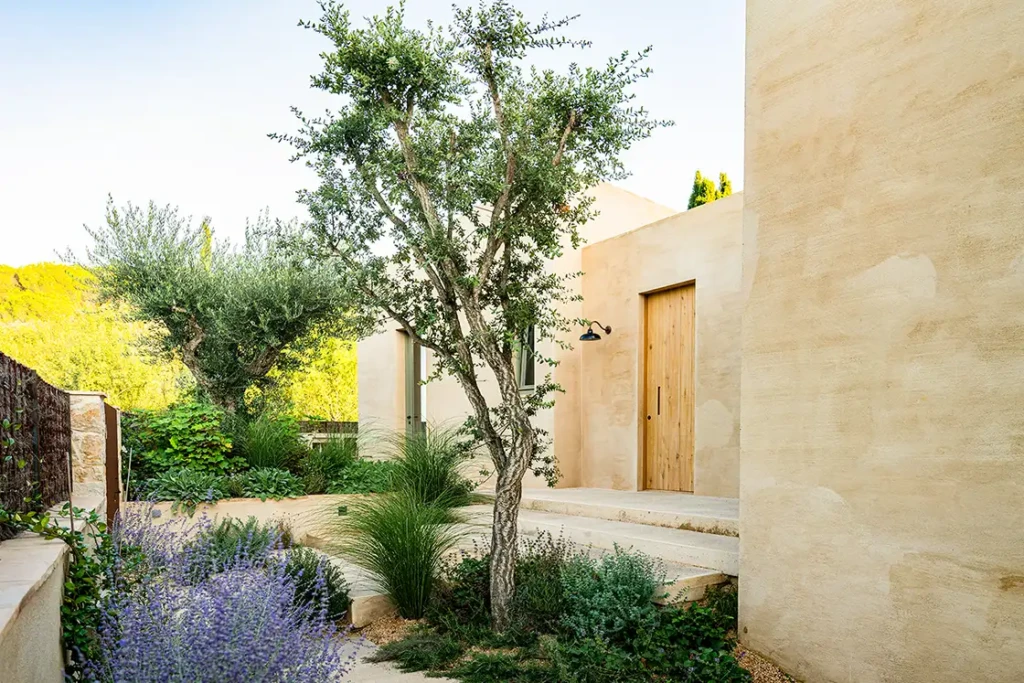
Today, I believe that one of the most beautiful gardens is located in the Catalan Baix Empordà, in Girona. It is one of those rare opportunities where the landscape architect can at least intervene in the entire context, in the entirety of the whole: paving, exterior woodwork, plantings… The context is also delightful. In the Empordà there is a great nobility of materials, something very harmonious. The clients gave us freedom and the result is a garden that has evolved very well. It has very photogenic, very special moments from late spring to early summer, even though it is a small-scale garden.
What is a good garden to you? What does it have to comply with?
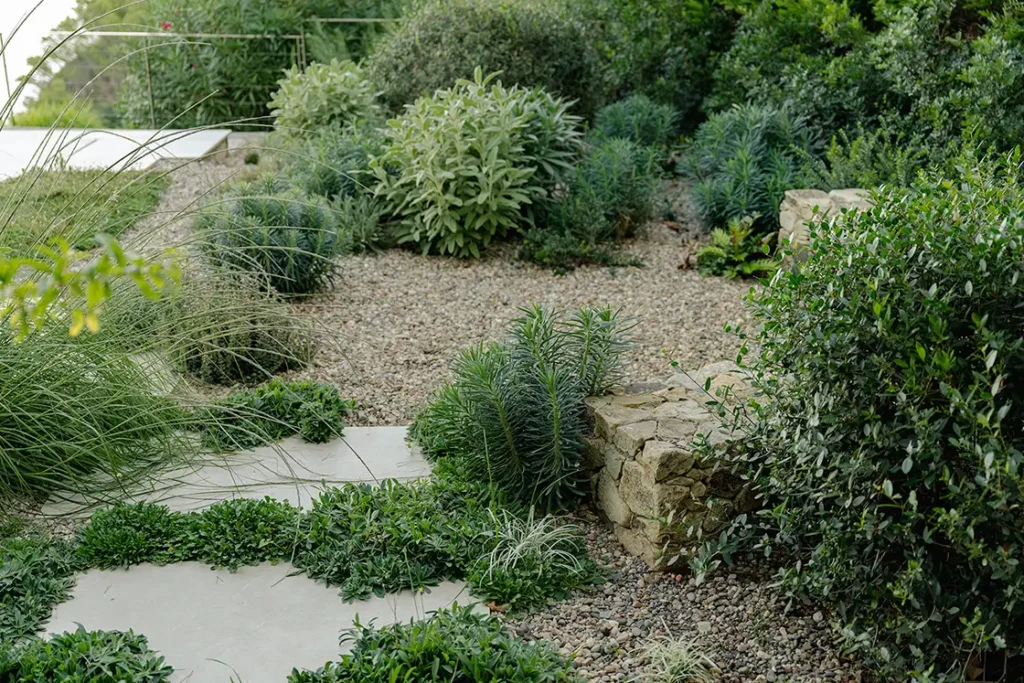
It has to be consistent with the environment, be well integrated. If the environment is good, fantastic, you respond to the environment and open it up and replicate it within. If the environment is bad, you shut yourself away in a separate world. It is always a response to the context. For me, a bad garden introduces elements that are not native to the place, that are an imposition on paper that then does not find a material, physical or spiritual response within the context.
What is a day in your life like as a landscape designer?
The good thing about landscape designers is that we alternate between days of intense study, very much on the computer, and then we are fortunate enough to also have creative and design work and the materialisation of all of this. It’s a huge change for those of us who previously didn’t dedicate ourselves to anything material or anything that is created, but rather everything moved on an abstract plane.
As landscape designers, a good part of what we do ends up being a physical reality that can be breathed, touched, and smelled. It’s incredibly lucky, because you know that all the work and all the hassles we get into end up having at least one magical moment: that visit after a year or two, when you enter the garden in May, there has been good maintenance and you say: “all this now exists, it can be enjoyed”.