Three countries, three artists and one goal: to explore new narratives about the soil and its importance in contemporary societies. That is the essence of the artist residency Common Grounds, convened in early 2025, which is open to all and has no age or artistic branch restrictions. “The idea was to present different projects, especially those related to soil degradation”, explains Laura Carro, who is in charge of organising the public program and curating exhibitions for the RIA Foundation, the Galician entity that is a partner in the project along with La Citadelle de Marseille (France) and Gradoscope (Bulgaria).
The selected artists were the painter and landscape artist Virgile Haëck, the illustrator and editor Andrea Popyordanova, and the sculptor Mar Ramón Soriano. In the summer of 2025, they began the experience with a stay in Marseille. The second stop was Galicia, where they spent two months (from October to December) developing their respective projects and, through the Foundation, contacting the local community and networking with other cultural and academic institutions. “We wanted to introduce the artists and allow them to learn more about the territory, to make a connection with the community”, Carro says.
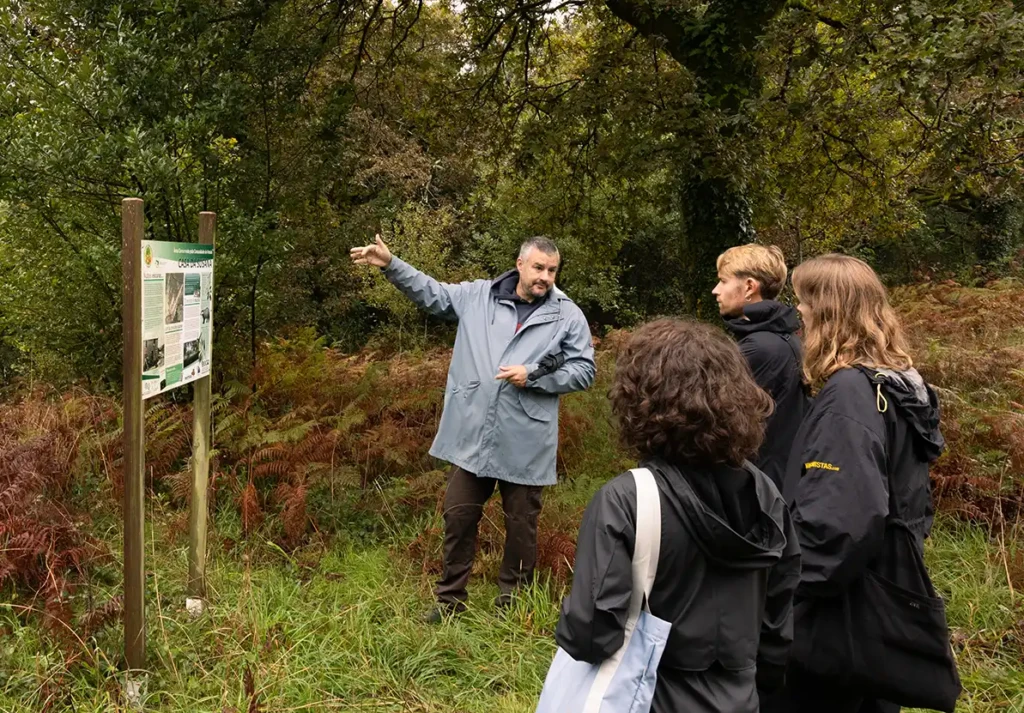
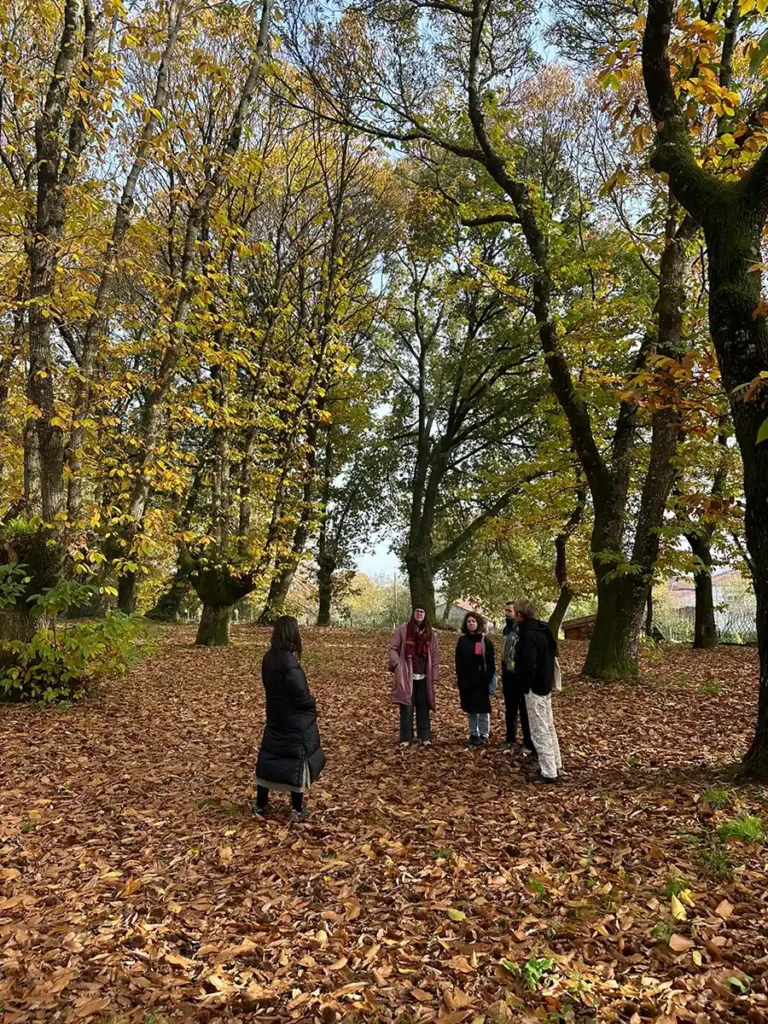
The core around which the artistic production of the residents in this Galician stage revolved was Froxán, in Lousame, a territory marked by pollution derived from the old mines of San Finx, as well as by the environmental restoration work that the local community has been promoting for years. There, they learned about the mountains and the soil conditions; in addition, they participated in other activities, such as visits to the EASD Mestre Mateo, the FMJJ Art Centre, the Cerámicas do Castro factory and the laboratory of the Uxafores research group, on the Campus Terra of the USC.
The three projects, in their own words
What were the results of this Galician part of Common Grounds? Carro explains that, since they were three very different artists, their projects were also very different. The result of these two months of research and work in Galicia on the contaminated soils of Froxán could be seen in a day organised at Casa RIA on December 11, 2025, with presentations by the artists, the exhibition of a selection of works in Sala RIA and a small culinary experience that they prepared in collaboration with A Cantina. “They also collaborated a lot among themselves, there were no restrictions of any kind”, says Laura Carro, citing as an example precisely that “culinary performance with local products”.
Here’s what they had to say about their respective projects:
Virgile Haeck
The French landscape artist and painter, who also has a background in urban planning, explores in his current project at Common Grounds “the role of soils in contemporary societies, with a special emphasis on their care”. The artist explains that he approaches soils “not only as a design material, but also as living environments: spaces of memory, vulnerability, and regeneration”. Using drawing, painting, text, and mapping techniques, he develops “exploratory representations that function as hypotheses to reveal the inner life and temporal depth of landscapes”. His work in Galicia was highly pictorial, focusing on nature, trees, mountains, and lush vegetation.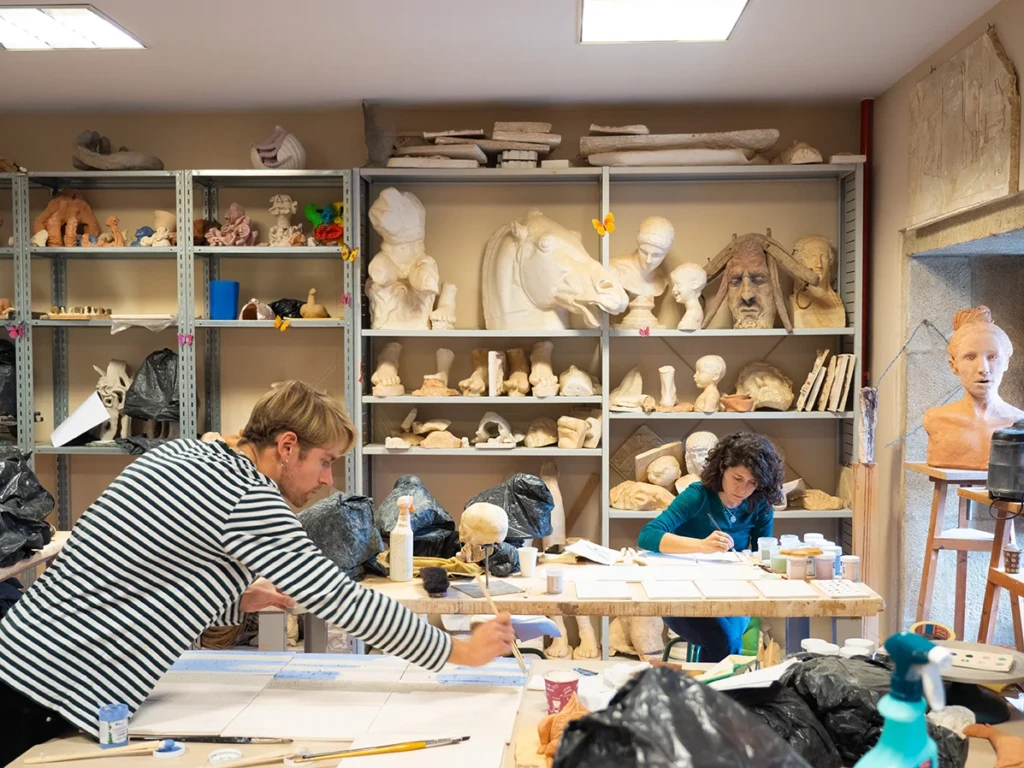
Andrea Popyordanova
The Bulgarian artist’s way of working is often closely linked to a specific place, a territory, “gathering visual fragments or stories about a specific site”, and, while she frequently opts for figurative works, she is also interested in how she can incorporate the territory into matter without representing it. “My project for Common Grounds is about the tension between the local and the endemic and the narratives surrounding species”, she explains.
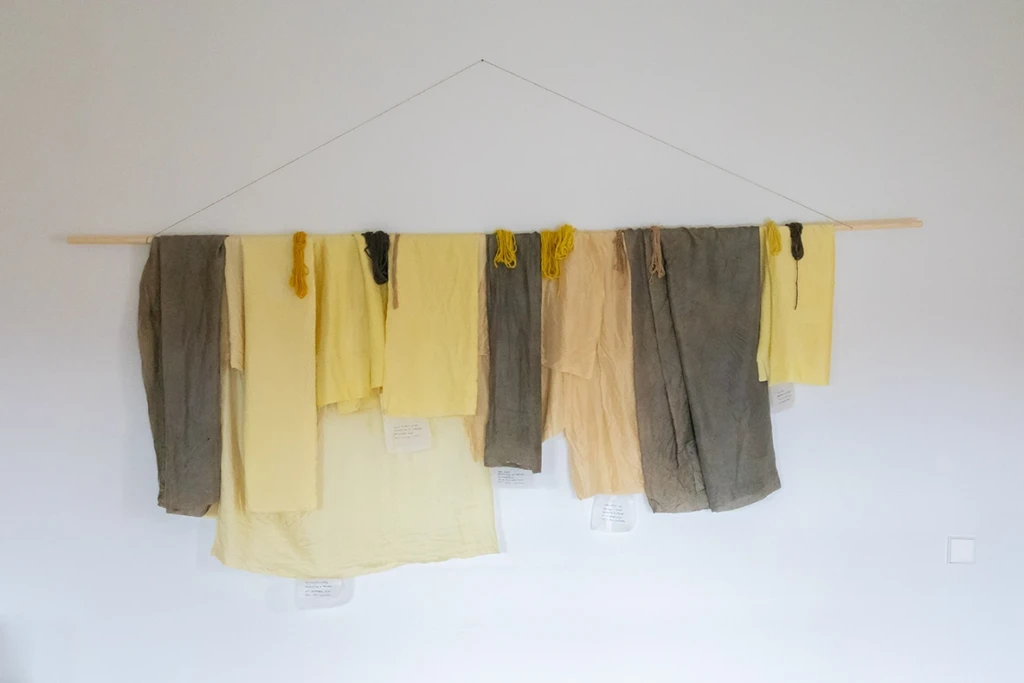
She explored this tension through drawing, textile dyeing, and words (she will make a book with all of this). In Galicia specifically, the focus was on endemic species such as oak and chestnut, and on eucalyptus as an invasive species, “which carry stories about the history and present of this region”. One of the projects, as an example, involved making dyes with chestnut leaves, eucalyptus bark, and oak galls. “I used them to dye pieces of silk and wool yarn, which I then displayed on a wall as layers of colour”, she explains.
Mar Ramón Soriano
“The project I am working on, located in three locations, attempts to reflect on different gestures of cleaning, on a small and large scale, understanding cleaning in a broad spectrum that ranges from de-ucalyptus to the management of mining waste, passing through more domestic cleaning practices and reflection on the very idea of clean or polluted”, explains the Valencian artist, resident in Niñodaguia (Ourense). Thus, the processes she uses “focus on working with materials that are leftovers that humans abandon in the territory, as well as the traces and cracks they leave in it”.
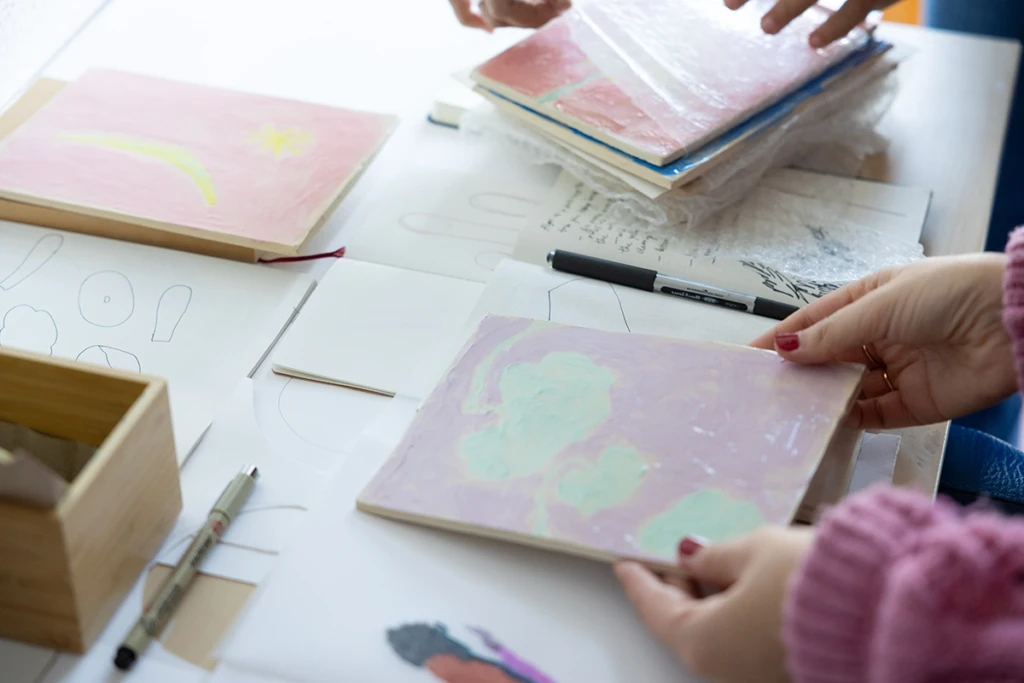
As for the part she carried out during her residency in Galicia, she focused on producing paper and working from the data provided by the researchers of Uxaforest in Lugo. “The specificity of this territory directs interest towards the ashes from forest fires and towards the metals present in the Froxán river (Lousame), subsequently absorbed by the native vegetation surrounding the San Finx mine. Both materials were used as dyeing agents in papers made from recycled paper”, she notes.
Interest in local forest communities
Beyond how this stay was or will be reflected in their respective works and projects, the two months spent in Galicia served the artists to get to know a region with which they were more or less familiar and to look for similarities and differences with respect to the territories they inhabit. Virgile Haeck, for example, found many parallels and shared challenges between the Galician eucalyptus trees and the pine plantations of southwest France, where he grew up. “Through fieldwork and participation in local eucalyptus removal brigades, I learned about the political history of these forests and the emerging practices of shared land management”, he says.
The collective and the community have an indisputable protagonist in Galician forest management, the communities of neighbouring forests, something that aroused the interest of the three participants. “I was very interested in her history and her present”, Andrea Popyordaneva confirms. “This middle ground between the hyper-individualistic private ownership of land that we are used to and public ownership, where people often feel disconnected from public space, was very intriguing to me. On a walk with a member of the Froxán community, I was also very impressed by what I learned and saw about the balance between animals, meadows, people, houses (villages) and the surrounding forest, as well as the fight against large companies that plant monocultures”, she elaborates.
For Mar Ramón Soriano, who lives in Galicia, the experience was also enlightening. “It was especially interesting to learn about the work of the intermunicipal associations and the forms of forest management in the region”. “Observing the traces left by the past in this autonomous community allowed me to understand how political and economic decisions affect multiple levels of daily life, and how interspecies relationships occupy a central place in the conversations and practices of the territory”, she recounts.
Common Grounds residency, a European initiative funded by the Creative Europe program and supported by the Carasso Foundation, continues in early 2026 with the three artists travelling to Bulgaria to finalise their projects.