
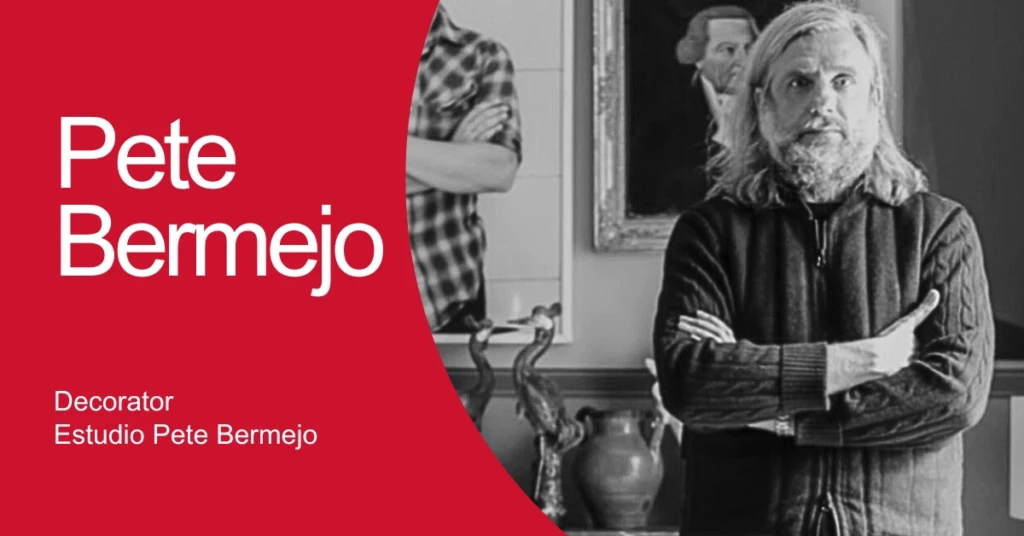
Interior designer Pete Bermejo likes mixing things up, colour, and above all, that the houses are lived in. In this CONNECTION WITH… we talk to him about how he started “by chance” to dedicate himself to interior styling, working for many magazines, how from there he made the leap to decoration and about his vision on materials, houses and trends.
You started as a decorating stylist, but you’ve been working as a decorator for years now. What was that whole journey like?
I came to the world of decoration completely by chance. My mother bought decorating magazines, but it wasn’t something I looked at either. I lived in Brussels for many years, and there were many small shops and many decorating magazines. And since I had to furnish and decorate my house, that’s when I really started looking at and following magazines, although I had no intention of dedicating myself to that.
When I returned to Spain, quite by chance, I began to reconnect with people who worked for or were directors of fashion magazines, in which they featured the homes of well-known people. One day, someone said to me, “Hey, do you know this person?” I said yes. “And have you been to his house?” How is?”. And they said she was pretty and asked me if I could take a picture of her to show them. That’s how I started, with houses of people I knew, I showed them to them, and they liked them. And I started saying, “Hey, I think we need to change the sofa here”. Because in most of the houses that are featured, you have to do a lot of styling and arrange the corners to look nice for the photo. I also started looking through the camera, and it was kind of intuitive. From then on, I started working a lot with AD Spain and other magazines. I completely changed my professional path.
What did you do before?
I was a lawyer, a facet that I think has helped me a lot. Since styling and decorating work is artistic, people always think I’m probably absent-minded, but I’m very organised. In these jobs, you must be very organised, because you have to keep track of many things: the material that has to arrive, the work, the upholsterer…
Ver esta publicación en Instagram
And how was the transition to interior design?
I believe that everyone has something creative inside them; we all decorate and dress ourselves, for example. There are people who, like me, may have a different view on how to combine colours, how to combine spaces or materials. We have further developed that part that is present in every individual. As a result of the interior design styling, people started calling me and saying, “Well, I have a house, come and see it”, and I would give them advice. That’s how I made the leap to interior designer.
Which parts of styling and decorating work would you say are most different?
I think the decorator has a fixed eye, while the stylist focuses a lot on corners, because the stylist’s eye is for the photo. You take a picture of the living room showing the whole room, but you also take a close-up, focusing on a corner. And I think I do that a lot in my decorations too; there are many corners that look like a setup to be photographed, because I pay a lot of attention to the overall picture and also to the specific details. I’m putting together still lifes in the room: here a painting, and here a sculpture or here a table, and here some books. In my view, the decorator has a global vision, and the stylist, a partial one. Although this is not exact, neither a philosophy nor a theory.
Is there anything you always do at the beginning, when starting a new decorating project?
I always, always, always arrange to meet with the client to go and see the house, because the most important thing is to talk to him. Maybe he tells you he wants a Swedish style, but what is that? I ask them to show me photos. Or I also show them some of my unpublished work so they can tell me what they like, to guide me a little in the style they want, although if they call me, it’s because they already know something about my work.
Before starting, I also try to make it clear what work they want to do, for example, changing the floor. I give advice, but I never impose. Then we look at the materials, the box, and from the box, you start with the decoration. It’s also very important to start with the materials because, depending on what you choose, there are delivery times. People think it can be done in a month, but it depends on the square footage and what will be installed. That’s why I always start with a talk.
Ver esta publicación en Instagram
What would you say is your style, that thing that those clients who then come to you see?
I like homes that are lived in, that have a sense of life, but I also try to make sure the client is happy in their home. I also really like antiques, portraits… but sometimes, let’s say, I combine a portrait with a contemporary figure. The house shouldn’t be too classic, but not too designer either. Now, if the client requests a design, I will provide a design. But there’s always a part of me that remains there.
I also really like popular materials, leather chairs, ceramics, Manises lamps, the mix. I place great importance on textiles, which envelop and warm the house: curtains, a rug, a sofa… I really like mixing materials and textiles: I love leopard print or suddenly adding a Chinese screen to something very white. Something that catches your eye, very theatrical.
How has your style evolved over time?
Perhaps I’m less theatrical because it’s not so fashionable now, although I predict that houses will be lived in again. I don’t like the word “trend”, but now all houses look like they’re mass-produced. Everything white, everything light wood… I miss the personality of the person who lives there. I like spaces that feel cosy. In time, those houses will become more ornate and decorated again.
You don’t like the word trend… what is your relationship with them? Are they inevitable?
The trends are there. In both fashion and decoration, in the end, it catches your eye because it’s there all the time. In decoration, they move a little slower because you can’t change the sofa every two days, but in the end, you live with them, and from seeing so much Campaspero flooring, people want Campaspero flooring, or from seeing so many kitchens with the white marble island, people want that. But I try to say, “Let’s bring this kitchen to life, let’s add some colour, because it’s all white…”.
Ver esta publicación en Instagram
How do you incorporate sustainability into your decorations?
For me, there is nothing more sustainable than an antique piece of furniture.
Do you return to the houses you’ve decorated some time later to see how they’ve changed once they’ve been lived in?
Yes, and I love it. I love being able to say, “You’ve made it your own”. I usually give it to them with everything, and they ask me, for example, “Can I put up this wedding photo or one of my grandfather?” I always say, “Put it up, it’s your house”. Or that sculpture they bought with their parents on a trip. That thing you love so much, that you’re going to live with it, put it in. But they respect my house a lot; they don’t usually change it. They bring in some personal items, but they don’t change my sofa.
Is there a project you’re particularly proud of?
Everyone, everyone, everyone. Because everything has been experienced with the soul, with a customer’s story behind it. I like them all because they all show a lot of love from both the owner and me.
Which interiors by other decorators have inspired you?
I have always been very inspired by the fantastic decorating magazines that existed years ago and that are no longer printed. I’ve been very inspired by travelling, which is why I think I like the mix so much. And I’ve been inspired by books and films from the 50s, 60s, 70s, or even the 30s. I love them.
As for specific houses, the house of Yves-Saint Laurent or the house of Coco Chanel or any house by Jaime Parladé. I also like all these houses in Maine or the Hamptons, but not the rich ones, the wooden ones, with painted floors, old, like they’re used. Or English houses, all English country houses. One so tiny that you have the old rug, a wooden floor and the dog on the sofa, because that’s how I am, I have a dog and I have him on the sofa.
What’s a typical day like for you?
A bit like a 24-hour pharmacy. The workers start at 9, but they arrive at the construction site at 8, and they’re already calling when I’m taking the dog out. There are always five thousand problems, but I say that in a positive way. A project is complicated, so there are a thousand things. Then at 9:30 I try to answer the email and focus a bit, and when the shops open at 10:30-11:00, I go to see them. At lunchtime, the upholsterer might stop and call me, and in the afternoon, I continue with a tour of the store or thinking about ideas or doing some administrative work. And then the client might call you at 8 or 9 pm, but at 9:30 pm, I say, “Please, no more calls”.
Ver esta publicación en Instagram
And finally, what would you say is the most important aspect of a decorator’s job?
For me, it is always very important to have a good relationship with the client. The customer should be able to let go and trust you, but also be able to add something if they like it. And I don’t just think about it being pretty, about how the photo will look, but about how you live, how you like it, and I also give a lot of importance to the details and above all to bringing each room to life.