Skyscrapers, modular hotels, and social housing are now a reality that can be built from wood. The responsibility for this revolution lies with cross-laminated timber (CLT), also known as cross-laminated wood. A technology that makes it possible to manufacture strong, stable, and surprisingly lightweight panels that can compete with steel beams. With CLT, high-rise buildings, prefabricated modules, and structures can be built much more quickly and cleanly.
However, the challenges are real: outdated regulatory frameworks, a cultural distrust of wood’s durability, and even higher initial costs. Therefore, every work that dares to use this material becomes a true marvel. “Just ten years ago, finding new wooden buildings in Spain was almost a rarity. Today, the situation is different, with very interesting examples in the Basque Country, Navarre, and Catalonia, as well as growing interest in Madrid. The arrival of CLT and the greater awareness of more efficient building have paved the way”, recalls María Sánchez Ontín, an architect and trainer specialising in efficient wood design at Cambium Estudio.
Global milestones in wood construction
The most high-profile example in recent months has been the announcement of the “world’s largest wooden building”, reported by Dezeen. This is the Grand Ring, designed by Sou Fujimoto for Expo 2025 in Osaka, Japan. A structure that reminds us that innovation is no longer anecdotal but is entering the realm of records.
Ver esta publicación en Instagram
The race to reinvent wood, however, is not limited to Japan. In Norway, the Mjøstårnet It shows that it is possible to design an 18-story, 85-meter building in wood. Its silhouette in Brumunddal, next to a lake surrounded by forests, seemed almost a poetic wink: to build a wooden skyscraper on the site where it is produced.
Ver esta publicación en Instagram
Shortly after, in the United States, Milwaukee’s Ascent raised the bar even further: 25 stories, 87 meters, and a profile that demonstrates that CLT can also work in the North American urban context, with its extreme climate and tradition of tall skyscrapers.
Spain: the first steps in wood construction
Spain, further behind, is beginning to contribute its own milestones. And this is where some of the most unique projects of recent years come into play.
Illa Glòries project, by Cierto Estudio, demonstrates that wood is not reserved for Nordic luxuries. These are 51 social housing units built with CLT Xilonor, organised around common spaces that encourage community life.
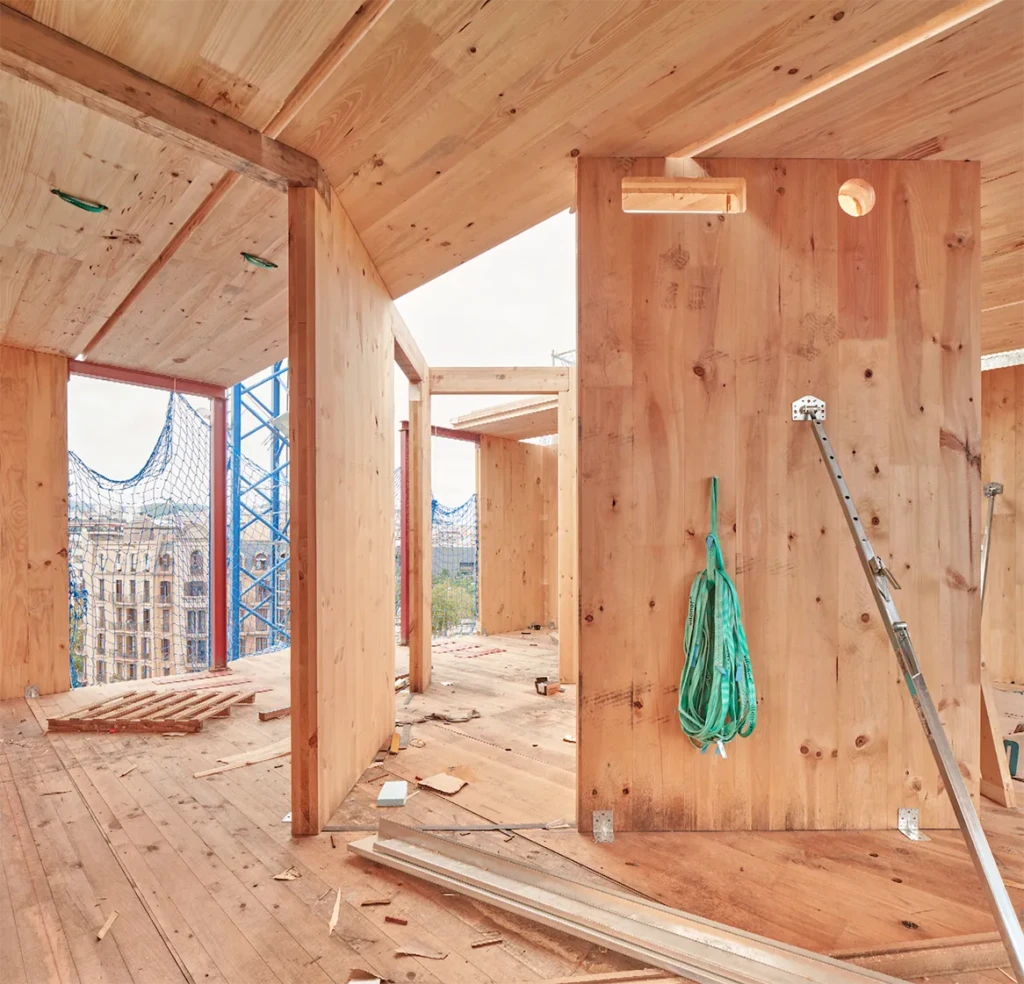
The building not only challenges prejudices (“wood for social housing in the heart of Eixample?”), but it also proposes a more sustainable and humane urban model. With a sober yet warm architecture, bright interiors, and finishes that avoid the coldness of concrete. Illa Glòries thus becomes a manifesto: wood can also be a city.
In Madrid, the Pirita Building, promoted by Distrito Natural and designed by sAtt Arquitectura, is another pioneering example. It was created under the ecological cohousing model, where residents share not only common spaces but also a collective commitment to sustainability.
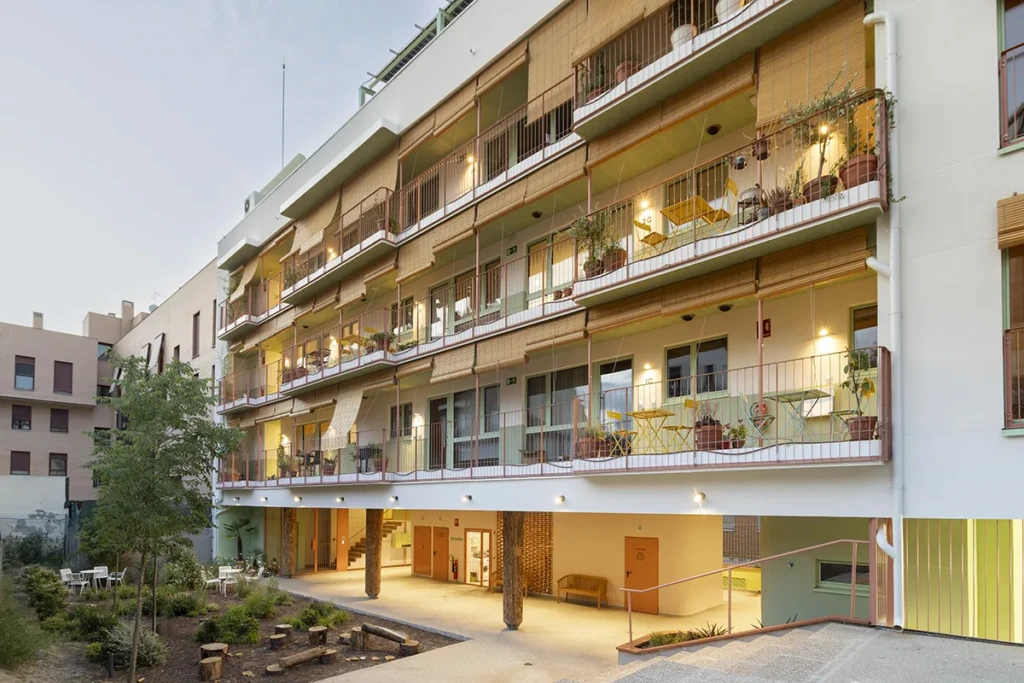
“Building with cross-laminated timber poses logistical challenges, but it offers speed, lightness, and CO₂ capture, which fits with a vision of comprehensive sustainability”, says Eduardo Ocaña, communications manager at sAtt Triple Balance and Distrito Natural. He adds that “this, combined with the use of BIM and Lean methodologies, improved coordination and prevented errors, making the most of the industrialisation of the construction process”.
The economic context didn’t make things easy either: “Inflation and the energy crisis caused by the war in Ukraine forced us to optimise costs without sacrificing overall sustainability or the Passivhaus standard. The project demonstrated that an efficient building that generates its own energy is much more autonomous and secure in times of volatility”, Ocaña added.
The community dimension was also key. “The participation of the future neighbourhood in the design and decision-making strengthens the project from the start”, says Eduardo. And he emphasises that material sustainability and collaborative living “reinforce each other: CLT reduces the ecological footprint, and shared living multiplies these benefits”.
Recognition of the model has not been long in coming. Pirita has received, among others, the 2024 Saint-Gobain Sustainability Award, something that for Ocaña and his team represents “a validation of the cooperative and ecological model, and a boost for more institutions and families to trust this type of project”.

According to Sánchez Ontín, these challenges are compounded by cultural rather than technical barriers: “Working with wood is like swimming against the current. Many prejudices persist about their resistance, durability, and fire behaviour. And it hardly appears in architectural curricula, which makes it difficult for professionals to feel comfortable designing with it”.
Another project that is paving the way in Spain is the Tomás Bretón building in Arganzuela (Madrid), developed using the Woodea construction system. For Pablo Medina di Fiori, COO and co-founder of the company, the greatest difficulty was not technical, but cultural: “At first, we had to ‘evangelise’ the development, technical, and industrial sectors that engineered wood does work. The sector is very conservative, and any innovation generates reluctance”.
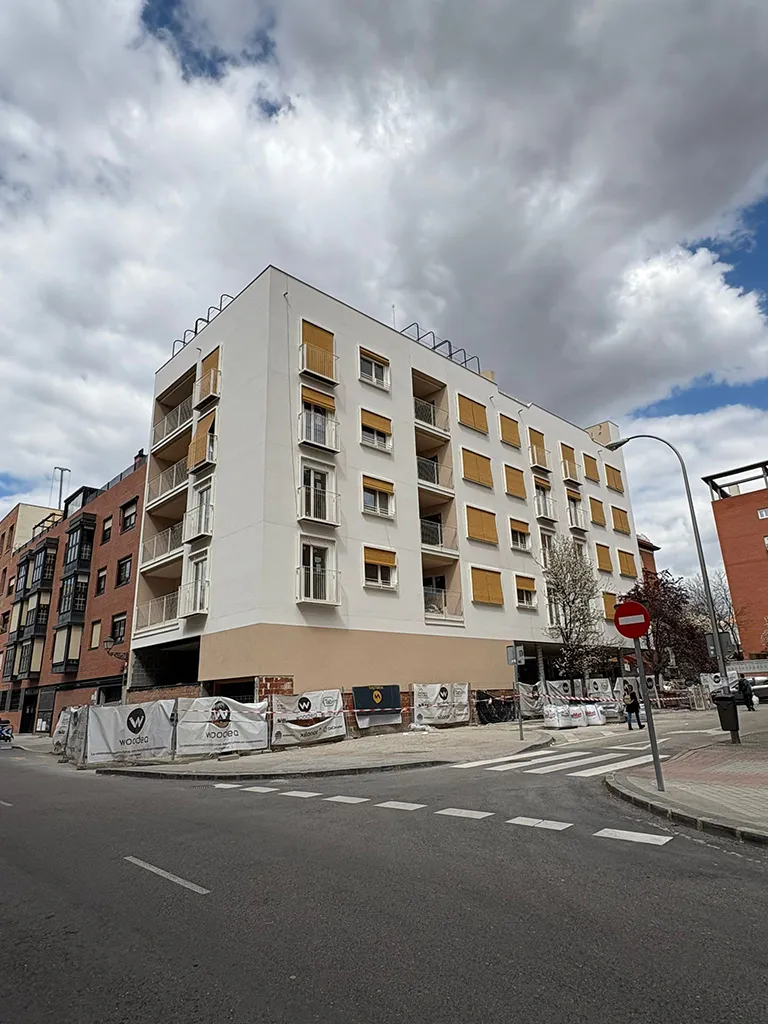
The project was also a test of industrialisation: the CLT panels arrived cut to the millimetre and numbered to fit precisely on site. “At Tomás Bretón, we set up a complete plant in just seven to ten business days. We went from improvising on-site to solving everything in the digital model, and the result was a quick, clean, and safe installation”, he explains.
Far from the clichés, fire safety and durability have not been a hindrance either. “Solid wood burns slowly and predictably, allowing us to accurately calculate evacuation times. And, with encapsulation strategies and design for durability—keeping the wood dry, ventilated, and protected from the elements—it fully complies with regulations”, he notes.
Although many people might think that fire is the greatest challenge, Medina clarifies: “Where we’ve had to innovate the most is in acoustics. We’ve put a lot of effort into composite floors, acoustic panels, and suspended ceilings to ensure comfort equivalent to, or even superior to, that of traditional structures”.
In parallel, Madreselva (Burjassot, Valencia) -promoted by Zubi Cities- explores wood in a different context: the province’s first high-rise residential development with a build-to-rent model and a strong community component. “Madreselva is showing us how wood integrates wonderfully with concepts of biophilia and coexistence. “It’s a building with urban gardens, vertical gardens, and common areas, designed for a more sustainable way of living”, he emphasises.
The lessons learned from both projects are clear: “At Tomás Bretón, we confirmed that we can match costs with traditional construction and reduce times by almost half. And at Madreselva we have seen how wood also adapts to Mediterranean climates and new ways of living”, he summarises.
The vision for the future is to consolidate a Design & Build model under a product platform. “We say that we don’t budget a design, but rather we design a budget. Our first project using this methodology is PINEA, in Valencia. It’s about moving from single prototypes to standardised component platforms, like those in the automotive industry: greater speed, fewer errors, and competitive costs. It is the path for wood construction to function as a truly modern industry”, he explains.
A future in wood conjugated in the present
The cases are still few, but their impact is greater than that of dozens of conventional promotions. Each one functions as a laboratory and a showcase: wood can be competitive in height, it can comply with fire regulations, it can accommodate social housing. Outside our borders, the numbers speak for themselves: the wood construction market is growing at double digits in Europe and North America. In Spain, although the curve is slower, initiatives such as Illa Glòries, Pirita, Tomás Bretón, Madreselva or Impulso Verde point the way toward a path that will soon cease to be the exception.
Beyond each specific project, the trends are clear. For Pablo Medina di Fiori of Woodea, the biggest obstacle remains cultural: “The construction sector has been educated around reinforced concrete for 100 years. Breaking that inertia is difficult, but every wood project serves to demonstrate that it is viable and safe”. This inertia has the support of Europe, which has already set a timeline that will require measuring and reducing emissions in buildings. “In 2026, calculating the carbon footprint of buildings will be mandatory; in 2028, public buildings will have to be carbon neutral; in 2030, all new buildings will have to be carbon neutral. Wood has an advantage because it is a natural store of CO₂”, adds Pablo Medina.
For María Sánchez Ontín, the next step is clear: “We need more outreach so that technical experts and the public can see what wood can achieve, and more training so that each project is well-built from the ground up. “A spectacular building is of no use if it fails in the basic details”.
Perhaps in a few decades, when strolling through a neighbourhood of wooden houses is commonplace, beyond the headlines about their uniqueness, these projects will be remembered as true marvels.