The kitchen no longer wants to look like a kitchen. Or at least not in the traditional sense, understood as a technical space, separate and recognisable by its functional codes. What we saw at EuroCucina 2026 confirms that the kitchen is becoming a hybrid space, capable of functioning as a living room, domestic gallery, work area, social space and, when necessary, a culinary laboratory.
The edition has been marked by a contained, almost silent evolution, where innovation appears in the coordination of materials, thicknesses, interiors, lighting and the strategic disappearance of appliances. In contrast to the show-kitchen, there is a more tactile, continuous, equipped and deeply domestic kitchen. We delve into the five trends that define this space.
1. Material Design: when the material drives the project
The first major trend is the shift from kitchen design understood as composition to kitchen design understood as a material system. Colour, texture and finish are the starting point. Hence, the power of Material Design and colour blocking: fronts, worktops, stones, interiors, faucets and profiles are coordinated to build compact visual blocks.
Next125, Poliform, Snaidero or Veneta Cucine have worked on this idea from a sober high range, where luxury is measured by continuity. Beige is establishing itself as the new white: shades like light cashmere, almond beige or pearl beige provide warmth without saturating. Alongside them, cocoa and mocha function as an organic alternative to black, more enveloping and less emphatic.
Ver esta publicación en Instagram
But black is also making a comeback. It does so in dark stones, open-pore stained woods, faucets, appliances and coordinated profiles. It’s not the glossy black of theatrical kitchens; it’s a more technical, matte, and architectural black. Berloni Cucine, GF Interiors or Scavolini use it to reinforce that block idea, while brands like Miele explore metallic beige finishes that allow the integration of appliances without breaking the harmony.
Ver esta publicación en Instagram
In parallel, accents of orange, red, and terracotta appear. They do not dominate the scene, but they introduce chromatic tension in interiors, details or specific modules. Stosa Cucine, Scavolini, and Snaidero incorporate them as small warm interruptions in a mostly neutral palette.
Ver esta publicación en Instagram
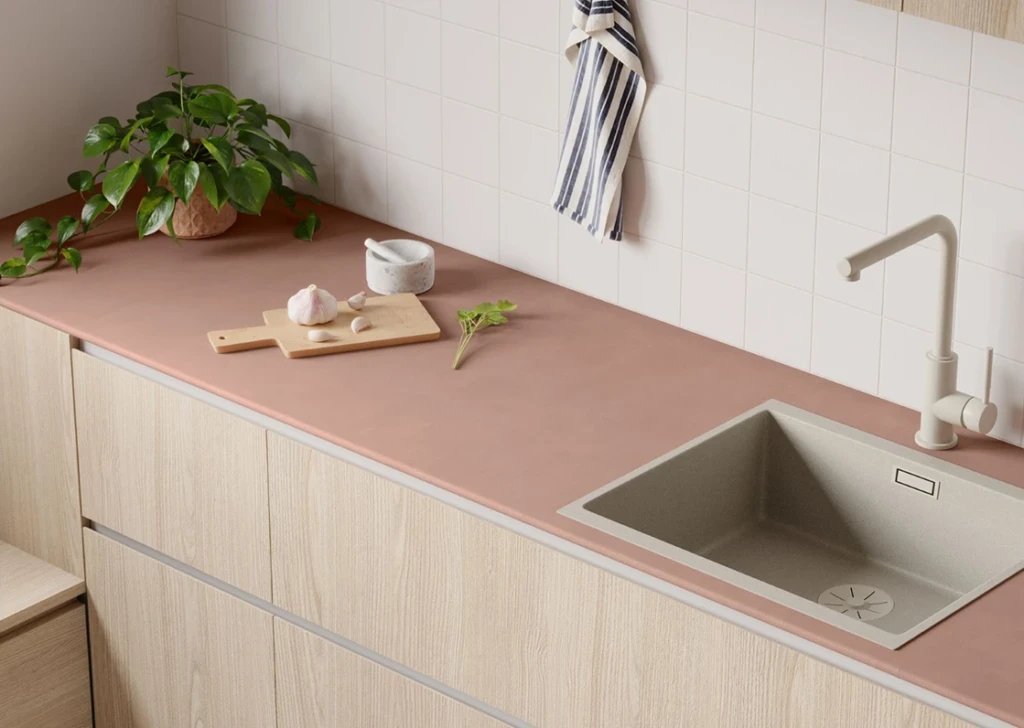
In this context, proposals such as Fintop Xtrim by Finsa find a natural reading of continuity in extra-thin worktops and coordinating surfaces that allow working the total look between horizontal plane, fronts and splashbacks.
2. The friendly kitchen: curves, thin frames and tactile surfaces
The second trend has to do with form, and that is that the cuisine is becoming softer. The islands and peninsulas adopt rounded corners; the edges become gentler; the tall modules lose their harshness; and the Shaker-inspired door is updated by very thin, almost graphic frames.
Manufacturers such as Häcker, Nobilia, Schüller, Stosa Cucine or Snaidero showcase a kitchen that appears simple, yet is technically very precise. The facades reduce thicknesses -from 22 mm to 19, 16 mm or even less- to gain visual lightness and rationalise the use of resources.
Sieh dir diesen Beitrag auf Instagram an
The finishes also point towards a more sensory experience. Matte finish continues to dominate in solid colours, metals, and fine woods. The powder coating effect, common in household appliances and profiles, is starting to be applied to facades due to its resistant and pleasant-to-the-touch microgranules. Bosch, Very Simple Kitchen or Veneta Cucine serve as references in this transition towards more technical, but less cold surfaces.
Ver esta publicación en Instagram
Also gaining prominence are grooved patterns, synchronised textures, and braids that evoke natural fibres, rattan, or herringbone, and that soothe the need to recover the sense of touch. In an increasingly integrated and technological environment, the surface becomes the place where the kitchen regains its humanity.
3. Invisible technology: AI, vapour, and structural light
Kitchen technology in 2026 is silent. What we saw at FTK -Technology For the Kitchen- points to a clear direction: more efficient appliances, AI-assisted functions, and professional systems adapted for home use.
LG, SKS, Bosch, Miele or Smeg represent different layers of this evolution. AI is applied to optimising consumption and managing functions, as well as to a more intuitive user experience. The goal is to reduce friction, cook better, consume less, and anticipate needs.
Ver esta publicación en Instagram
The concept of a home chef sums up this aspiration well. Professional-inspired steam cooking systems are available in integrated formats, designed for homes where everyday cooking coexists with a more demanding gastronomic culture.
Lighting deserves its own chapter. It is no longer a later addition or an atmospheric resource. It is integrated into plinths, profiles, golas, drawers and shelves using opening sensors, temperature regulation and digital control. In proposals from Stosa Cucine or Next125, light becomes an invisible infrastructure: it helps to work, visually organises, and transforms the kitchen when the more technical function is turned off.
Ver esta publicación en Instagram
4. Beyond the kitchen: the end of domestic boundaries
The contemporary kitchen extends into the rest of the house. Under concepts such as Beyond the kitchen or Kitchen, Bath & Beyond, brands such as Dica, Scavolini, Stosa Cucine, Nobilia or Veneta Cucine propose a common language for kitchen, living room, bathroom, hall and wardrobes.
Ver esta publicación en Instagram
The key element in this transition is the equipped wall. The old parapet becomes a modular system of panels that can cover the wall from floor to ceiling, conceal hardware, and allow the incorporation of shelves, display cases, or movable accessories. This solution reduces the presence of tall modules and makes it easier for the kitchen to communicate with the living room without looking like a service space.
Ver esta publicación en Instagram
The solidified effect also appears: upper drawers aligned with the worktop, concealed storage, very marked horizontal lines and furniture that is perceived as a sculpted block. The kitchen stops adding pieces and starts building interior architecture.
Ver esta publicación en Instagram
When the same material logic can be applied from the worktop to the front, from the splashback to the living room furniture, or from the bathroom to the wardrobe, the home gains coherence without losing nuances.
5. More capacity, better interiors
The latest trend is inside. Literally. EuroCucina 2026 confirms that the interior of the furniture is taking centre stage. Manufacturers pay as much attention to colours, textures, hinges, profiles, lighting, and storage solutions as they do to the fronts.
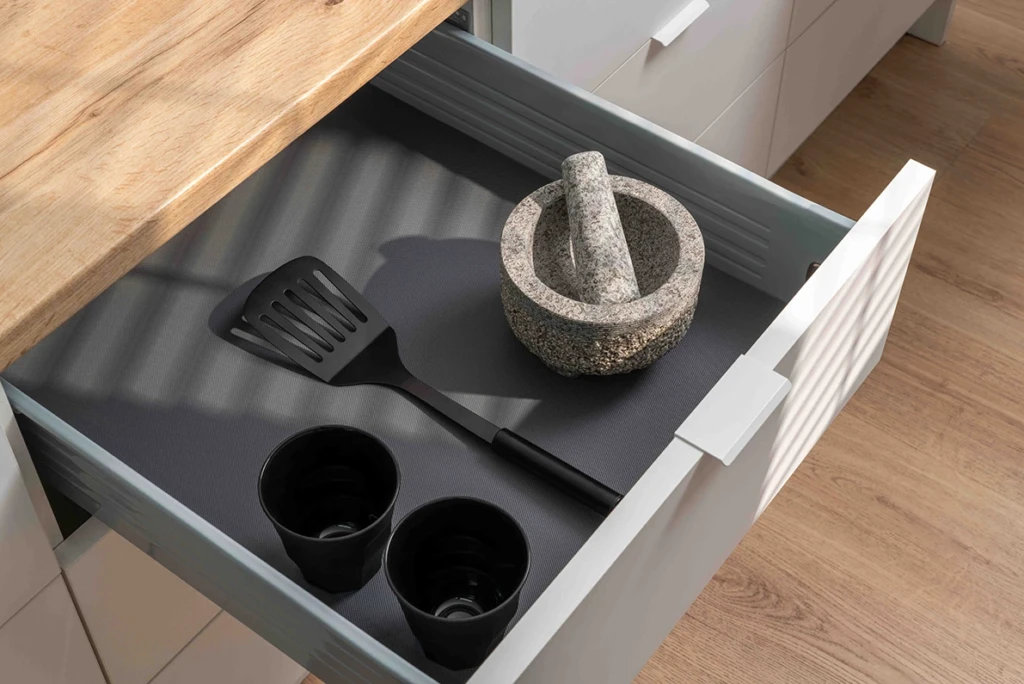
Nolte, Häcker, Stosa Cucine or Snaidero showcase interiors that abandon generic grey to incorporate beiges, oaks, textiles or metallics. Hinges are simplified, shelf profiles are coordinated, and lighting is integrated to improve everyday use. Opening a drawer should no longer break the aesthetic promise of the kitchen.
Ver esta publicación en Instagram
Large-format storage is also growing. Built-in refrigerators reach widths of up to 750 mm, offering more capacity without sacrificing integration. Dishwashers, washing machines and refrigerators are panelled or given decorative finishes to blend into the overall design.
Ver esta publicación en Instagram
Taken together, the five trends point to the same idea: the kitchen of 2026 will be less iconic and more systemic, more attentive to continuity, touch, use and coexistence with the rest of the home. A kitchen that seeks to be part of a more fluid, precise and habitable interior architecture.