In contrast to the device that vibrates, lights up and demands constant attention, silent technology relinquishes its central role in the experience. As an example, we bring you these three proposals that explore a different relationship with digital technology: one filters out the urgent, another introduces physical friction against the automatic gesture of scrolling, and the third reduces the visual presence of the gadget to almost dilute it. Three different strategies for the same intuition, because in a culture saturated with signals, connecting less can also be a way to design better.
SPKTRL: the ring that wants to filter digital noise without sacrificing luxury
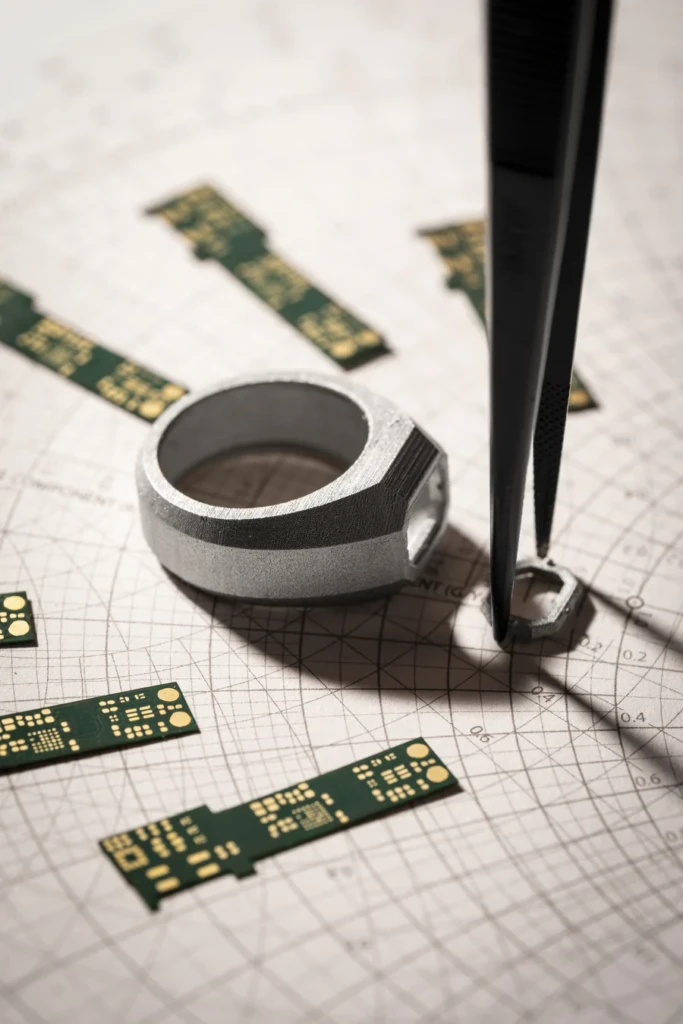
The French start-up Spktrl proposes one of the most sophisticated versions of this idea, with a ring connected to the smartphone that does without a screen and translates only what is important into light signals. Its artificial diamond lights up in colour when relevant messages or calls arrive, while an AI system learns over time what to interrupt and what not to.
The object’s interest lies in its cultural approach, reducing notification to a minimal, elegant, and almost intimate gesture. Technology thus ceases to impose itself as an invasive interface and becomes a discreet layer that accompanies without colonising attention.
Pinky Promise: the jewel that makes the automatic gesture of looking at your mobile phone uncomfortable
While Spktrl opts for algorithmic subtlety, Pinky Promise resorts to a much more physical strategy. Developed by UScellular in collaboration with designer Luna De Smet, this steel ring is placed on the pinky finger, right where the phone usually rests, and incorporates small internal protrusions that make it uncomfortable to hold for too long. It needs no battery, app or connection, and it works as a material reminder, discreet but direct, that design can often help us set limits.
Its value lies precisely in that renunciation of technological sophistication. Instead of promising intelligent time management, it introduces minimal resistance into the body and brings awareness back to an almost reflexive habit.
Ver esta publicación en Instagram
Beats x Kim: when technology doesn’t seek to stand out, but to disappear from sight
The third case operates on a different level, although it shares the same underlying logic. The collaboration between Beats and Kim Kardashian brought the Fit Pro headphones to a skin-tone palette designed to reduce their visual presence and make the device blend more naturally into the body and clothing. This desire for aesthetic discretion is complemented by a sound experience based on environmental control, with features that help modulate how much outside noise we let in.
Here, silent technology takes a backseat; think of the object as an extension of the user, not as a piece that demands attention on its own.
Viewed from the perspective of architecture and interior design, these three solutions are suggestive because they transfer to the technological object a common concern of the spatial project: how to reduce sensory friction without sacrificing functionality.
Just as a well-designed interior uses acoustics, light, textures, and materials to reduce cognitive fatigue, these devices explore more humane ways of relating to the environment and the body. At that intersection of perception, comfort, and use, an increasingly relevant idea for contemporary living emerges: the most advanced design does not multiply stimuli; it knows how to order them, filter them, and give them just the right intensity. In spaces as well, luxury is beginning to resemble less exuberance and more that difficult-to-measure quality that makes everything work without making a sound.