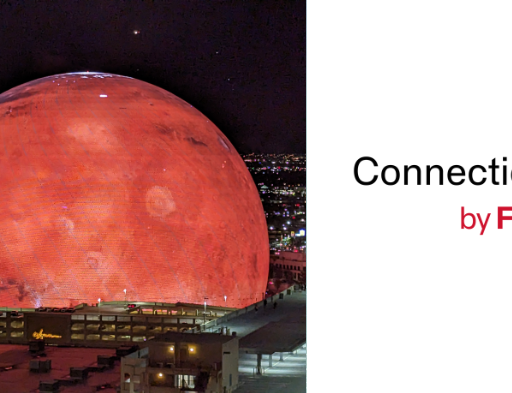
A brick doesn’t have to be just a brick. Architecture has demonstrated through all its aspects that the buildings we live in, work in, or visit can do much more: from provoking emotions to redefining spaces. This is the case, for example, of dream architecture, which transcends material logic to approach the universe of dreams. Its objective is not simply to house bodies, but to activate the senses.
The origins of dream architecture
Although often confused with surrealism, dream architecture has its own identity. Surrealism, which emerged in the 1920s, is an ideological and artistic movement that seeks to provoke and liberate the individual from rational logic, using the absurd, the disturbing, and the symbolic. Dream architecture, on the other hand, does not always pursue this kind of rupture, nor does it aim to be a political statement. Its purpose is more atmospheric, sensory and emotional. It does not represent the dream: it embodies it. It does not seek to narrate the unconscious, but rather to provoke in those who inhabit it a personal experience, free from pre-established mental structures.
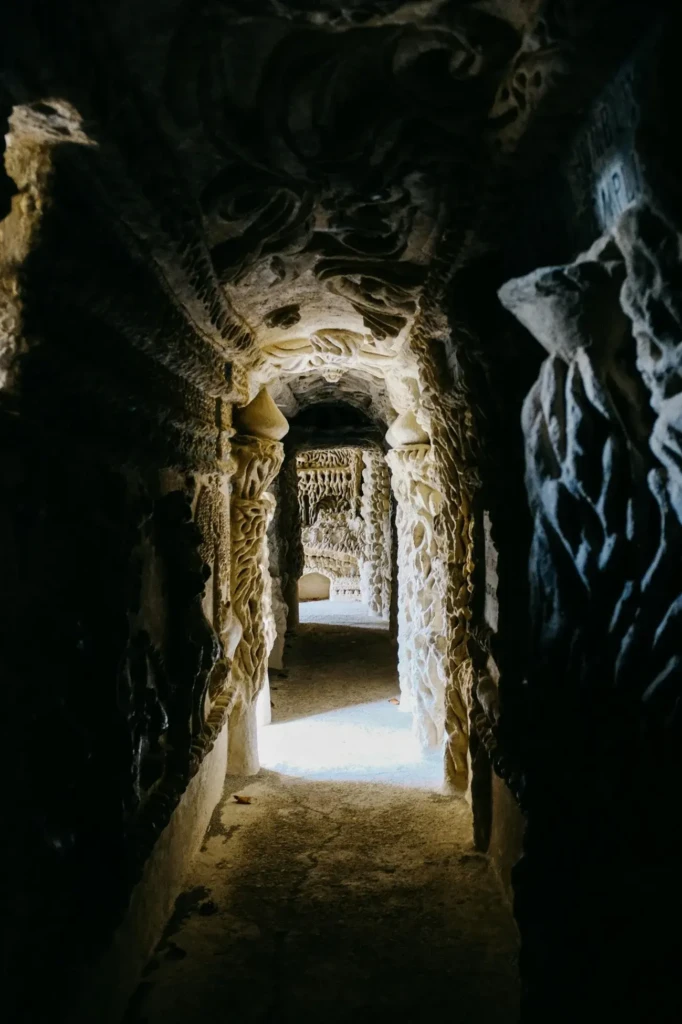
Despite its ethereal foundation, dreamlike architecture has left physical traces that can be visited today. An early and emblematic example is the Ideal Palace of the postman Ferdinand Cheval, in Hauterives, France. For more than three decades, Cheval —with no academic or architectural training—collected stones while delivering mail and built a palace that existed only in his night visions. What emerged from his hands is a monument that seems sculpted by the unconscious: mythological creatures, passages that branch off without apparent logic, columns that defy symmetry. It is a habitable work of art, outside the norms of traditional architecture.
A century later, another creator found the opportunity to build his personal universe in an abandoned factory. Catalan architect Ricardo Bofill transformed a former cement factory on the outskirts of Barcelona into what he called The Factory: a labyrinth of shapes, passageways, hanging gardens, and meditation spaces. This timeless construction combines the industrial, the classic, and the futuristic.
The most practical applications of dream architecture
One of the most fertile—and least explored—grounds for dream architecture is the educational environment, especially in childhood. Various studies and disciplines, such as neuroarchitecture, agree that the spaces children inhabit directly influence their cognitive, emotional and creative development. In that sense, designing schools that are like dreams or that foster imagination can be a very smart strategy to foster interest in learning.
Instead of straight hallways and grey walls, these dreamlike schools feature curved shapes, vivid colours, ceilings that vary in height, round windows, interior caves, tunnels, staircases that lead nowhere, or hidden corners for exploration. A paradigmatic case is that of Fuji Kindergarten, in Tokyo, designed by architects Takaharu and Yui Tezuka. The building is shaped like a large ring without walls, with trees running through it and a rooftop where you can run around and use slides to descend to the ground floor. There are no visual barriers or fixed routes: just fluidity, natural light, and freedom of movement. The structure does not impose: it accompanies the game.
Ver esta publicación en Instagram
In Copenhagen, Danish studio COBE designed the Frederiksvej Kindergarten as a small, child-sized village. Gabled roofs, connected modules like fairytale houses, and warm materials make this school a space that evokes a tiny, real-world integrated into a nursery. Houses are the theme of this construction, allowing children to play and create their own space and share it with their peers as if it were a community.
In countries like Finland and Denmark, some schools have replaced traditional classrooms with interior landscapes: artificial hills, grottoes, hanging nests, and winding paths. The idea is simple: learn through context. It is no coincidence that these countries lead the world rankings in educational quality and child well-being.
New technologies, new horizons for dream architecture
Technological advances in digital representation have also revitalised dream architecture. Tools such as parametric design, artificial intelligence, and virtual reality allow us to imagine and build previously unthinkable shapes. Firms like Zaha Hadid Architects have brought this exploration to large cities, with buildings that appear sculpted by the wind or drawn underwater. Fluidity, the breaking up of orthogonal geometry, and the use of materials that capture light in changing ways open up new possibilities for designing spaces that simultaneously evoke experiences.
Ver esta publicación en Instagram
In digital art, names like Refik Anadol and Andrés Reisinger have leapt into virtual environments where the architectural merges with the emotional. They use generative algorithms to create immersive installations where walls float, stairs dissolve, and memories take three-dimensional form. Although not always physically built, these designs open the door to new architectural models that integrate these experiences into buildings.
Dreamlike architecture in the habitable: examples of housing
In Mexico, architect Javier Senosiain has developed projects such as El Nido de Quetzalcóatl, where the home blends with nature through curved tunnels, organic passageways, and intense colours. Their constructions resemble animal mouths, where passageways begin that lead to astonishing places, which can be reminiscent of a nest full of eggs.
Ver esta publicación en Instagram
In Spain, where there are many vestiges of surrealism, one can also find examples of dreamlike architecture. In Catalonia, the artist and architect Xavier Corberó built his house like a meaningless labyrinth: impossible and unfinished arches, staircases with no destination or open courtyards. In general, all buildings with dreamlike architecture characteristics have one thing in common: it seems as if something has happened in those spaces. The one in charge of imagining what each person’s brain is.